2024 Annual Report Shifting Policy and Practice
In 2024, the Alliance of Bioversity and CIAT continued to conduct policy-oriented research and catalyze policy innovation and action, supporting governments and markets to achieve more resilient and sustainable food systems. Through long-term evidence generation and strategic partnerships, the Alliance influenced decision-making processes across conservation, adaptation, and sustainable market development.
Conservation: guaranteeing access to plant genetic resources
Building on decades of scientific research and advocacy, the Alliance has helped shape international agreements that guarantee free access to Plant Genetic Resources for Food and Agriculture. Our evidence has contributed to systems that recognize and incentivize the contributions of farmers in conserving agrobiodiversity.
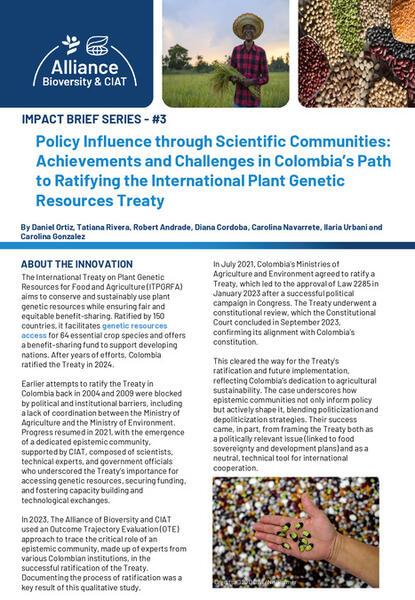
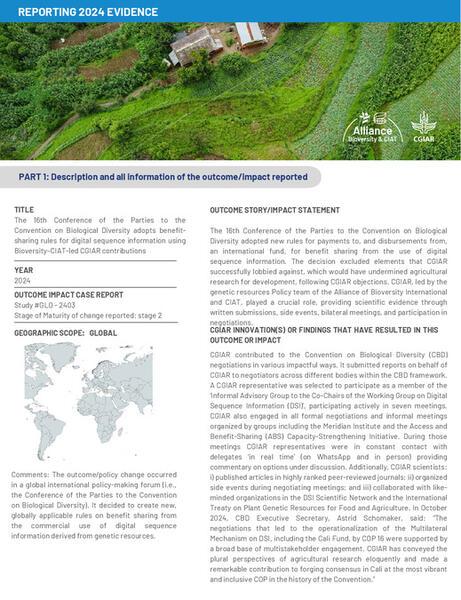
This culminated in last year’s UN Biodiversity COP16 negotiations, where the Alliance played a crucial advisory role during discussions on Digital Sequence Information (DSI), supporting Colombia’s leadership in brokering an important step toward fair and equitable sharing of the benefits derived from digital genetic resources. Furthermore, the Alliance provided technical evidence that informed Colombia’s pathway toward ratifying the International Treaty on Plant Genetic Resources for Food and Agriculture.

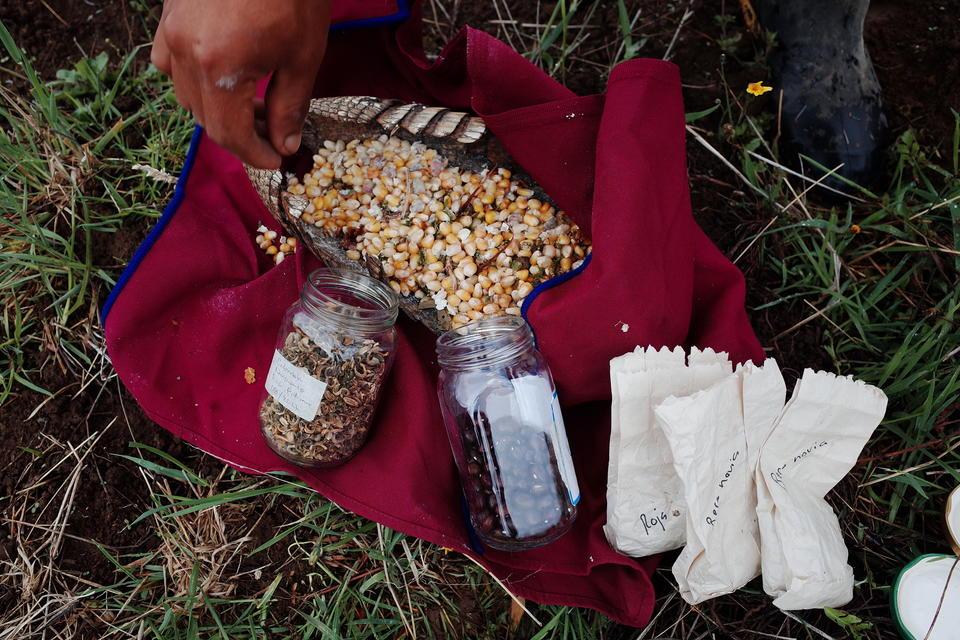
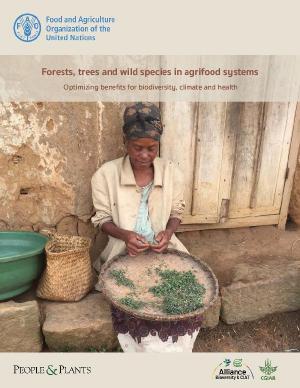
Elsewhere, complementing these efforts, the Alliance collaborated with the FAO to promote the recognition of forests, trees, and wild species as essential pillars for healthy agrifood systems, reinforcing the link between biodiversity conservation and food security.
Providing support to governments: Focus on Asia
The climate crisis means upheaval: as this analysis predicts both globally and in Asia, the majority of farmers will need to change the crops they grow. Meanwhile, immediate climate events are forcing government action; for example, when Typhoon Yagi- assessed as the strongest storm in 70 years- swept Southeast Asia in September 2024. Following the devastation, Alliance teams rapidly mobilized to pledge both relief and research recommendations, reaffirming our commitment to strengthening climate resilience in Asia through partnerships with national and local governments.
“The contribution will be invaluable in helping us understand the causes and impacts of these floods and develop effective mitigation strategies,” - Dr. Phetmanyseng Xangsayasane, Deputy Director General of the National Agriculture & Forestry Research Institute, Laos

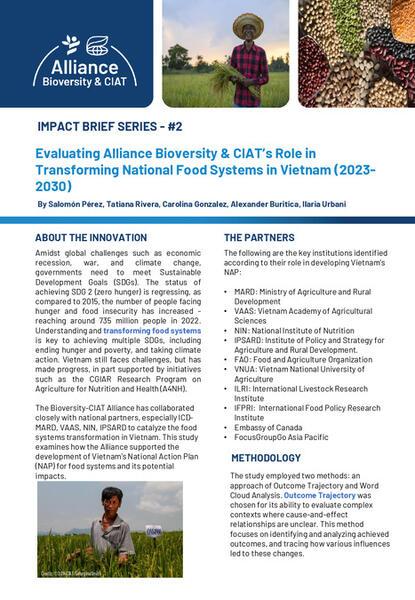
In Vietnam, under the Transforming National Food Systems Initiative, the Alliance supported national and local stakeholders in reshaping food system strategies to prioritize sustainability, resilience, and equitable access.
Advisories aid farmer decision making
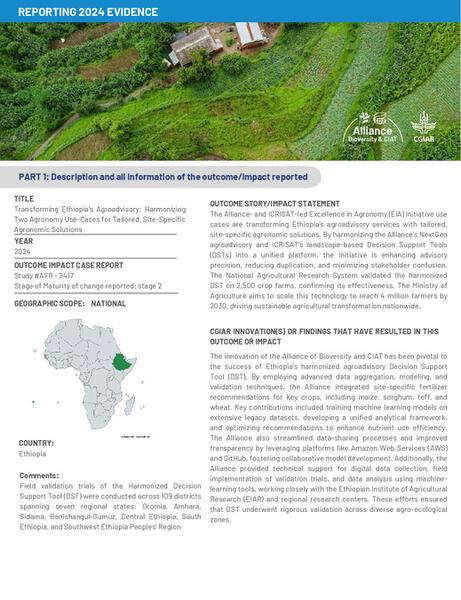
Fertilizer recommendations in Ethiopia
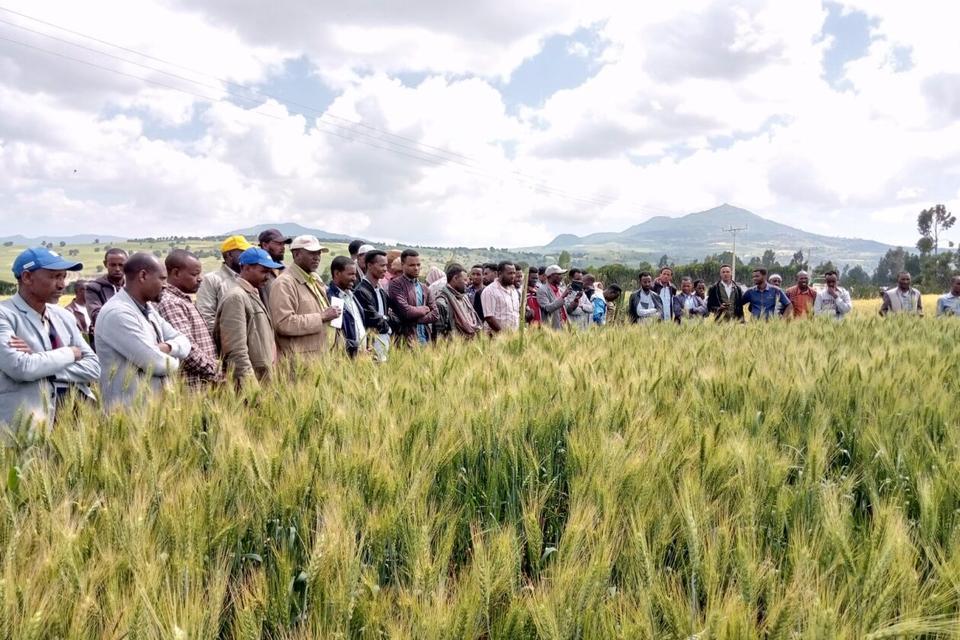
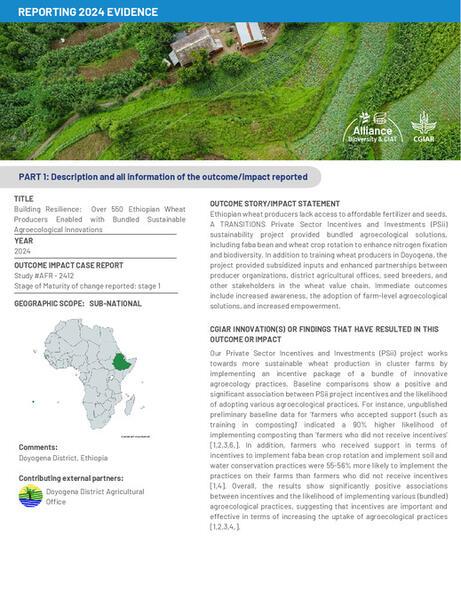
In Ethiopia, uniform fertilizer recommendations have historically overlooked diverse agroecological landscapes, resulting in inconsistent crop production. To address this gap, our NextGen advisory services – developed along with national research institutes and CGIAR centers- have used a machine learning algorithm to analyze a massive set of data about how wheat performs in different conditions. The resulting site-specific fertilizer recommendations have been tested on 2,500 farms for key crops including maize, sorghum, teff, and wheat. So far, this has enabled farmers to increase wheat yields by up to 28%, and the Ministry of Agriculture aims to roll these services out to millions of farmers in the coming years. Additional training initiatives in Ethiopia have focused on agroecological practices such as crop rotation for nitrogen fixing and other environmental benefits.
Climate information services in Southeast Asia and Central America
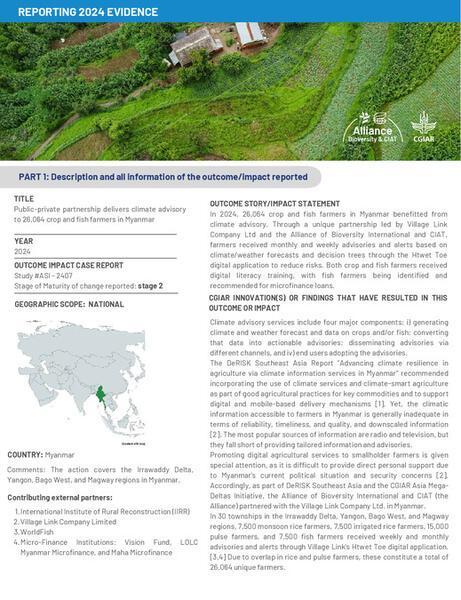
We link climate and weather forecast and data on crops into actionable advisories before disseminating the information to end users. Take for example in Myanmar, where we reached 26,064 rice and fish farmers in 2024 by partnering with Village Link Company, one of the country’s leading agtech startups empowering rural communities with mobile and digital technology. Meanwhile, the Vietnamese government scaled the delivery of agroclimatic bulletins across 13 provinces in the Mekong Delta, reaching more than 290,000 farmers.
810,000 farmers in Honduras, Guatemala, and Mexico are now more resilient in the face of climate change thanks partly to Local Technical Agroclimatic Committees, an innovation developed to foster systematic and collaborative design and dissemination of improved climate services, for example easy-to- understand local agroclimatic bulletins that are now effectively used by farmers to inform their decisions.
Explore our climate advisories in 2024
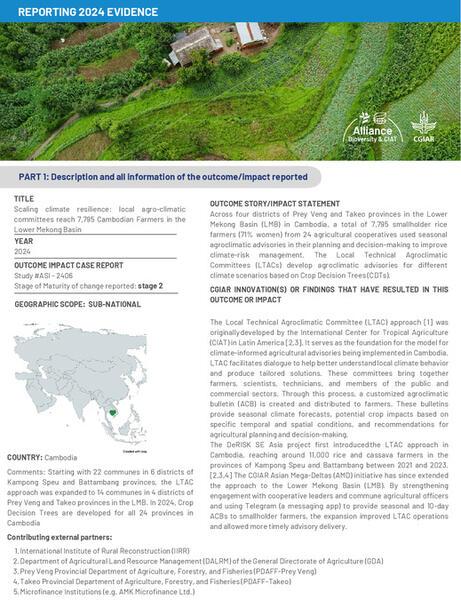
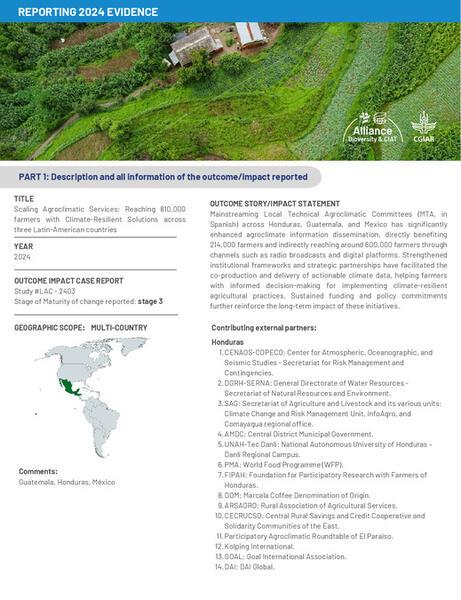
In April 2024, the Vietnamese government recognized the Alliance with a Certificate of Merit for its role in disseminating agroclimatic bulletins across the Delta region. This reflects rapid growth since the pilot phase in 2020: as of June 2024, the bulletins have reached over 270,000 farmers through a combination of broadcasts, trainings, and digital chat groups.

Informing policy on adaptation
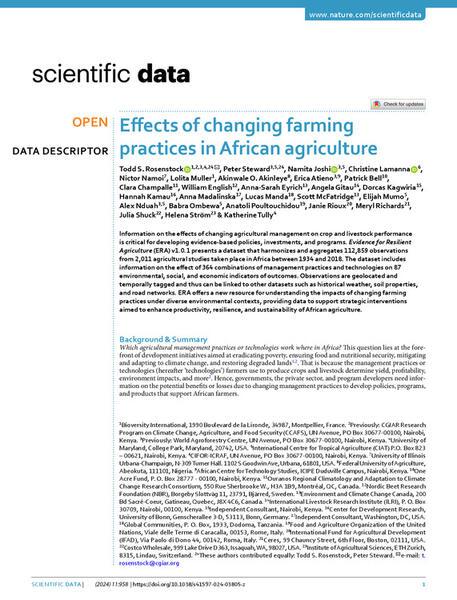
Equipping policymakers and practitioners with evidence enables the design of targeted and effective adaptation interventions. For example, research conducted under our new Adaptation Insights Project highlighted how different agricultural practices influence crop productivity, system resilience, and environmental sustainability.
The Alliance also contributed to advancing non-market approaches to climate adaptation, promoting innovative financial and incentive mechanisms beyond traditional markets, as explained by Alliance researcher Eliza Villarino.
Ensuring sustainable markets
Supply chain transparency is a critical issue for both farmer livelihoods and environmental health. But navigating regulations and understanding risks can be challenging for smallholders trying to bring their produce to market.
Deforestation-free production
For example, the recent European Union Deforestation Regulation (EUDR) intends to reduce unsustainable production by setting strict environmental compliance standards, relying on geo-mapped data. This has unintended implications for smallholder farmers, such as José Darío Enamorado, a coffee farmer whose agroforestry practices are nearly invisible from a satellite perspective.
“This regulation is worrying for producers because it defines whether their coffee will be sold or not, and it is certain that the production cost will rise in order to comply.” - José Darío Enamorado, farmer, Honduras
The Alliance is providing producers like José Darío access to tools including Croppie, a phone app to estimate and record yields, or Terra-i, which detects changes in land cover in near-real time. These resources increase transparency and help smallholder farmers, as well as cooperatives and businesses, navigate emerging environmental and due diligence regulations.


In another approach to reduce deforestation, Ghanian cocoa growing communities were offered Payments for Ecosystem Services, supported by Mondelez International, in which community public infrastructure and incentives deterred illegal farming and logging. The result? After one year of implementation that spanned over a thousand hectares of forest, a projected 71% reduction in deforestation compared to the business-as-usual scenarios avoided the loss of 2.9K tons of CO2 equivalent.
Predicting crop risks and opportunities
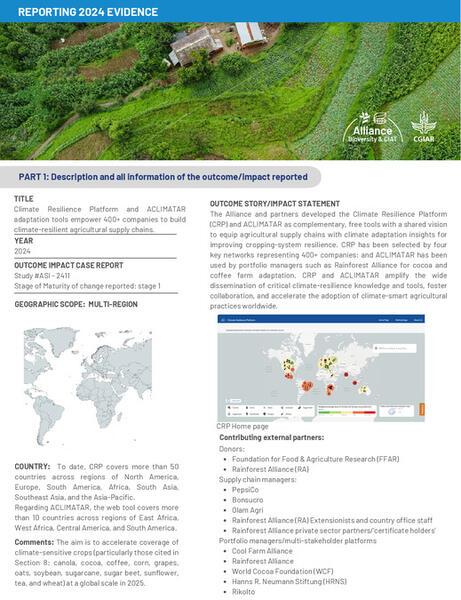
Two platforms we codesigned to help the agri-food sector address climate risks are the Climate Resilience Platform and ACLIMATAR. The Climate Resilience Platform interprets yield risks and opportunities, supporting supply chain decisions around vulnerable crops from coffee to tea and grapes to soybean. ACLIMATAR, launched in 2024, equips smallholder cocoa, coffee, and tea farmers with localized projections and farm-level advice. Both platforms share data, methods, and goals, offering user-specific solutions- for corporations and farmers, respectively.
Banana and Cacao diversity
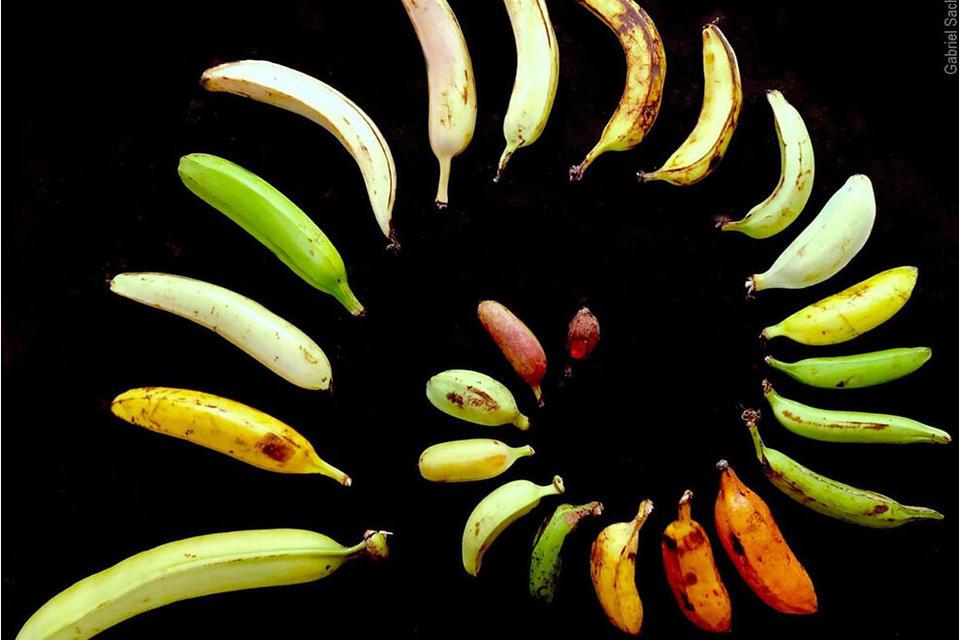
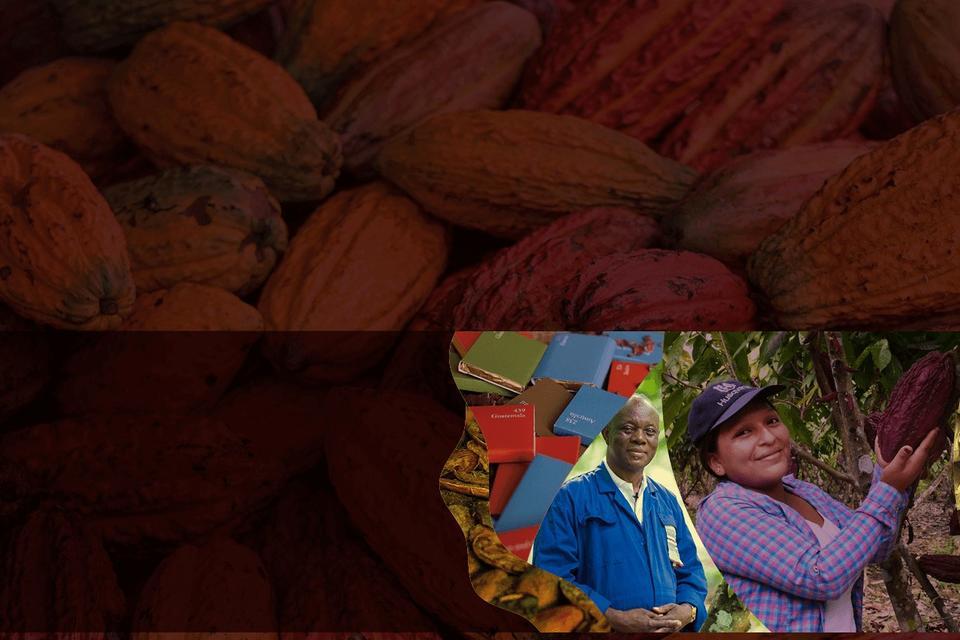
Additionally, our work targeting markets with high-value crops like bananas and cacao showed the payoffs of diversifying what smallholders grow. During the World Banana Forum at FAO, we advocated for agroecological cultivation of diverse bananas in Latin America, Africa, and the new frontier of Asia and the South Pacific. Meanwhile our Cacao of Excellence Program celebrated the smallholder producers, often family farmers, whose 222 samples were assessed by chocolatiers to valorize fine flavor varieties from diverse points of origin ranging from the DRC to Costa Rica.
“These Awards are an important window to the world, helping our product gain global recognition and creating value for our cacao.” -Carmen Montes Taipe, winning cacao producer from Peru