From the Field From market stalls to healthier communities: Viwandani vendors leading the way to nutritious and safe food access in Nairobi's informal settlements


In Nairobi’s Viwandani informal settlement, 100 fruit and vegetable vendors are co-creating solutions to improve food safety, nutrition, livelihoods, and access to affordable, healthy produce.
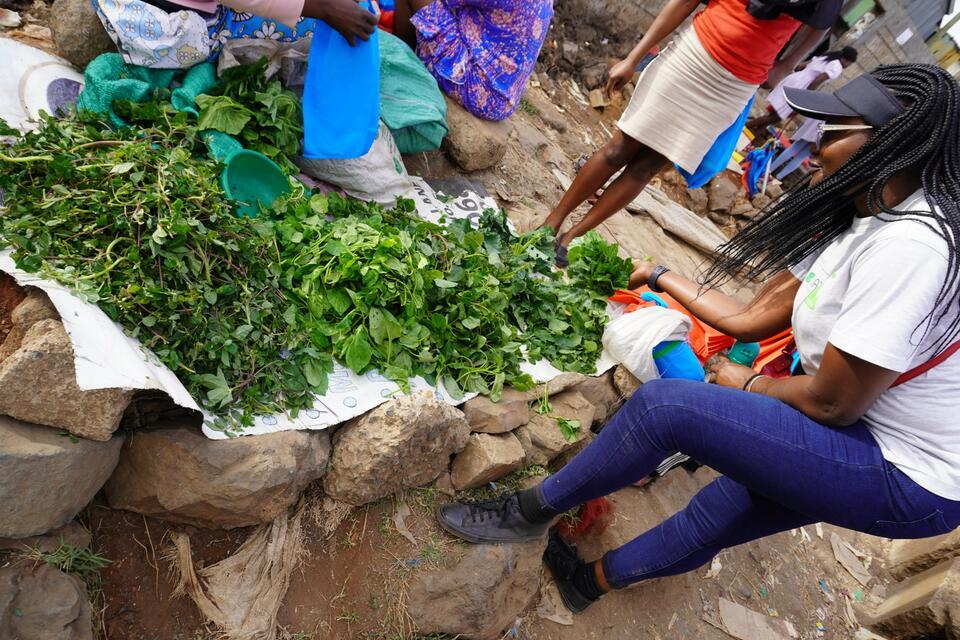
In many Kenyan neighbourhoods, the food environment consists of mainly informal vendors, who, together, play a central role in shaping what many households consume every day. They influence individual and household food choices, thereby impacting nutrition and health outcomes. Informal fruit and Vegetable (F&V) vendors, popularly known as ‘Mama Mbogas’, are the most important point of access to fresh, healthy produce for families, especially in low-income urban informal settlements where affordability, proximity, and convenience matter the most. Despite their significance, most F&V vendors do not fully understand the critical role they play in the food system by linking consumers to healthy diets in these resource constrained settings.
Through the project “Enhancing Kenya’s Organic Food System through Improved Market Access for Vulnerable Consumers in Nairobi and Smallholder Farmers in Makueni County,” funded by the Biovision Foundation, Switzerland, a series of participatory co-creation workshops were held from December 2025 to July 2026 with fruit and vegetable vendors from Viwandani, Makadara Sub-county, Nairobi County. The workshops engaged 100 vendors drawn from Viwandani ward, organized into three cohorts of approximately 35 vendors each. Each cohort participated in six days of engagement, allowing vendors to contribute meaningfully while balancing the demands of their daily businesses.

The workshops brought together a diverse group of stakeholders, including representatives from Nairobi County departments of Health, Agriculture (Food Systems), Trade, and Social services, implementing partners like World Vegetable Centre, Global Alliance for Improved Nutrition-GAIN; and project partners: Diabetes Awareness Trust-DAT, Feedback to the Future-FttF, and the Alliance Bioversity and CIAT. Most importantly, the workshops placed the informal fruit and vegetable vendors at the centre of the conversation, not only as participants, but as knowledge holders, problem-solvers, and key actors in advocating for and advancing access to safe and nutritious food systems in the informal settlements.

Vendors engaging in group discussions.
Understanding the vendor experience
The objective of the workshops was to better understand the challenges faced by fruit and vegetable vendors operating in informal settlements, which hinder their sale of safe fruits and vegetables, and to co-create practical, viable solutions to the challenges mentioned. The process recognized that vendors are not simply end-point sellers in the food system. They are connectors between producers, markets, and consumers; they absorb risks related to perishability, price volatility, fluctuating demand, and limited infrastructure, and they continue to provide essential food access despite difficult operating conditions.
Through participatory group discussions, vendors openly shared their lived experiences. Many described waking up as early as 1:00 a.m. to travel to markets, purchase produce, transport it back to their selling points, prepare their displays, serve customers throughout the day, and close late into the night, to go home to attend to family duties. Despite insecurity, fatigue, uncertain earnings, and limited infrastructure, many vendors continue to run businesses that have sustained their families for years; paying school fees, rent, food expenses, and even supporting long-term investments such as homes and property.

A vendor presenting challenges.
A participatory approach to co-creation
The workshops were designed as interactive learning and solution-building sessions. Vendors worked in groups with facilitators to identify challenges, discuss their causes, and propose practical solutions. The programme began with foundational discussions on basic nutrition knowledge and the role of markets and vendors in influencing nutrition and health outcomes.
The process also included dissemination of diagnostic findings related to household consumption, fruit and vegetable intake, vendor distribution, vendor diversity, household distance to vendors, and findings from in-depth interviews with ‘Mama Mbogas’, conducted in the year 2023. Vendors reflected on whether the findings represented their market realities and discussed the barriers affecting fruit and vegetable selling and consumption.
In the later sessions, vendors focused on identifying viable solutions and turning these into bundled interventions and action plans.

Vendors discussing action plans.
Key challenges identified by vendors
Across the workshops, vendors identified several interconnected challenges affecting their businesses and the wider fruit and vegetable supply system. These included perishability, inadequate storage, and post-purchase losses; poor and inconsistent produce quality; limited knowledge on business operations, record keeping and customer relations; limited capital and high operating costs; high competition and market saturation; seasonality, climate change, and price volatility; inadequate water, hygiene, and sanitation infrastructure, limited trust and coordination among vendors, and security concerns, among many others.
These challenges affect not only vendors’ incomes, but also the availability, affordability, safety, and quality of fruits and vegetables for consumers in informal settlements. For example, poor storage and limited water infrastructure can contribute to losses and food safety concerns, while price volatility can affect both vendor profitability and consumer purchasing power.

Challenges outlined by vendors.
Co-created solutions and opportunities
The workshops generated a rich and comprehensive set of vendor-led solutions. These included improving produce quality and handling, strengthening collective action and vendor organization, promoting financial literacy and collective financing mechanisms, improving sourcing and inventory management, enhancing storage and preservation, strengthening water, hygiene and waste management systems, improving market infrastructure and security, supporting fair pricing and market regulation, strengthening customer relations and credit management, improving food safety and quality assurance, and enhancing government and stakeholder support.
The programme also emphasized practical planning. Vendors were guided to develop action plans by reflecting on where they wanted their businesses and groups to be in the next two to three years, towards enhancing the supply of safe and nutritious food to the consumers.
Another important outcome was the emphasis on group formation. Vendors explored the value of working collectively, learned from an already established vendor group- Mukuru Agribusiness Association, discussed how to form vendor-led groups, and engaged with the Department of Social Services on leadership roles, duties, and qualities of good group leaders.

Vendors discussing and ranking solutions.
Building a sustainable model
A key strength of the workshop model was its participatory and inclusive design. Rather than prescribing solutions, the process provided an opportunity for vendors to define their own challenges and identify solutions that reflected their lived realities. It also brought county departments and project partners into direct dialogue with vendors, helping to align community-level needs with institutional support.
The model also points to clear next steps, organizing vendor trainings through the Nairobi County Departments of Health, Social Services, Agribusiness and Trade, supporting vendors to be organized into groups, scoping potential suppliers, and following up on vendor progress.
Conclusion
The Viwandani fruit and vegetable vendor co-creation workshops demonstrated the importance of listening to those who operate at the heart of low-income informal urban food systems. Vendors understand their markets, customers, risks, and opportunities in ways that can directly inform practical interventions. By engaging them as partners, the project has taken an important step toward strengthening access to safe, nutritious, and sustainably sourced foods for vulnerable consumers in Nairobi, while also supporting more resilient and dignified livelihoods for vendors.
Ultimately, enhancing Kenya’s organic food system will require more than improving production. It will require stronger market linkages, better infrastructure, supportive policy environments, organized vendors, informed consumers, and inclusive partnerships. The experience in Viwandani shows that when vendors, county officials, research and development partners come together to learn, reflect, and co-create, practical pathways toward healthier communities and stronger local food systems can be realized.
The team

Céline Termote
Senior Scientist - Africa Regional Team leader Food Environment and Consumer Behavior
Consolata Nolega Musita
Research Fellow
Nicanor Odongo
Research Fellow