Research Articles Community seed banks show promise as grassroots peacebuilding institutions
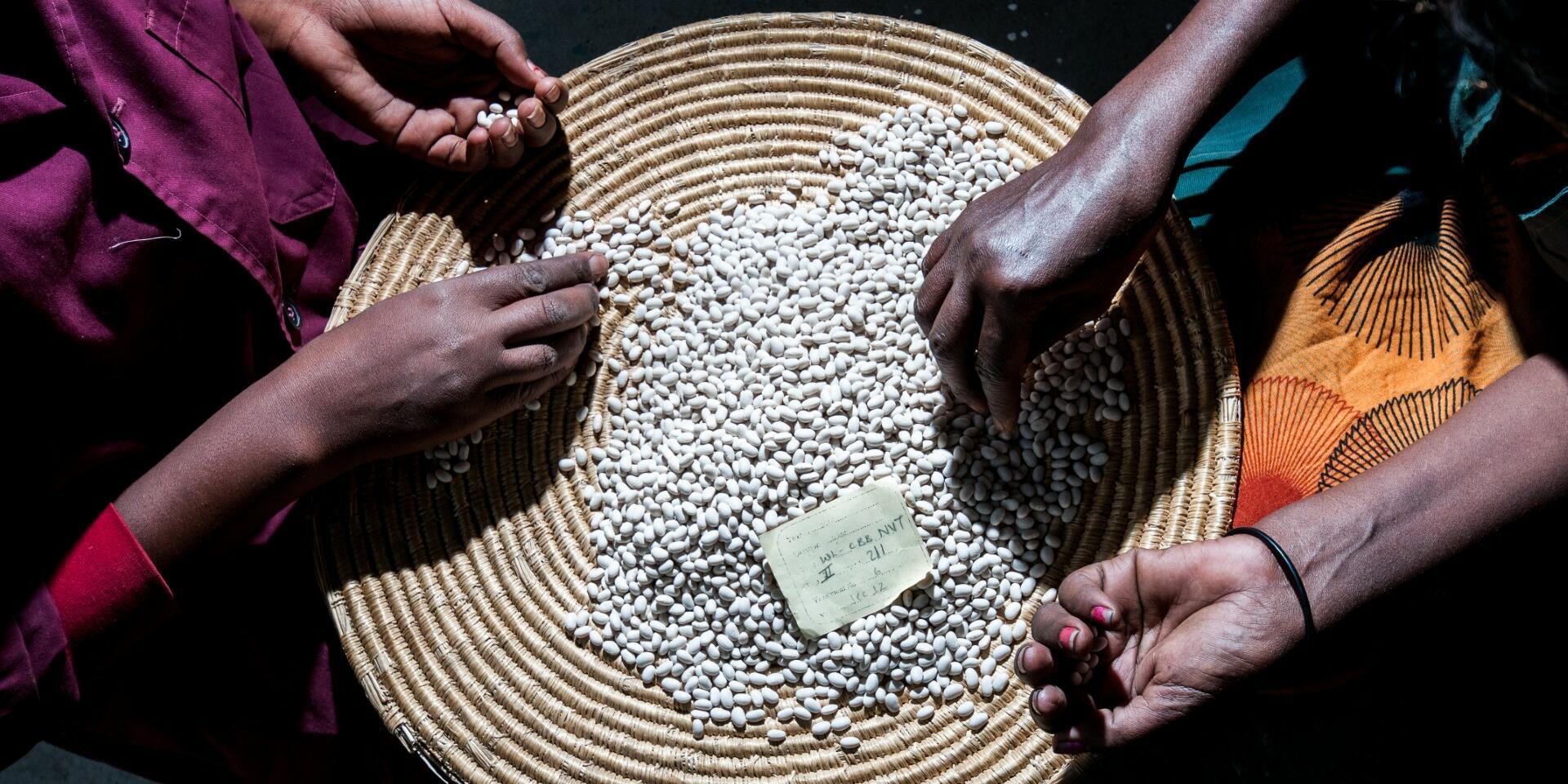

A study in conflict-affected northern Ethiopia explored how community seed banks can strengthen trust, communication, social interaction and conflict-resolution capacity, revealing a social role that reaches far beyond conserving crop diversity.
In the rural communities of northern Ethiopia, a seed can carry much more than the promise of a harvest. It can hold a family’s memory of what grows well in difficult soil, knowledge passed between generations and a measure of protection against the next drought. New research suggests that seeds can also give neighbors a practical reason to meet, cooperate and begin rebuilding trust.
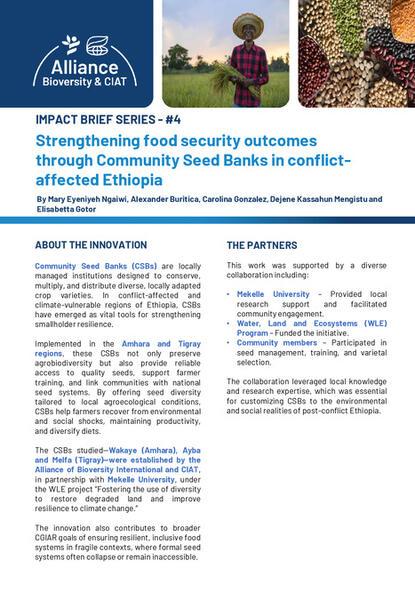
A study published in Peace and Sustainability examined community seed banks in Ayba, Melfa and Wakaye, three climate-vulnerable communities in Ethiopia’s Tigray region that have been affected by armed conflict. Based on survey data from 393 rural households, the researchers found that affiliation with some seed banks was associated with stronger trust, better communication, more frequent social interaction and greater capacity to address conflicts.
The finding expands the conventional understanding of community seed banks. These locally governed institutions were originally created to conserve agrobiodiversity and improve farmers’ access to locally adapted seed. Their daily work often includes seed multiplication and exchange, participatory selection of crop varieties, collective storage and the preservation of Indigenous and local knowledge. In northern Ethiopia, the three banks emerged through the Seeds for Needs initiative, which helped farmers identify and test varieties suited to increasingly variable climatic conditions.
Yet the same practices required to manage a shared seed resource can also shape relationships. Farmers meet to make decisions, agree on rules, share information and resolve disagreements over access, responsibilities or seed returns. Through repeated cooperation around something everyone needs, a seed bank can become a space where community members learn that commitments will be honored and collective problems can be solved.
That possibility has been discussed before, largely through qualitative research, case studies and anecdotal evidence. What makes the new study especially noteworthy is its effort to measure the relationship systematically. This research evaluated six dimensions of social cohesion: trust, unity, communication flow, social interaction, conflict mitigation and resolution, and perceived security.
Different seed banks, different social outcomes
The results show that peacebuilding benefits do not arise uniformly from every community seed bank. Compared with Melfa, households affiliated with the Wakaye seed bank reported significantly higher levels of trust. The result suggests that Wakaye may function as a dependable, rule-based institution in which community members believe agreements will be respected. In places where conflict and disruption have weakened formal institutions, that confidence can become an important foundation for collective action.
Ayba showed a broader pattern. Affiliation with its seed bank was associated with higher trust, stronger communication, more social interaction and improved capacity to handle conflict compared with Melfa. These findings point to a bank whose value may lie partly in the regular activities it creates: exchanging seed, managing stocks, sharing knowledge and making decisions together.
The differences among the three sites are important. A community seed bank does not generate cohesion simply because it stores seed or carries a community label. Its governance, leadership, decision-making processes and ability to include different groups help determine whether it becomes a trusted common institution.
Transparent seed-loan rules, open records, equitable access to varieties and accountable leadership can strengthen perceptions of fairness. Joint workdays and collective maintenance can build shared responsibility. Meetings, feedback mechanisms and participatory committees can reduce misinformation and provide structured ways to address disputes before they escalate.
The study therefore presents community seed banks as possible “infrastructures for peace”: locally rooted institutions that create recurring opportunities for dialogue, cooperation and nonviolent problem-solving. Their peacebuilding contribution is woven into ordinary agricultural life rather than delivered as a separate intervention.
A common purpose rooted in everyday need
Communities affected by conflict do not leave their disagreements at the door of a seed bank. Divisions over identity, resources, leadership or past grievances may remain. Shared dependence on reliable seed access, however, creates a concrete purpose around which cooperation becomes both possible and necessary.
Farmers need planting material adapted to local conditions. They need systems for conserving varieties that may otherwise disappear. They need ways to preserve knowledge about cultivation, food and climate that is rarely captured in formal databases. Managing these resources collectively can bring people into sustained contact and make cooperation visible.
This is where the seed bank’s social potential lies. Trust is rarely rebuilt through a single meeting. It grows when people repeatedly exchange information, follow agreed rules, share responsibilities and see that collective arrangements produce something valuable. A successful seed bank can provide that rhythm of cooperation.
Other findings reinforce the importance of everyday settings. Access to piped water was strongly associated with greater social interaction and, to a lesser degree, improved communication. The researchers suggest that infrastructure can become a social interface, creating places and reasons for neighbors to meet. Paid employment among household heads, meanwhile, was associated with lower scores across five of the six cohesion dimensions, possibly because employment leaves less time for participation in community life.
Internet access produced another striking result. Connectivity was associated with greater unity and better information flow, but also with lower trust, less face-to-face interaction, weaker conflict-resolution capacity and reduced perceived security. The finding does not establish that internet access causes these outcomes, but it highlights the continuing importance of physical spaces where relationships can be maintained and disputes addressed directly.
Peacebuilding benefits require intentional design
The researchers caution that the study is cross-sectional and relies largely on self-reported perceptions. It identifies meaningful associations, but it cannot prove that participation in a seed bank caused the observed social outcomes or determine whether they will persist over time. Longitudinal studies, attendance records and documented conflict-resolution outcomes could provide stronger evidence.
Even with those limitations, the research offers a compelling direction for agricultural development, climate adaptation and post-conflict recovery. Programs supporting community seed banks could monitor changes in trust, participation and conflict resolution alongside seed diversity and access. Climate finance and rural development initiatives could also treat social cohesion as an intended result rather than an incidental benefit.
However, the central lesson is practical: conserving seeds together can help conserve relationships, but only when fairness, inclusion, accountability and conflict sensitivity are built into the institution. A poorly designed seed bank may reproduce existing inequalities or deepen exclusion. A carefully governed one can protect crop diversity while giving people a shared space to communicate, cooperate and manage essential resources.
In regions facing the combined pressures of conflict and climate change, recovery depends on more than restoring fields and infrastructure. It also requires restoring the relationships that allow communities to act together. This study suggests that some of that work may begin in a place already familiar to farmers: around the seeds they need for the next planting season.
The team
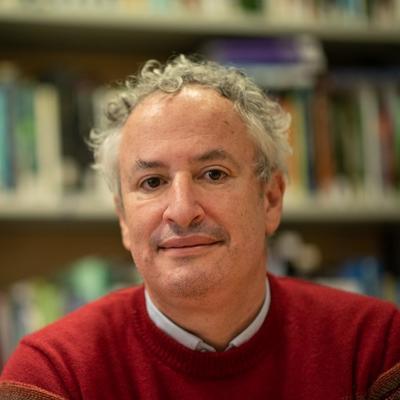
Carlo Fadda
Director, Agrobiodiversity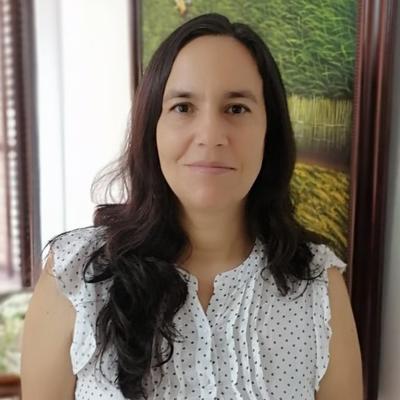
Carolina Gonzalez
Thematic Leader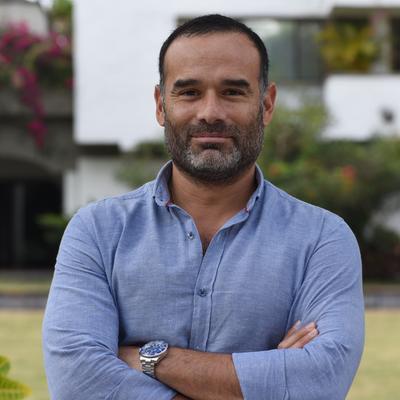
Augusto Castro-Nunez
Senior Scientist Low-Emissions Food Systems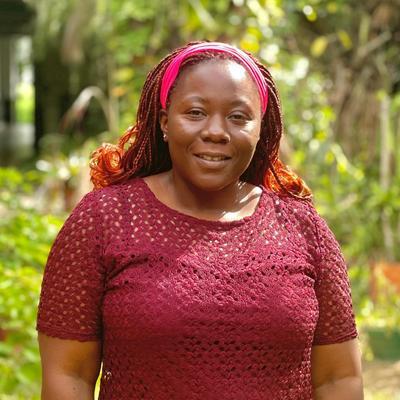
Mary Ngaiwi
Research Specialist
Alexander Buritica
Postdoctoral Fellow