Research Articles A six-step approach: Balancing low-emission goals with sustainable development

As climate change intensifies, a new six-step approach helps countries scale low-emission food system innovations while aligning with development goals like nutrition, peacebuilding, and sustainability.
As the world grapples with the escalating impacts of climate change, particularly in developing countries, the challenge of balancing economic development with low emission becomes increasingly complex. As governments strive to meet commitments to reduce greenhouse gas emissions such as the Paris Agreement, the need to balance multiple priorities, from nutrition and food security to peacebuilding, is increasingly pressing.
“This approach aims to support countries to identify incentives and navigate realities such as policies, regulations, and value chain-related barriers,” explains George Amahnui Amenchwi, an expert in greenhouse gas emission measurement and estimation in agricultural system at the Alliance of Bioversity International and CIAT, based in Colombia.
The six-step approach, developed to complement existing scaling tools in literature, serves as a guideline for creating an enabling environment to scale innovations that achieve both greenhouse gas emission reductions and sustainable development co-benefits within the food system. Recognizing that transforming the food system requires significant and purposeful changes to reduce greenhouse emissions and meet other Sustainable Development Goals, this approach provides policymakers, researchers, and practitioners with essential insights to foster such an environment.
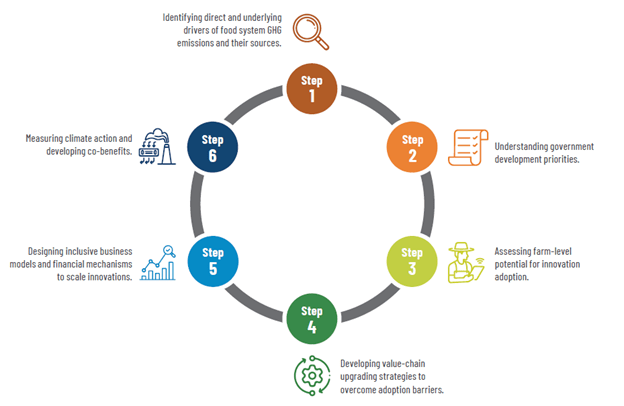
The Six-step Approach for generating the enabling environment for scaling innovations for low-emission food systems. Adapted from Bonatti et al. (2021).
Step one: understanding emission sources and drivers
The first step of this approach involves identifying the drivers of greenhouse gas emissions in the food system. Understanding where emissions are coming from allows for targeted interventions.
“This helps us to understand the emission sources and where the highest emissions are, enabling us to prioritize our efforts in reducing them,” Amahnui says.
Step two: understanding government priorities
The second step is to understanding government priorities and aligning development priorities with opportunities to reduce greenhouse gas emissions.
“We look at geographical areas where governments are prioritizing issues like nutrition, and we try to see if we can overlap our mitigation objectives in that geography to achieve both goals,” Amahnui explains.
By working together with local communities, governments and all those involved in the development process, the approach fosters political and social support to introduce sustainable practices.
Step three: Bringing farmers into the discussion
The third step of the approach aims to assess the farm-level potential of adopting specific practices.
For this stage, the involvement of farmers is critical, says Amahnui. “We need to ask the people who will be implementing the innovations what their priorities are. By understanding the incentives of farmers to adopt a certain innovation, the team can design sustainable solutions that it will make sense for these farmers to use in practical circumstances.”
Step four: overcoming value chain barriers
But sometimes, there may be other bottlenecks to adopting a practice beyond the farm level.
“We understand that there can be barriers within the value chain that may directly or indirectly obstruct farmers from adopting innovations, even when they’re willing,” notes Amahnui.
Step four therefore focuses on developing value chain upgrading strategies, to overcome these barriers that exist at the value chain level.
Step five: Assessing financial mechanisms and designing business models for scaling innovations
The fifth step is about exploring financial mechanisms and business models necessary for scaling sustainable practices.
“Having gathered enough evidence in previous steps; this step of the scaling framework is about finding the best ways to finance these approaches so that they can be implemented sustainably” Amahnui explains.
This step focuses on assessing financial mechanisms and building inclusive business models that ensure sustainable food value chains.
Step six: Measuring climate action and developing co-benefits
Finally, the sixth step is about measuring the climate mitigation benefits and sustainable development outcomes.
“We quantify the climate impact of the innovations we are implementing, such as measuring impacts on greenhouse gas emission reduction and enhancing carbon sequestration. This step also measures the sustainable development co-benefits,” Amahnui says, and evaluates unintended effects of scaling innovations on other environmental components and social systems, ensuring that the approach remains sustainable.
Taking lessons from a case in Colombia
This six-step approach isn’t just theoretical; it has been successfully tested in Colombia through projects aimed at scaling livestock silvopastoral systems in the Colombian Amazon region by the Alliance of Bioversity and CIAT. The aim is to balance climate mitigation action and peacebuilding.
“We are creating synergies for achieving both development and mitigation, which is often overlooked. By integrating these two objectives, we can find more sustainable solutions that benefit everyone involved,” Amahnui notes.
For example, the livestock silvopastoral systems is a form of livestock agroforestry where forage plants, such as grasses and creeping legumes, are integrated with shrubs and trees, for animal feed and other complementary purposes. By forming part of a broader strategy for conserving biodiversity and ecosystem services at the landscape scale, the negative impacts of such activities on the environment such as deforestation were reduced.
“In Colombia, the government was prioritizing peacebuilding due to a treaty that ended a long-standing conflict,” Amahnui recalls. “Analyzing the underlying drivers of deforestation was crucial for understanding the root causes of the emissions that the interventions would aim to address. We looked at how we could promote mitigation alongside peacebuilding, helping communities improve their livelihoods while also ensuring that negative consequences did not occur.”
The silvopastoral study demonstrates that understanding the direct and underlying drivers of food system emissions is critical. Then, such interventions must be aligned with government development priorities and within a structured, enabling environment for scaling low-emission solutions. Encouraged by success in Colombia, the team is now shifting its focus to Africa, specifically Kenya, where they aim to apply the same principles to rangeland management, to simultaneously increase peaceful coexistence and climate mitigation in rangelands.