
Blog Where to act, what to fund: Ethiopia turns El Niño forecasts into agricultural preparedness
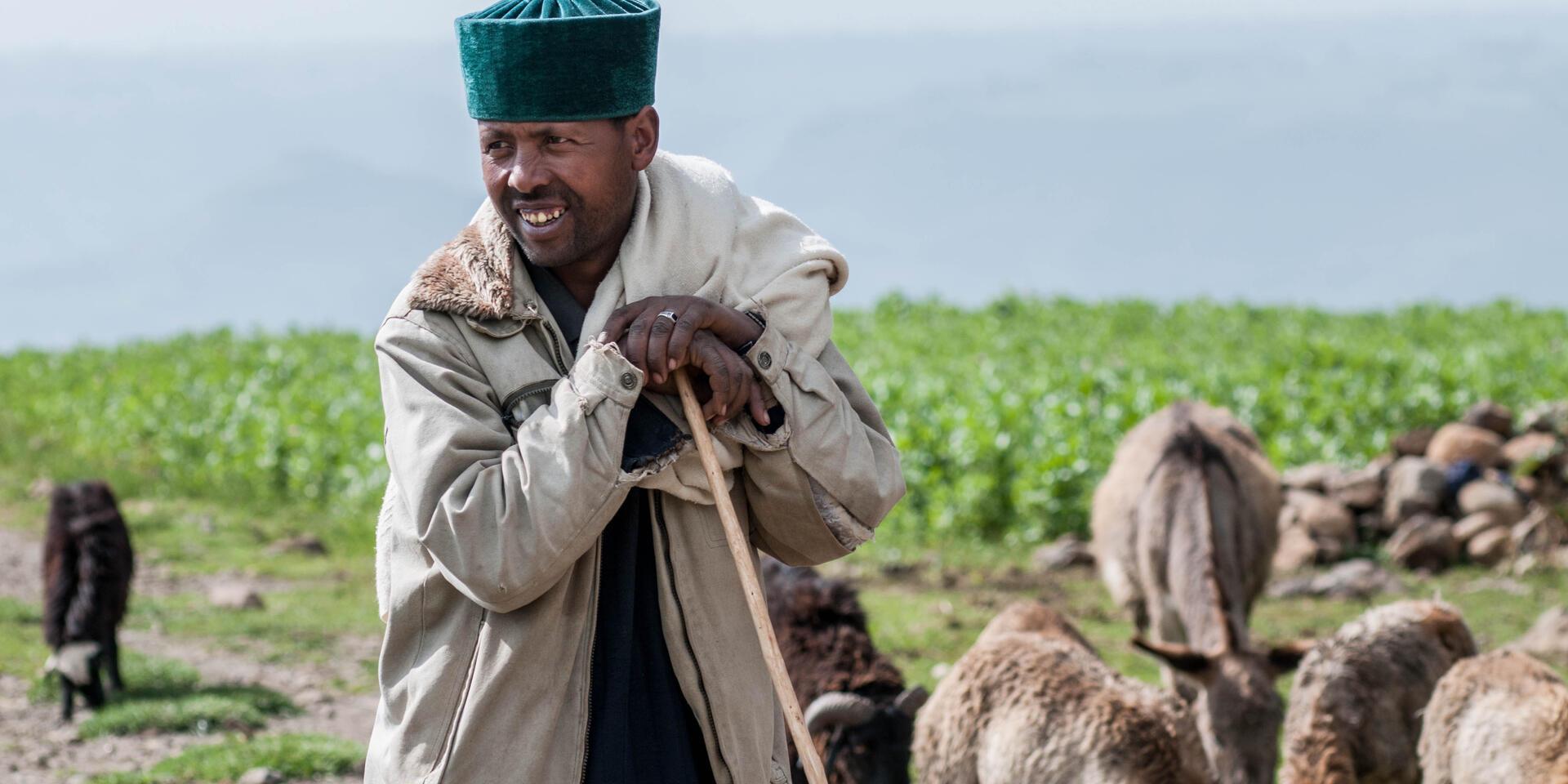

CGIAR science through national leadership and private sector partnerships are helping Ethiopia turn El Niño forecasts into practical guidance for agricultural planning and farmers.
A seasonal forecast can indicate an increased likelihood of poor rains due to El Nino. But how can government institutions use that information to decide which districts need support, what agricultural measures to prepare, and how much emergency funding will be required? Or help farmers decide when to plant, which crops to grow, or how to prepare for a prolonged dry spell? Ahead of Ethiopia’s 2026 Kiremt season, these were the practical questions behind a government-requested agricultural risk assessment.
Ethiopia knows the devastating consequences of El Niño. The 2015–2016 event severely affected farmers and pastoralists, triggering one of the worst agricultural and humanitarian crises the country had experienced in decades. Failed rains devastated crops, depleted pasture and water resources, and led to widespread livestock losses.
By early 2016, some 10.2 million Ethiopians were facing food insecurity. With another El Niño anticipated in 2026, Ethiopian institutions were looking for ways to prepare, particularly during Kiremt (June–September), the main rainy and agricultural growing season across much of the country.
Responding to government demand, scientists from the Alliance of Bioversity International and CIAT worked with Ethiopian national institutions to assess agricultural risks across 690 woredas, or districts. The assessment connected seasonal forecasts and historical El Niño evidence with recommended contingency measures and estimated emergency funding requirements. It provided a basis for identifying where support should be prioritized, when measures would be needed, and what resources they would require.
Getting ahead of El Niño, one district at a time
Knowing that a season may be drier than normal is not the same as knowing which districts are most vulnerable, what the consequences might be for agriculture, or where preparedness resources should go.
This was the challenge facing Ethiopian government institutions, including the Ministry of Agriculture and Ethiopian Meteorological Institute (EMI), when they sought CGIAR's technical support ahead of the 2026 Kiremt season.
Drawing on long-standing partnerships, an Alliance-led team combined seasonal forecasts with lessons from previous El Niño events, including those of 1997–1998, 2009–2010 and 2015–2016.
Working with the Ethiopian Meteorological Institute (EMI), the team used the best available seasonal forecasting system and applied bias correction and downscaling to assess anticipated conditions during Kiremt 2026. Historical El Niño analysis and 23 agroclimatic indicators, including rainfall, dry spells, crop water stress and livestock heat stress, the team assessed agricultural risks across 690 districts supported the characterization of potential agricultural impacts. Districts were classified using composite agroclimatic indices developed through the CGIAR Climate Action Science Program. The resulting risk classifications informed the selection of contingency measures and the estimation of emergency funding requirements, linking seasonal forecasts directly to agricultural preparedness and financial planning.The findings were striking: 33 districts were classified as Emergency, 228 as Alert, 342 as Watch and 87 as Normal. In total, 261 districts—38% of those assessed—fell into the two highest risk categories.
For the first time, Ethiopia had El Niño-specific agricultural risk information translated to the contingency and emergency budget at this geographic scale, accompanied by practical recommendations on planting calendars, drought-tolerant seeds, water management and livestock protection.
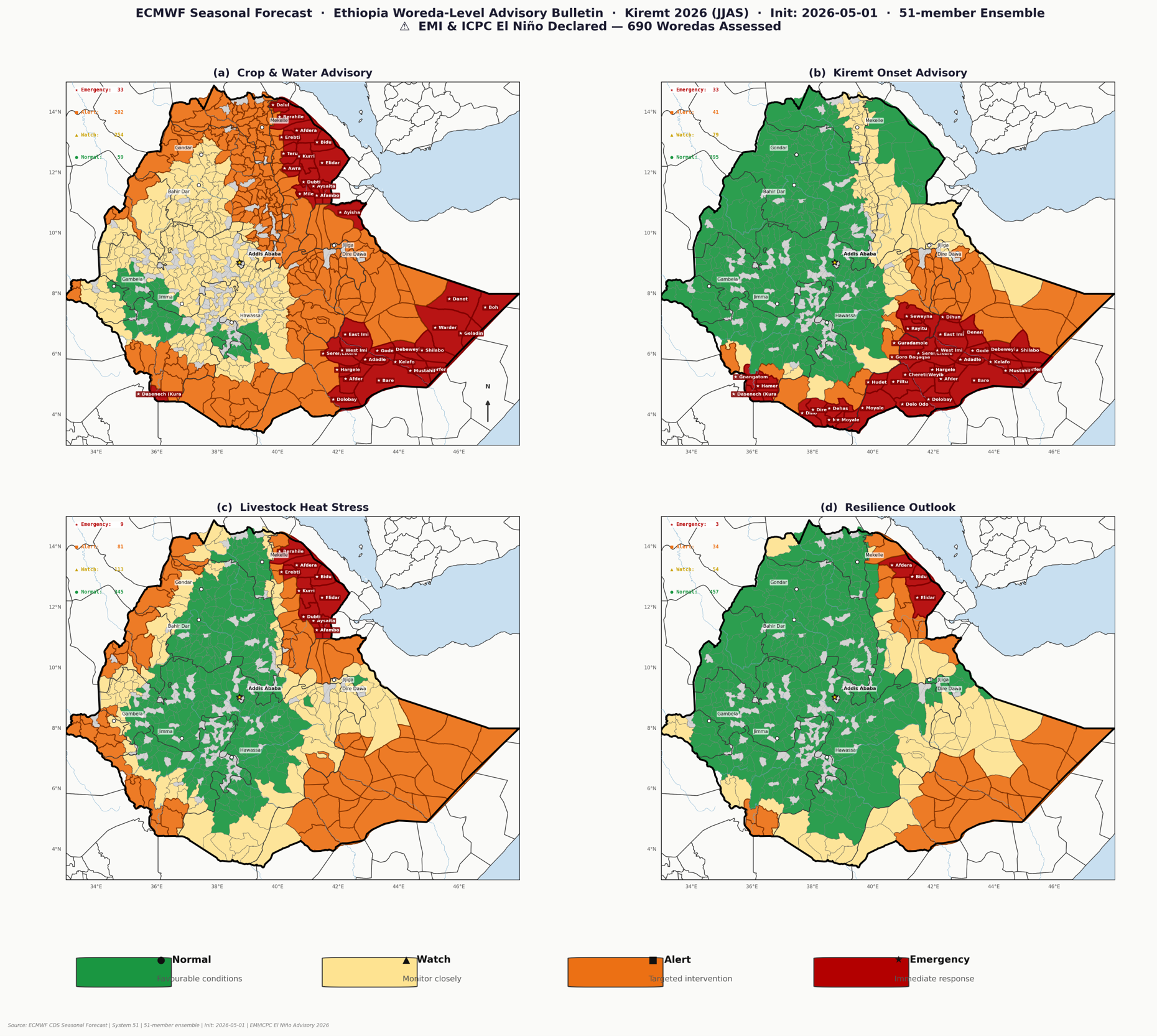
El Niño-related agricultural risks were assessed across 690 Ethiopian districts to support more localized preparedness planning, and delivered in comprehensive advisories to the Ministry of Agriculture.
“Our long-standing partnership with CGIAR support’s EMI’s leadership in translating climate science into practical guidance for agricultural preparedness.” - Asaminew Tshome, Ethiopian Meteorological Institute
“Strengthening Ethiopia’s capacity to anticipate and manage climate risks is a national priority. Our long-standing partnership with CGIAR supports EMI’s leadership in translating climate science into practical guidance for agricultural preparedness. Through this collaboration, we are building institutional capacity to connect early warning with timely planning and resource allocation,” says Dr Asaminew Teshome, Deputy Director General of the Ethiopian Meteorological Institute (EMI).
Knowing where to act and when
Identifying agricultural risks is only the beginning. Government officials must also decide where to direct limited resources, which interventions to prioritize, and when to act.
“The government needed to know where agricultural risks were greatest, when to act, and how much emergency funding to prepare.” - Jemal Seid Ahmed, Alliance of Bioversity International and CIAT
The comprehensive advisory was designed with these decisions in mind. Alongside district-level risk classifications, it provides recommended interventions, indicative contingency costs and a seasonal monitoring calendar.
“The government needed to know where agricultural risks were greatest, when to act, and how much emergency funding to prepare. We developed a new tool that translates seasonal forecasts into district-level early warnings, contingency actions and funding requirements. By linking anticipated risks with the timing and cost of interventions, it helps policymakers prioritize resources before impacts occur. This work complements the EMI-led National Forum for Climate Services and supports national institutions in translating climate information into preparedness plans and budgets aligned with Ethiopia’s priorities,” explains Jemal Seid Ahmed, Data Science Specialist at the Alliance.
The experience highlights the value of established scientific partnerships. When an urgent need arises, governments can draw on existing relationships and expertise rather than starting from scratch.
Beyond the forecast: What’s inside Ethiopia’s comprehensive El Niño agricultural advisories?
- Historical El Niño analysis: Lessons from the 1997–1998, 2009–2010 and 2015–2016 events.
- 23 agroclimatic indicators: Rainfall, dry spells, onset and cessation of rains, crop water stress, livestock heat stress, pasture conditions and other risks.
- Four risk categories: Emergency, Alert, Watch and Normal classifications for 690 districts.
- Agricultural recommendations: Planting calendars, drought-tolerant seeds, water management, livestock protection and other preparedness measures.
- Planning and budget guidance: Recommended interventions and indicative contingency costs to help prioritize resources.
- Seasonal monitoring: A calendar identifying indicators and decision points for tracking changing conditions.
The innovation is not simply predicting rainfall. It is helping decision-makers understand what expected conditions could mean for agriculture—and what they can do about it.
From forecasts to farming decisions
Alongside the assessment’s support for government contingency planning and emergency Alongside the assessment’s support for government contingency planning and emergency funding needs forecast, a complementary effort brought together the Alliance of Bioversity International and CIAT, the International Maize and Wheat Improvement Center (CIMMYT), the Ethiopian Institute of Agricultural Research (EIAR) and the Ethiopian Meteorological Institute (EMI) to strengthen localized agricultural advisories for smallholder farmers.
While government planners need to know where agricultural risks are greatest and where to direct resources, farmers face immediate decisions: Should they plant now or wait? Which crops and varieties are suitable? How should they respond if the rains stop midway through the season?
Through the Ethiopian Digital AgroClimate Advisory Platform (EDACaP), these partners combine climate forecasts with crop, soil and management information to support practical farming decisions. Guidance on planting dates, crop and variety selection, and field management can be updated as new forecasts become available and seasonal conditions evolve.
“Farmers don’t just need a forecast at the beginning of the season. They need advice as conditions change.” - Fasil Mequanint Rettie, CIMMYT
Building on years of investment through initiatives such as the Accelerating Impacts of CGIAR Climate Research for Africa (AICCRA) project, EDACaP combines climate forecasts with agricultural information. During the 2026 El Niño response, scientists also drew on historical El Niño patterns to strengthen their forecasting approach.
“Farmers don't just need a forecast at the beginning of the season. They need advice as conditions change—when to plant, what to watch for, and how to respond. That's what we're trying to make possible, even during an El Niño year,” says Fasil Mequanint Rettie, Agricultural Systems and Climate Change Specialist at CIMMYT.
Bridging the last mile through private sector partnerships
Delivering timely agricultural guidance requires both scientific capability and trusted channels that reach farmers. CIMMYT, the Alliance of Bioversity International and CIAT, and Ethiopian national partners are strengthening a public–private delivery model that connects EDACaP’s advisory services with existing digital platforms and extension networks.
Shared API endpoints make EDACaP information accessible to LERSHA, Digital Green, Kifiya and Hello Erf, alongside public institutions including EIAR, ATI and the Ministry of Agriculture. This enables partners to integrate agricultural climate information into their services and support delivery through multiple channels.
One example is the collaboration with Green Agro Solution, the Ethiopian agritech company behind LERSHA. It combines CGIAR’s scientific expertise and national institutions’ knowledge and infrastructure with LERSHA’s capacity to deliver localized advisories through SMS and voice messages in local languages.
And the scale is significant. In 2026, the broader LERSHA-supported advisory effort reported reaching 403,185 farmers and 6,566 agricultural extension agents across 169 districts.
LERSHA also connects farmers to agricultural inputs, mechanization, financial services and markets—recognizing that information alone is not always enough to help farmers respond to climate risks.
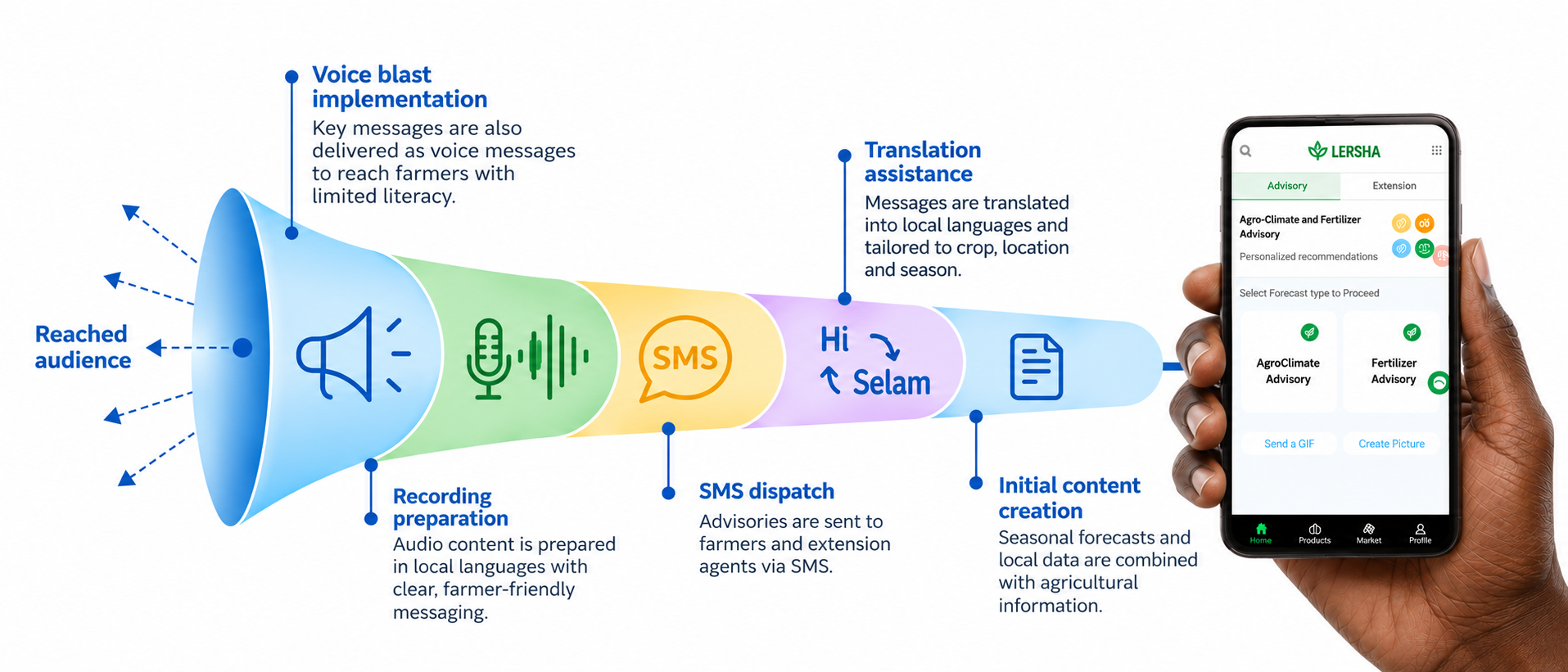
Through collaboration with Green Agro Solution’s LERSHA platform, localized agricultural advisories can reach farmers through mobile-phone services.
What is EDACaP?
The Ethiopian Digital AgroClimate Advisory Platform (EDACaP) is an agricultural decision-support system developed jointly by CGIAR scientists and Ethiopian national institutions. It integrates seasonal and shorter-term climate forecasts with crop modelling, soil data and agricultural management information to generate localized guidance on planting dates, crop and variety selection, and soil and water management. Advisories can be updated as new forecasts become available and seasonal conditions evolve.
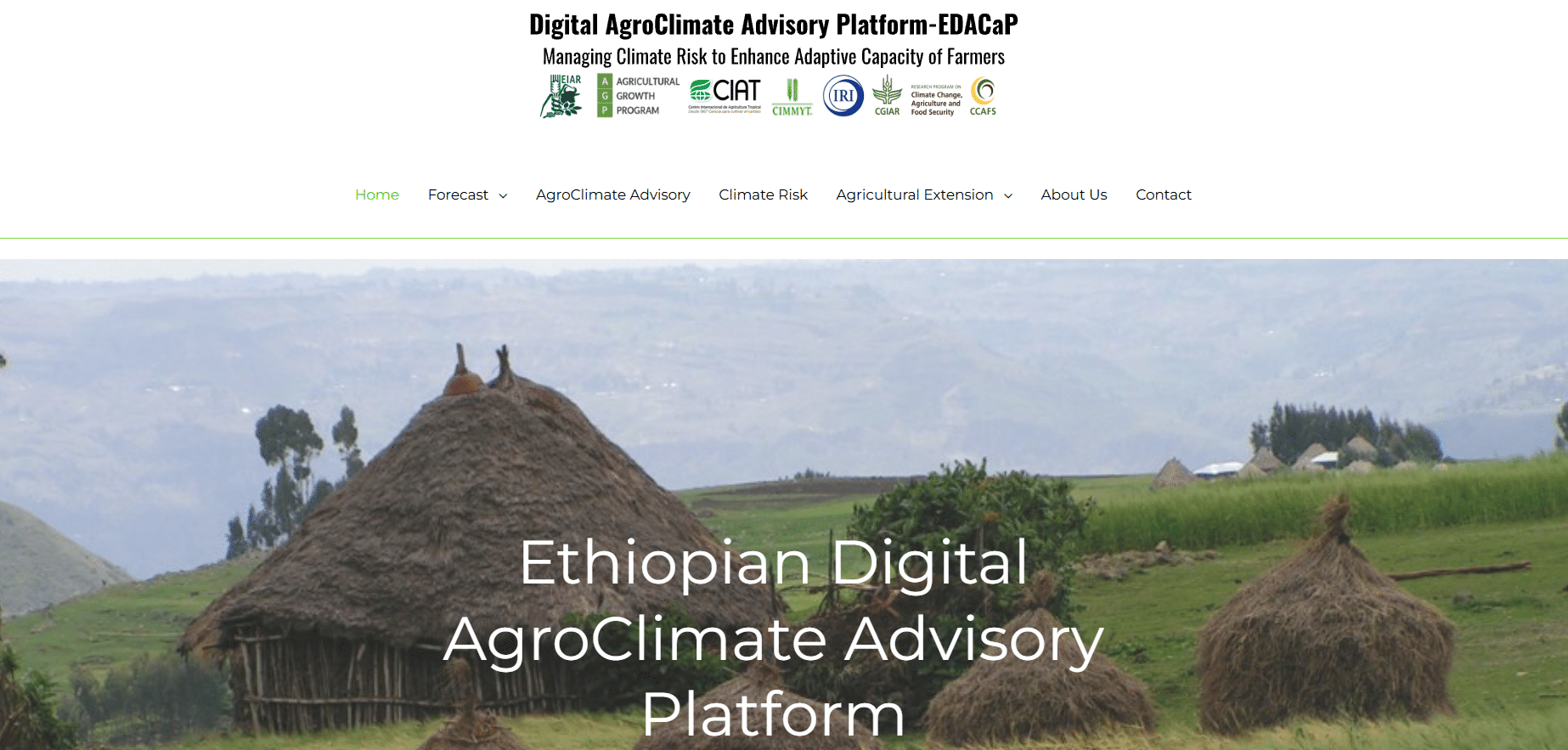
- EDACaP uses a public–private delivery model to extend access through multiple advisory channels. Shared application programming interface (API) endpoints make its information accessible to four private-sector delivery partners—LERSHA, Digital Green, Kifiya and Hello Erf—and public institutions, including EIAR, the Agricultural Transformation Institute (ATI) and the Ministry of Agriculture (MoA). This allows partners to integrate climate-informed guidance into their own services, supporting last-mile delivery through digital platforms, mobile services and extension networks.
- For the 2026 El Niño preparedness effort, historical El Niño analysis informed the interpretation of anticipated agricultural risks and the development of targeted guidance. Hosted on infrastructure managed by EIAR, EDACaP supports national ownership and institutional capacity, while its delivery partnerships broaden access to agricultural climate services.
Turning early warning into institutional readiness
An early warning creates an opportunity to prepare. Seizing it requires institutions that can interpret the forecast, agree on priorities, estimate funding needs and communicate practical guidance.
Additional support through the CGIAR El Niño Response Fund will help Ethiopia strengthen these capabilities, building on the district-level assessment and the partnerships already supporting agricultural advisories.
The assessment and the innovation tools across 690 districts established a foundation: connecting anticipated agricultural risks with contingency measures and emergency funding requirements. The next step is to strengthen the capacity to use that evidence—from senior ministry officials making policy and budget decisions to technical teams preparing sector plans and communities deciding how to respond.
Working with EMI, planned capacity building will support senior officials in interpreting seasonal forecasts, understanding uncertainty and communicating agricultural risks. Policy dialogues will bring climate evidence into discussions on preparedness priorities, institutional responsibilities and resource allocation. This will complement the EMI-led National Forum for Climate Services and reinforce national leadership in coordinating the response.
Technical training with EIAR, EMI and disaster risk management institutions will help staff apply the new tools (Seasonal Agroclimate Indices Forecast Pipeline) to sector-specific planning.
Participants will work through the connection between forecast conditions, district-level risks, recommended interventions and estimated costs. The aim is to make forecast-informed contingency planning and budgeting a repeatable institutional practice, supported by monitoring as seasonal conditions change.
At community level, planned activities will help farmers, extension staff and local leaders interpret El Niño bulletins and incorporate the guidance into action plans. Public–private delivery partnerships can broaden access, while local discussion can help translate that information into decisions suited to farmers’ circumstances.
This effort also connects with AgWise’s broader work on climate-informed agronomy. When fertilizer is expensive and household resources are limited, decisions about planting dates, varieties and input application carry greater financial consequences. Linking climate information with agronomic guidance can help farmers assess when and how to commit those resources, while government institutions use the same seasonal outlook to prepare support for areas facing the greatest risks.
The Fund’s contribution is therefore an investment in the capacity to act: connecting science with policy, budgets and farm decisions. By strengthening these links within Ethiopia’s institutions and delivery networks, the effort aims to leave a lasting capability—one that can support preparedness for the next season as well as the next El Niño.
Preparing for the next season and the next El Niño
The lasting value of Ethiopia’s El Niño effort lies in the connection it establishes between anticipating a difficult season and preparing for its consequences. By linking seasonal forecasts with district-level agricultural risks, recommended interventions and emergency funding requirements, the assessment gives institutions a basis for deciding where to act and what resources to prepare. The complementary farmer advisory services extend that connection to decisions about planting, varieties and crop management.
Together, these efforts demonstrate a shift toward climate services shaped by demand. Government planning questions and farmers’ management needs determine how forecast information is interpreted, combined with agricultural evidence and communicated. This puts the ambition of the Global Framework for Climate Services (GFCS) into practice and supports the EMI-led National Framework for Climate Services (NFCS): bringing climate science, sector expertise and users together to inform decisions.
Making that approach dependable requires a cycle of assessment, action and learning. As Ethiopia prepares for the 2027 Belg season, comparing Kiremt forecasts with observed conditions can reveal where the analysis needs improvement, while documenting how institutions and farmers used the guidance can show whether it arrived in time and addressed their priorities. These findings can inform revised risk assessments, more practical contingency plans and clearer advisories. The forthcoming impact study can contribute evidence on advisory use, while the ten-year roadmap provides a direction for sustained service development.
That learning also matters for the financial decisions made on farms. Complementary AgWise work on climate-informed fertilizer recommendations can connect expected seasonal conditions with nutrient management, helping farmers assess how to use costly inputs when rainfall and returns are uncertain. Across government and farm decisions, the practical purpose is shared: using climate evidence to allocate limited resources before the season’s risks materialize.
Scaling this approach therefore requires investment in the full connection between evidence and action. In Ethiopia, that means embedding the tools in institutional planning and budgeting, maintaining the technical capacity to update them, and extending access through public–private advisory networks. Building on these foundations, partnerships in Tanzania, Malawi and other priority countries offer opportunities to adapt the approach to different agricultural systems and national priorities, with local institutions and users shaping its development.
For partners and funders, the opportunity is to help turn a seasonal response into a sustenaible public capability. Sustained investment can strengthen the science, institutions and delivery partnerships that make an early warning usable—and help ensure that the next forecast reaches a government ready to plan and a farmer better equipped to decide.
The Alliance team

Amanda Sue Grossi
Research Team Leader, Climate Action and Resilient Food Systems
Jemal S. Ahmed
Research Specialist
Aniruddha Ghosh
Senior Scientist
Degefie Tibebe
Research SpecialistFurther reading


