
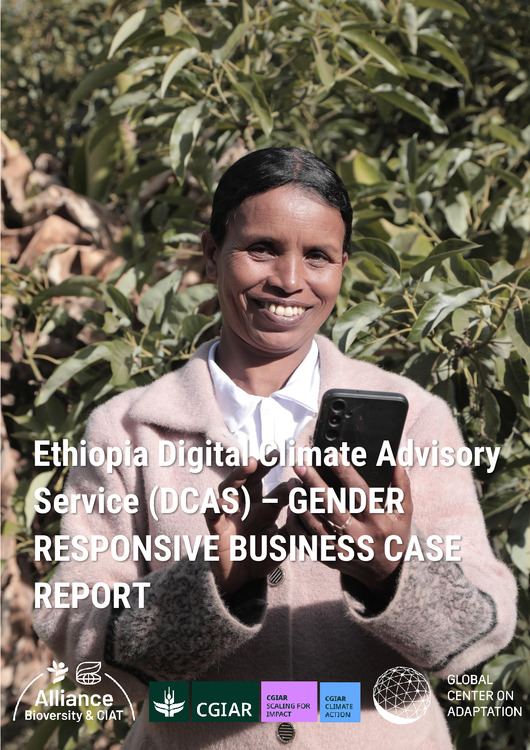
Ethiopia Digital Climate Advisory Service (DCAS) – Gender responsive business cases report
The analysis identifies three critical insights for investment. First, DCAS performance operates across three distinct dimensions—access, engagement, and impact—which are not achieved simultaneously within a single model. Public systems are effective at delivering access at scale but less effective at driving sustained engagement and behavioral change. Private-sector models are more effective at enabling engagement and impact but face constraints in scaling due to cost and operational complexity. Second, there is a fundamental trade-off between scale and depth: systems optimized for mass reach do not necessarily produce actionable outcomes, while high-touch, bundled models that drive outcomes are resource-intensive and difficult to expand. Third, gender inclusion remains a systemic gap. Women farmers face structural barriers, including lower mobile phone ownership, limited digital literacy, and constrained decision-making power. Without targeted interventions, DCAS systems risk reinforcing existing inequalities rather than reducing them. Evidence from the assessment shows that gender-responsive DCAS requires deliberate system design. Multi-channel delivery mechanisms such as IVR, voice messaging, and extension services are essential to overcoming access barriers, while human-mediated delivery and incentive structures are critical to sustaining engagement. Where such approaches are implemented, women demonstrate strong participation and reliability as users. However, inclusion does not occur automatically and must be embedded within both operational and financial models.