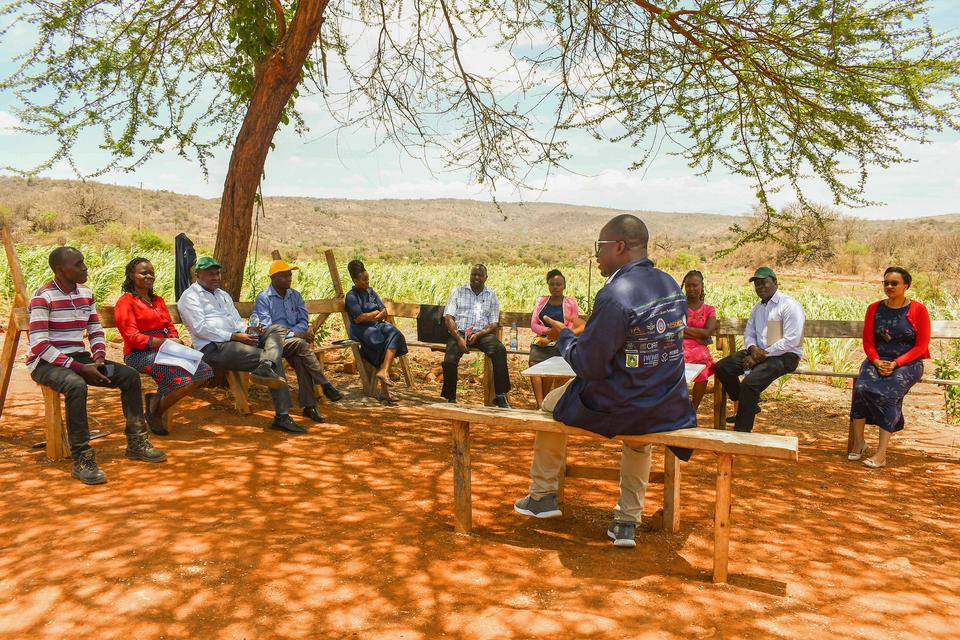
Blog Science in fragile settings: Reimagining the Alliance’s support in fragile and crisis contexts
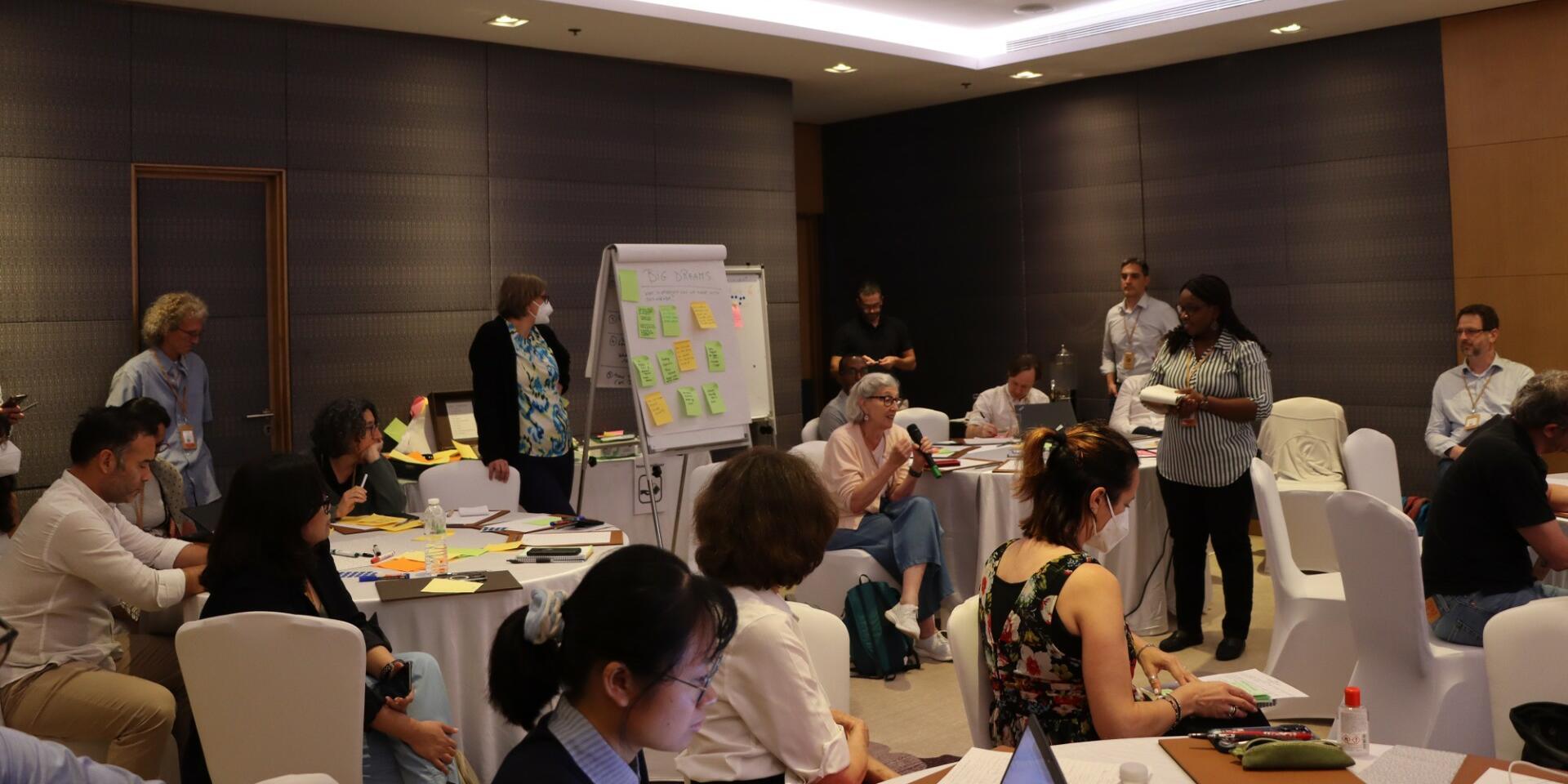

As conflict and climate shocks reshape food, land, and water, leaders from the Alliance of Bioversity International and CIAT met at their annual Science Week to rethink how science can better serve fragile and crisis-affected regions.
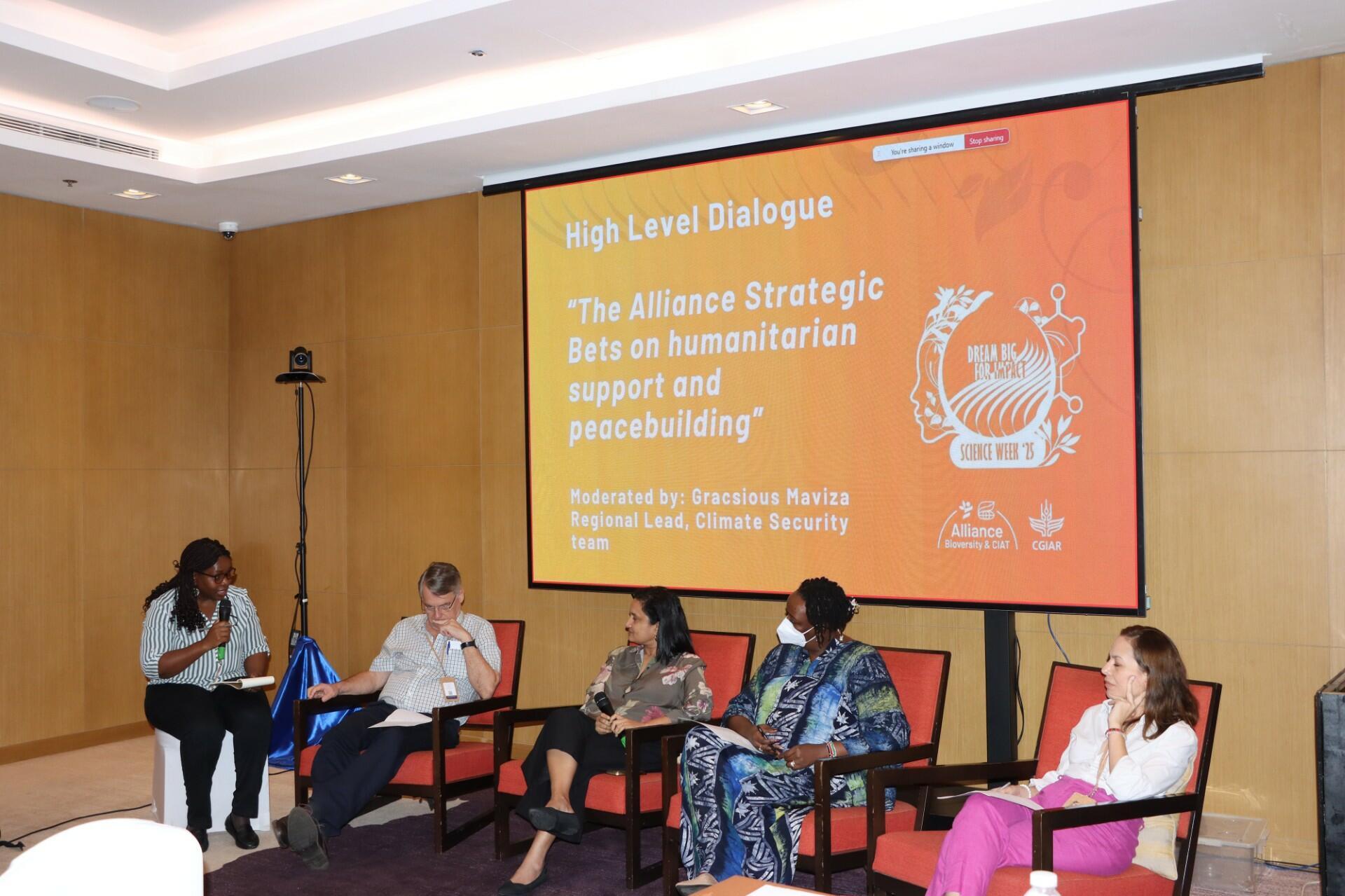
At Alliance Science Week 2025, the Climate Security team of the Climate Action Lever convened a high-level parallel session event to reexamine the organization’s role in fragile and conflict-affected settings. Titled “Building an Inclusive Agenda for Peacebuilding and Humanitarian Support in Food, Land, and Water Systems,” the event brought together the Senior Management Team, Research Directors and a small number of senior researchers to build a shared vision for how the Alliance can strengthen peacebuilding and humanitarian support through sustainable management of food, land, and water systems in fragile and crisis-affected settings.
Conflict and climate shocks are reshaping food, land, and water systems; not just in obvious hotspots but across regions traditionally seen as stable. Across the Global South, the Alliance’s work is increasingly intersecting with humanitarian needs, governance vacuums, and social tension.
“Peace is not just the absence of conflict. It is the presence of systems that sustain it. Lasting peace needs resilient systems, and that means our science can’t stay in the lane of pure development anymore.”

Grazia Pacillo
Senior Scientist and Lead of the Climate Security Team
That quote, offered during the opening remarks delivered by Grazia Pacillo, co-Lead of CGIAR Climate Security, set the tone for a bold 90-minute conversation. This was followed by two high-level discussions in quick succession, the first with Research Directors and the second with the Senior Management Team of the Alliance. Below is a summary of the conversations.
Alliance Science at the Frontlines of Fragility
In a fast-paced lightning round, senior researchers and research directors across Alliance research areas shared how some of their work is already contributing to peacebuilding and humanitarian outcomes, even when those were not the initial goal. The session revealed an exciting pattern - research designed for development is increasingly being tested in contexts of disruption and often rising to the challenge.
Carlo Fadda
Director, Agrobiodiversity
Jacob van Etten
Director, Digital Inclusion
Chun Song
Spatial Econometrician
Carolina Gonzalez
Thematic Leader
Christophe Béné
Principal Scientist - Senior Policy AdvisorCommunity Ownership as a Peace Infrastructure: Carlo Fadda, Agrobiodiversity Director, recounted how community seed banks in Ethiopia's Tigray region, previously established by the Alliance, were protected by local communities during the war.
“In Ethiopia, community seed banks were set up before the war as a development tool. And during the conflict, they became hubs of resilience. Locals protected them so fiercely that even the army left them untouched. Seeing this, other organizations began using the seed banks as entry points for supporting affected communities.”
These seed banks not only safeguarded biodiversity but also became anchors of recovery - reinforcing the insight that when communities truly own scientific interventions, those systems endure even in conflict.
Rethinking What Causes Conflict: Jacob Van Etten, Research Director for Digital Inclusion, called for a more nuanced understanding of conflict, one that goes beyond climate triggers and looks at underlying social and historical narratives:
“Most conflicts are shaped by complex, multi-layered factors. The good news is that we can now track everyday disputes, many of which are early indicators of larger tensions.”
He called for using large language models (LLMs), newspaper data, and court records to detect patterns of tension long before they escalate; a more nuanced, predictive, and localized approach to conflict prevention.
Mapping Future Flashpoints: From the PISA team, Chun Song shared spatial analysis on how drought-related water conflicts often emerge in border regions with weak governance.
“At first glance, the logic seems intuitive: drought leads to water scarcity, and water scarcity can lead to conflict over water. But the real question is: where is this dynamic most influential? Our findings show that such conflicts are more likely to occur near national borders.”
Her team is already using this research to forecast where future conflicts may emerge, and where smart investments in governance and policy could reduce those risks. This type of spatial and policy-relevant insight shows how climate-driven conflict can be anticipated, not just responded to.
Innovation Networks for Peace: Carolina Gonzalez, thematic leader in Foresight and Applied Economics for Impact Evaluation, emphasized that no single crop drives resilience, rather, it’s the ecosystem of innovation and community engagement that matters. As an example, she highlighted beans which were introduced in a conflict region in Cauca, Colombia, which helped improve nutrition and livelihoods, while also creating community empowerment structures that outlasted conflict cycles.
“Beans served as a gateway for community engagement and empowerment. These beans also help address malnutrition in vulnerable populations, due to their higher iron content, and offer environmental co-benefits like improved soil health. This network of innovations creates the enabling environment for peace.”
Resilience as a Strategic Necessity: Senior Policy Advisor, Chris Béné, encouraged the Alliance to expand its research lens and to explore and document how food systems function in the context of armed conflicts, not just in period of stability. He illustrated this approach through a recent research implemented jointly with WFP and CIRAD in northern Burkina Faso:
“We looked at how different actors within the food system developed specific strategies to keep their businesses running, and what impact that had on internally displaced populations. We believe this is worth continuing exploring.”
These stories and examples prove that while traditionally focused on development settings, the Alliance's research is increasingly relevant to fragile, displacement and conflict-affected contexts, where land, water, and food systems are under acute pressure.
Big Bets, Big Dreams - Betting on the Future
The second session moved from reflection to strategy. Moderated as a forward-looking discussion, it asked four senior leaders to propose strategic bets the Alliance could make to support peace and humanitarian outcomes more deliberately.
Marcela Quintero
Associate Director General, Research Strategy, and Innovation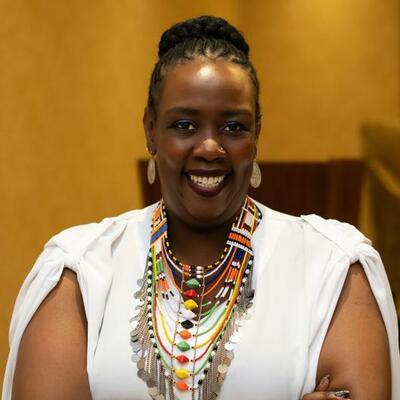
Wanjiru Kamau-Rutenberg
Managing Director, Africa, and Trustee, Bioversity International USA
Maya Rajasekharan
Managing Director, Americas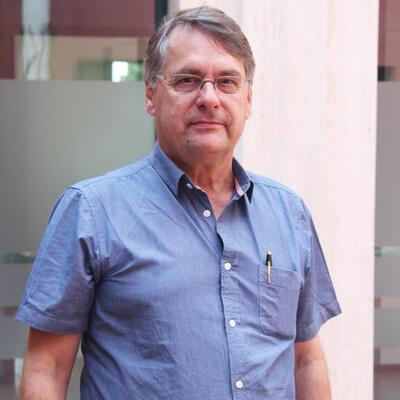
Stephan Weise
Managing Director, AsiaBe More Explicit and Evidence-Led: Marcela Quintero, Associate Director General, opened with a call for greater clarity and realism around the Alliance’s ambitions in peace and humanitarian contexts. She flagged three priority areas:
- Understanding the linkages between conflict and food system resilience
- Defining what it means to deploy science alongside humanitarian aid
- Revisiting the evidence base around climate insecurity and conflict
Marcela also challenged the Alliance to not just deploy climate tools where it’s easy, but to deploy them where they’re most urgently needed.
“We prioritized countries that are more stable because they are more ready… But what if managing better climate risk in unstable contexts can reduce conflict?”
Be Bolder, Be Strategic: Wanjiru Kamau-Rutenberg, Managing Director for Africa, challenged the development sector’s caution around complexity and politics and called for the Alliance to be bolder in shaping continental dialogue.
“We’re still too shy. It’s the nature of academia, maybe, but if we want to make an impact, we need to at least put our thinking out there for discussion.”
She pushed for stronger decision support tools to anticipate the tradeoffs of agricultural expansion, particularly in areas of ecological tension between farmers and pastoralists. Her vision is for the Alliance to influence not just national policy, but bodies like IGAD, the African Union, and AfDB.
Job Creation and Bundled Solutions: Maya Rajasekharan, Managing Director for Latin America and the Caribbean, urged the Alliance to frame its peacebuilding and resilience work around job creation and bundled solutions:
“One of my bets would be to frame our work around job creation, because that’s a primary driver in LAC. Many people are leaving because they can’t find work. If we lead with that lens, we can still bring in our evidence around peace and conflict but also introduce solutions we already have within the Alliance.”
She also emphasized engaging international financial institutions like the World Bank, especially as bilateral donors retreat from the region.
In Fragile Contexts, Go in with Humility: Stephan Weise, Managing Director for Asia, emphasized the need for the Alliance to understand political complexity before offering solutions, particularly in Southeast Asia.
“In Southeast Asia and across Asia more broadly, the political context is often highly sensitive. So, we need to enter those spaces with humility. We have to take the time to understand the landscape before suggesting how we can contribute.”
He called for partner-led entry points and multi-level buy-in before advancing in fragile areas.
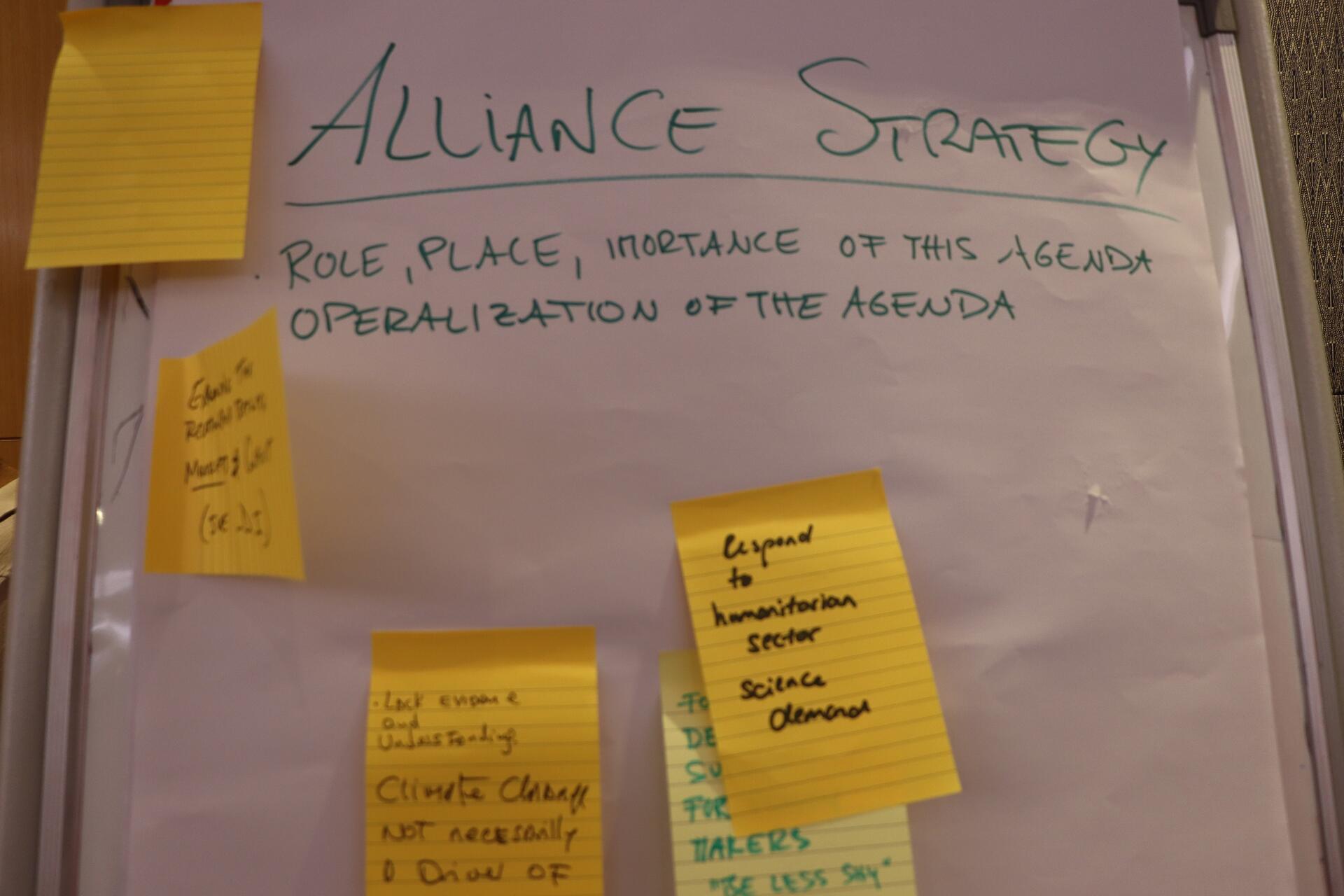
Together, these sessions laid the foundation for a clearer, more confident posture for the Alliance. The Alliance’s growing engagement across fragile and conflict-affected settings highlights a recognition of our comparative advantage and a response to real-world demand.
Our systems-based research in food, land, and water has proven relevant beyond development challenges, to the complex realities of conflict, displacement, and recovery.
With growing expertise across our levers, we are poised to contribute meaningfully, from informing humanitarian programming and early warning systems to building national-level partnerships for resilience. In the near term, we aim to sharpen our scientific engagement rules, build capacity among peace actors, and co-design interventions with communities and institutions on the frontlines.
But to shape a credible, lasting contribution, we must learn from those already working in humanitarian, development, and peace spaces. We therefore invite partners across the Humanitarian-Development-Peace nexus to help us shape a credible, strategic role for science in fragile settings:
What gaps do you see, and where can we contribute most? We are excited to hear from you.