Grazia Pacillo
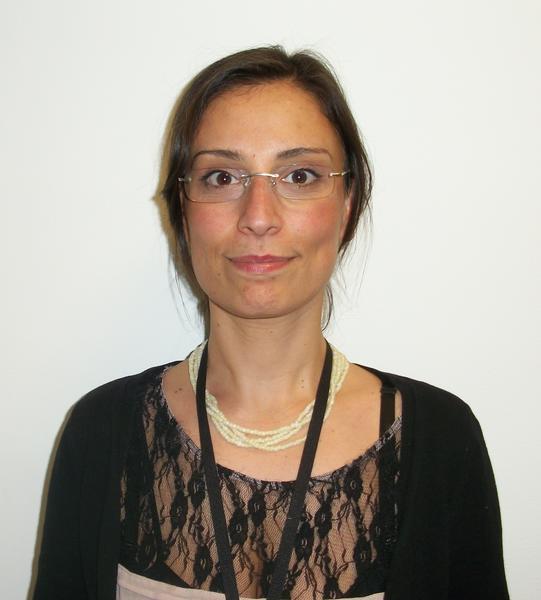
Grazia Pacillo has dedicated her career to supporting decision-makers in designing and implementing sustainable development projects, programmes, and solutions that are sensitive to multiple risks, particularly the nexus of climate, fragility, migration, and security.
She is the Lead of the Climate Security research flagship, managing a fast-growing, multidisciplinary team of more than 70 staff in 26 countries across seven regional hubs, including climate scientists, peace and security experts, social scientists, spatial analysts, econometricians, and policy specialists.
Her main responsibilities include strategic leadership of the Alliance offer on climate, fragility, conflict and displacement. This involves resource mobilization, proposal development, project management, partnership development, and high-level advocacy to align Alliance’s food systems science with Humanitarian, Development, and Peace (HDP) nexus initiatives worldwide.
She works closely with national and international partners, including the African Union, IGAD, NATO’s Climate Security Center of Excellence, WUR, SIPRI, NUPI, Interpeace, UNDP, UNHCR, WFP, IOM, and FAO, to position Alliance’s science in global policy processes. She has represented CGIAR in high-level fora such as the UN Security Council, UN Food Systems Summits, COP presidencies, contributing to strategic frameworks and policy processes including Kenya’s National Climate Change Action Plan, Zambia’s Green Growth Strategy, the AU Climate Risk Assessment, and UNHCR’s Global Climate Strategy.
Her leadership has already resulted in landmark achievements: the establishment of long-term strategic partnerships with humanitarian and development actors (e.g., WFP, UNHCR, IOM), and the recognition of the CGIAR Climate Security Observatory as one of the top 10 game-changing solutions at the 2021 UNFSS.
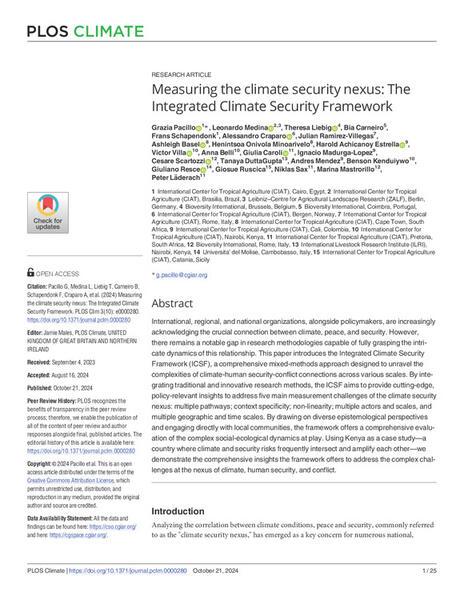
Grazia also provides thought leadership in analyzing and assessing compound fragility and displacement risks. She leads multiple projects that combine advanced econometric, spatial, and mixed-method approaches to qualify and quantify how climate interacts with displacement, food systems, and governance in Africa, Latin America, the Middle East, and Asia. Her work supports the design of peace-responsive solutions, informs recovery pathways, and advances anticipatory and risk-informed policymaking.
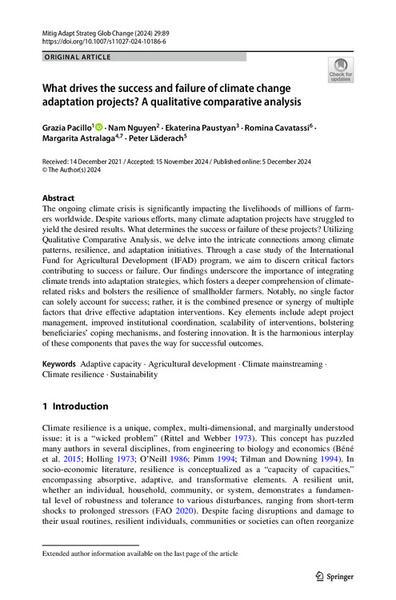
Earlier in her career, she led impact assessment research in Southeast Asia (Thailand, Viet Nam, Philippines) at CIAT and worked with Save the Children UK and IFAD on designing and evaluating climate-resilient programs in fragile and emergency settings, including Ethiopia, Nigeria, Indonesia, Bangladesh, and Rwanda.