Research Articles A framework for low-emission food systems: Linking climate action and SDGs

The Alliance’s Low-Emissions Landscapes team developed a framework to integrate climate-change mitigation with SDGs in food systems. Led by Diana Gutiérrez, it aims to guide global action for sustainable development and low-emission agriculture.
As humanity faces multiple threats from biodiversity loss, poverty, malnutrition climate change and extreme climate events, the wellbeing of billions of people and the planet is at risk. These challenges need to be tackled holistically. For example, mitigating climate change isn't just about reducing greenhouse gas (GHG) emissions. Sustainable economic development and improving people's well-being must be achieved in parallel.
The Low-Emissions Landscapes team of the Alliance has developed a framework to support the integration of climate-change mitigation efforts with Sustainable Development Goals (SDGs) from a low-emissions food systems perspective. Diana Gutiérrez, senior research associate and a data analysis specialist, explains the approach.
The framework considers the interdependence between environmental sustainability and socio-economic development, embracing a holistic approach, from understanding food system drivers of GHG emissions to addressing the institutional frameworks that underpin social equity and economic prosperity. It highlights six components:
1. Food system drivers of greenhouse gas emissions
Identifying the underlying food system drivers of GHG emissions is crucial to facilitate policymakers and stakeholders to integrate efforts to reduce emissions with broader development goals. Food-related land-use change, particularly deforestation, is a major driver of emissions in the tropics. From a food-system-based approach, deforestation encompasses several stages beyond pre-production by considering drivers such as demand, consumption trends or investment opportunities. Therefore, deforestation is implicitly linked to production, post-production, diets, and consumption.
Understanding these drivers across a broader spectrum of food systems can help identify the factors and activities that would be most responsive to mitigation interventions. This, in turn, could also assist in addressing the socio-economic and cultural issues associated with these changes, for example land tenure.
2. Connecting climate-change mitigation actions with sustainable development priorities
While mitigation actions are primarily aimed at reducing GHG emissions, their implementation often results in co-benefits that extend beyond the environmental dimension. Leveraging the co-benefits of climate action can be an effective strategy for increasing public support for climate-change mitigation. However, clear communication about core climate benefits is essential to ensure sustained public engagement and policy effectiveness.
While the interconnectedness of both challenges enables policy integration, aligning economic growth, social development and environmental sustainability, trade-offs may pose risks to achieving these objectives. Therefore, priorities must be established to protect the most vulnerable groups, promote benefits for all segments of the population and avoid exacerbating inequalities.
Percentage of NDC actions related to prioritized SDGs. Own source.
3. Food system solutions that meet both climate-change mitigation and SDG targets
There are already several strategies and technological innovations in place that can be used to develop low-emission food systems that deliver benefits across environmental, social and economic dimensions. In developed countries, there is a greater focus on strategies that address GHG emissions at the consumer level, such as dietary changes. In contrast, production-level strategies such as intensification of production systems, tend to be the focus in developing countries.
In the latter, solutions such as sustainable land-use systems, including agroforestry and silvopastoral systems, and regenerative agriculture techniques like mulching and crop rotation, have proven effective in improving ecosystem health and protecting the services they provide, as well as improving socioeconomic indicators. However, factors such as lack of access to finance and land tenure, poor institutional coordination with local stakeholders, and lack of market connectivity significantly affect farmers' ability to adopt and benefit from these practices.
4. Assessing the contribution of proposed solutions to climate-change mitigation and SDGs
There are limitations that hinder the integration of existing initiatives to achieve climate-change mitigation goals with the SDGs at the operational level. They include geographic coverage of data, the level of data disaggregation, frequency, timeliness, and data quality. For example, disaggregated information at the local level is important to effectively inform territorial development plans.
Therefore, the development of indirect measures is an option to extend existing indicator frameworks and help overcome such limitations. By using proxy indicators on production growth, food security and climate-change mitigation and adaptation, the co-benefits on social, environmental and economic dimensions can be measured to assess countries' international commitments.
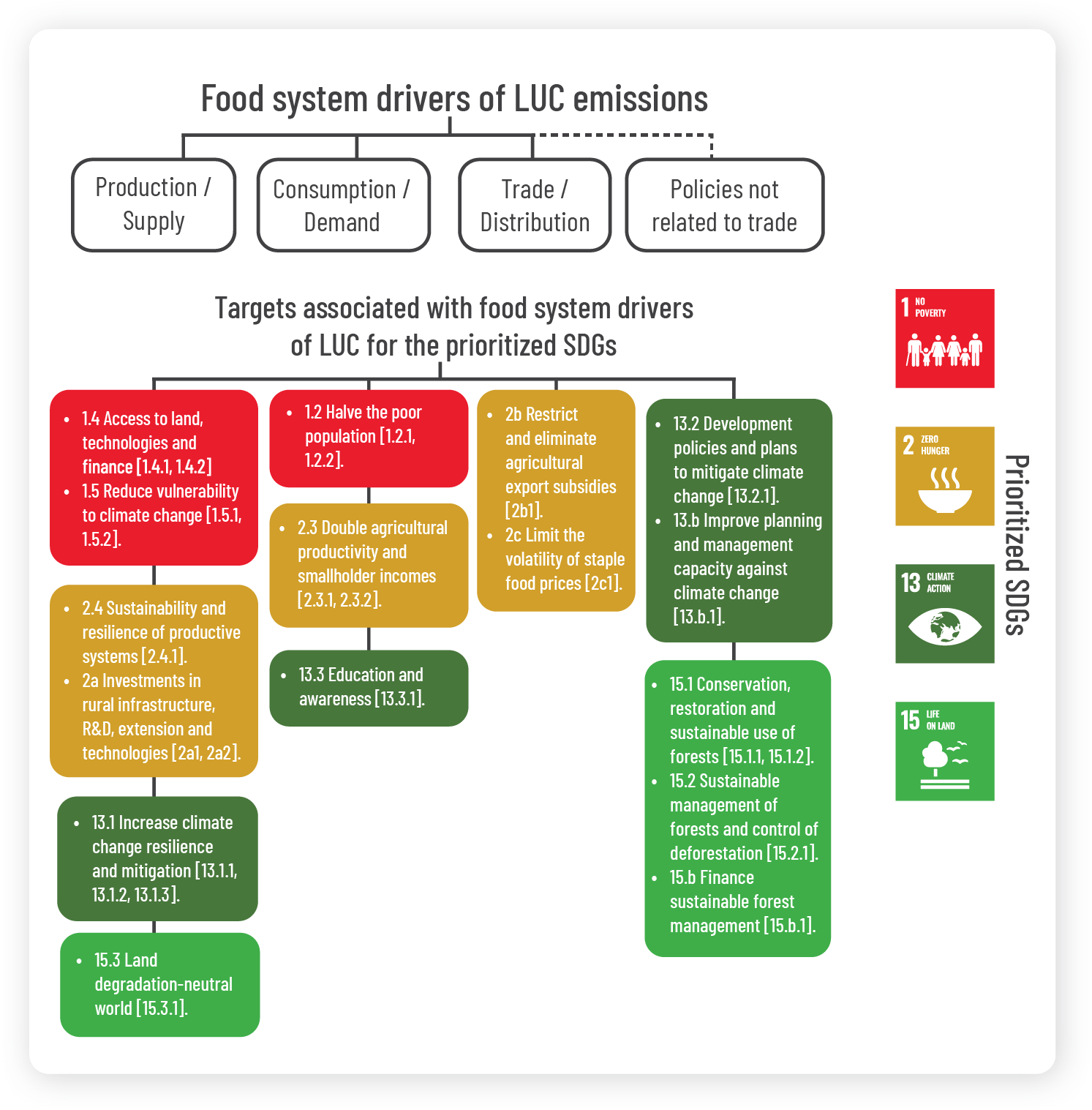
Targets and indicators of the prioritized SDGs connected to drivers of LUC in the food system by category. Own source.
5. Priority areas for implementing integrated solutions
Successful implementation of any policy or project depends initially on ensuring adequate allocation of financial and human resources. It is important to identify areas for implementation on the ground where the different challenges converge, to apply solutions that deliver maximum possible impact.
By adopting an integrated approach, governments can maximize the effectiveness of its interventions and minimize potential trade-offs between climate- change mitigation and SDGs actions. To identify these strategic areas, various approaches based on explicit spatial analysis can be employed, considering the multidimensional factors to be integrated and the type and quantity of data available. This will provide valuable insights into the types of solutions required and the regions where they are most needed.
6. Enable scaling of integrated solutions
In the context of sustainable, low-emission food systems, scaling refers to expanding socio-technical innovations up and out to minimize greenhouse gas emissions across the different stages of the agri-food value chains, achieving profound system transformation. However, before scaling any solution, is crucial to identify potential undesirable effects, such as environmental degradation, worsening labor conditions or exacerbating inequalities, to establish safeguards accordingly.
Two key aspects for scaling integrated solutions addressing climate change and development goals are critical: (1) financing, and (2) gender, youth, and social inclusion (GYSI). As financing is a major barrier to the adoption and scaling of solutions, there is a need to improve access to financing mechanisms for local actors, on favorable terms, and with the required technical assistance for implementation and maintenance.
This can be achieved by leveraging existing mechanisms to redirect private investments towards businesses that promote sustainable food systems, as exemplified by the Colombian "Works for Taxes" mechanism. Regarding GYSI, integrating critical considerations of power dynamics and ensuring diversity and participation from all sectors is crucial to scale and achieve equitable distribution of benefits.
The framework lessons learned
The framework emphasizes four key strategies for transforming food systems toward sustainability: developing integrated, science-based policies that align climate mitigation with SDG targets; promoting sustainable agricultural practices that reduce emissions while improving livelihoods and food security, supported by incentives and training; establishing robust monitoring and evaluation systems to track progress and adapt strategies; and fostering multi-stakeholder collaboration through platforms that enable knowledge sharing, innovation, and resource mobilization to integrate climate and development goals effectively.
The path to sustainable development and climate resilience lies in recognizing the deep interconnections between food systems, environmental sustainability, and social equity. By aligning policies, investing in inclusive solutions, and scaling innovations responsibly, we can transform food systems into engines of low-emission growth and human well-being. The time to act holistically is now.
Team

Georgina Smith
Journalist and Communications Professional
Diana Gutierrez
Senior Research AssociateAcknowledgements
This framework was supported by the CGIAR AgriLAC Resiliente and Low-Emission Food Systems (Mitigate+) initiatives. We would like to thank all funders who support this research through their contributions to the CGIAR Trust Fund: www.cgiar.org/funders. We would also like to express our gratitude to Ireland's Department of Foreign Affairs for funding the Environmental Peacebuilding for Improved Nutrition and Emission Reductions (EPINER) project in Cauca and Putumayo.