Blog Biodiverse landscapes, biodiverse plates: lessons from Ucayali and Colombia's new dietary guidelines
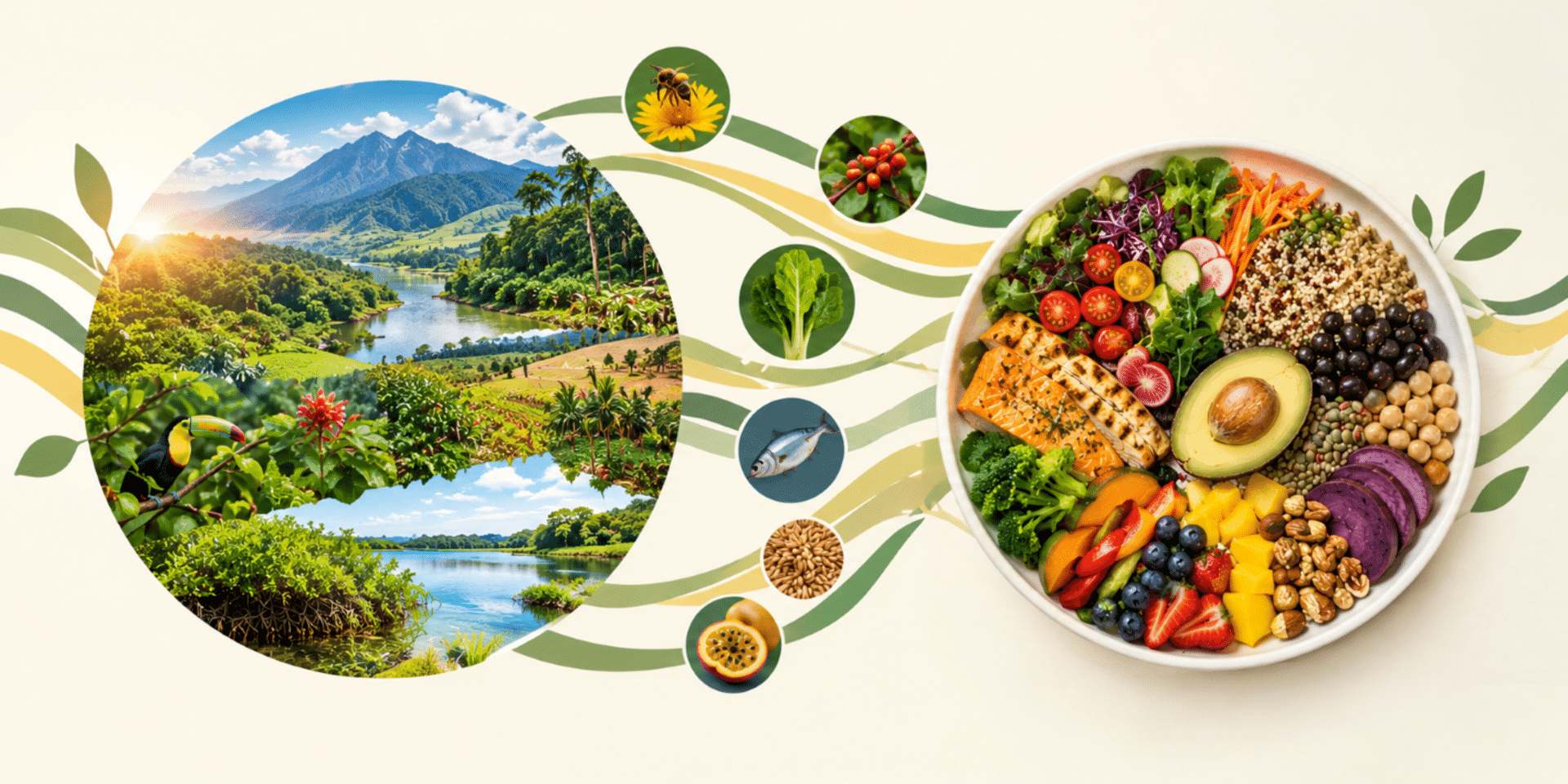

Diversity is one of four pillars, but we usually measure only half of it
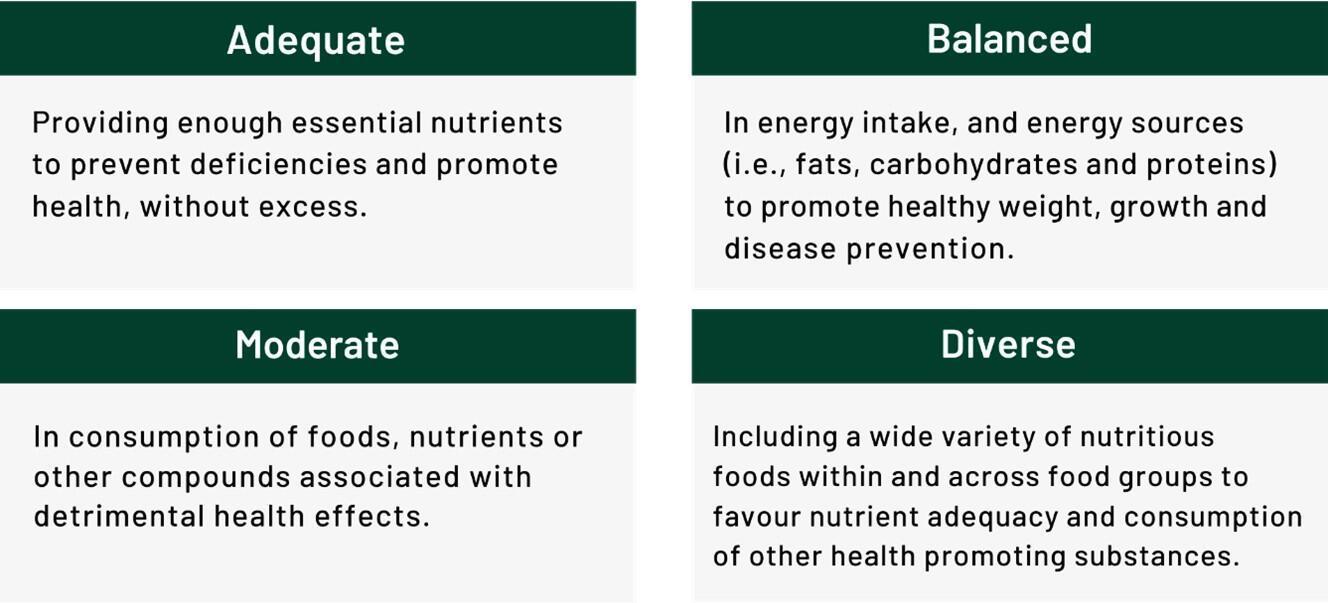
WHO describes four core principles of a healthy diet: adequacy, balance, moderation, and diversity. Diversity is defined as "inclusion of a wide variety of nutritious foods within and across food groups" (WHO healthy diet fact sheet). The word "within" is often easy to overlook.
Most of us in the field (me included) have been trained to measure diversity between food groups. Indicators like the Household Dietary Diversity Score (HDDS) or Minimum Dietary Diversity for Women (MDD-W) ask: did you eat some fruit, a vegetable, or a fish yesterday? One banana counts the same as five native Amazonian fruits.
[Nuance note: these indicators are validated, quick, and useful. The point is not to replace them, but to recognize that they answer a different question.]
Between and within diversity: why the second half matters
Diversity between food groups tells us if the diet covers the basics. Diversity within food groups tells us how many different species and varieties sit behind those basics. Different species carry different micronutrients, fibers, and bioactive compounds, so two different "fruit" servings are not nutritionally the same. The diversity principle teaches us that the more diverse we eat, the more chances we have to cover all our needs in terms of nutrients and health-protective compounds.
The evidence for counting species has grown considerably in recent years. Hanley-Cook, Lachat and colleagues compared several food biodiversity metrics across cohorts in nine European countries and five low- and middle-income countries (Nature Food, 2025). The simplest one, dietary species richness (DSR), which is just the count of distinct species a person eats, captured the biggest differences between and within countries. Higher DSR was associated with nutrient adequacy in LMICs and with lower mortality in Europe.
A follow-up in the European EPIC cohort found that plant species richness also went hand in hand with lower greenhouse gas emissions and land use (Berden et al., Nature Food, 2025). Counting species is therefore not only about nutrition. It links what people eat to the landscapes that feed them.
What we learned from the Ucayali study
A study led by colleague Dr. Genowefa Blundo-Canto illustrates this well (Food Security, 2020). They interviewed the same 53 mestizo households in Ucayali, Peruvian Amazon, in 2000 and 2015.
Over those 15 years, forest cover fell, and farms specialized in oil palm and cacao. Diets came to rely on fewer food groups, fewer food items, and more foods bought in the market. Fish, wild fruits, herbs, and other forest foods that families once ate regularly largely dropped out.
|
Measure |
2000 → 2015 |
|
Food items eaten |
69 → 35 |
|
Household dietary diversity score |
down 1.3 food groups |
Food items, measured by a non-quantitative 24-hour recall, nearly halved in one generation, while the food-group score fell by just over one group point. A food-group indicator alone would have substantially understated how much the loss of the landscape reached the plate.
[Nuance note: the authors also challenge the common assumption that more income and market orientation automatically improve food security. That finding deserves a separate discussion.]
Colombia puts biodiversity on the plate
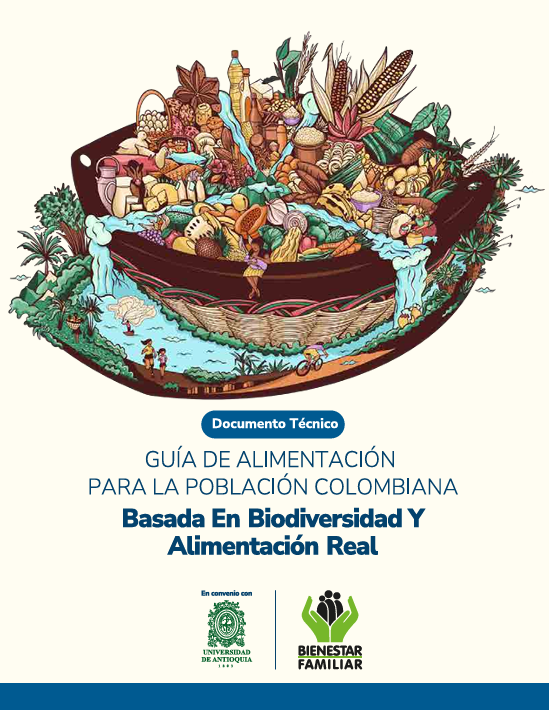
In 2025, Colombia (Instituto Colombiano de Bienestar Familiar) and the Universidad de Antioquia released the Guía de alimentación para la población colombiana basada en biodiversidad y alimentación real. The guide frames healthy eating around biodiversity, sustainability, food sovereignty, and real, minimally processed food.
Biodiversity here means "the richness of species, ecosystems, cultures and traditional cuisines" (ICBF). Importantly, it was built with communities from 13 food territories, through dialogues of knowledge, observation, and interviews, from Guainía and Meta to Chocó, La Guajira, Boyacá, and San Andrés. The examples are regional: native fruits, roots, and fish in the Amazon; potato, maize, and quinoa in the Andes; fish, seafood, and coconut on the Caribbean coast; Afro-Colombian dishes on the Pacific (MIPA).
Rarely do national dietary guidelines make food biodiversity this explicit. It also raises a practical question: how will we know whether people are eating diversely as the guide recommends? Food-group scores cannot answer that. Species counts that capture diversity within food groups fill that gap.
Guía de alimentación para la población colombiana basada en biodiversidad y alimentación real
A tool that counts within food groups, at the species level: ANQ-24
To measure within-group diversity at scale, we need a recall tool that captures species without the cost and burden of a full quantitative survey. This is the purpose of the ANQ-24 (Adult Non-Quantitative 24-hour Recall). Alliance colleagues Tosin Akingbemisilu, Francis Oduor, and Celine Termote first developed and validated it in Kenya. The benefits of this tool include:
- Fast: a 10-15 minute interview on everything an individual has eaten the previous day, including ingredients of mixed dishes.
- Species-level: each food is coded to species and linked automatically to national or merged food composition tables through the dietrecallkit R/Python package.
- Many indicators from one recall: Dietary Species Richness (DSR), Dietary Diversity Score (DDS), SDG indicator - Minimum Dietary Diversity for Women (MDD-W), Global Diet Quality Score (GDQS), and the GDQS submetrics (GDQS+/-). It also captures meal patterns, meal timing, and culinary complexity.
[Nuance: this is the same type of qualitative 24-hour recall used in the Ucayali study. We are building on an established method rather than designing a new one. Quality of training is critical for using this tool.]
How CGIAR is putting this evidence to work: biodiversity on the plate
In the spirit of moving from describing the problem to acting on it, here is what we are doing in CGIAR's Multifunctional Landscapes (MFL) science program. The idea is to build food biodiversity measurement into the research from the start, not add it on at the end.
Tools that see species. Our team is adapting ANQ-24 for MFL sites in Peru, Colombia, Kenya, and India. Much of this work is in the food composition tables. For Ucayali (Peru) and Cumbal (Colombia), we merged tables from Peru, Colombia, Ecuador, and Brazil for a larger Amazonian food composition database. Species not in the database can still be included using an “other” option, which requires post-data-collection analytics.
Embedding diets in the study design. The dietary recall sits in the same survey as the landscape and household modules (consent, demographics, and where relevant, the TAPE agroecology tool). This lets us link the species a person ate to the landscape, products, practices, sources, and interventions around them, at the individual level.
Harmonization across centers and science programs. The same tool, coding, and indicators run across CGIAR centers, four countries, and two CGIAR science programs (Better Diets and Nutrition and Multifunctional Landscapes) so data can be pooled and compared across continents. It also saves each team from rebuilding methods from scratch, which makes better use of limited research budgets.
Conclusion
Colombia's guide asks people to eat from the biodiversity around them. The study in Ucayali, Peru, shows how quickly that biodiversity can slip off the plate and how food-group scores can miss it. If diversity is truly one of the four pillars of a healthy diet, we should measure both halves: between food groups and within them.
Are you working on food biodiversity metrics, or on a biodiversity-based guideline in another country? Are you interested in using the ANQ tool in your context? We would love to hear from you; please reach out to [email protected] or [email protected].
Ramya Ambikapathi
Scientist II
Tosin Harold Akingbemisilu
Research SpecialistSources
- WHO. Healthy diet fact sheet (2026).
- Hanley-Cook G.T. et al. Dietary species richness provides a comparable marker for better nutrition and health across contexts. Nature Food 6, 577–586 (2025).
- Berden J. et al. Biodiverse diets present co-benefits for greenhouse gas emissions, land use, mortality rates and nutritional adequacy in Europe. Nature Food 6, 857–867 (2025).
- Blundo-Canto G. et al. Changes in food access by mestizo communities associated with deforestation and agrobiodiversity loss in Ucayali, Peruvian Amazon. Food Security 12, 637–658 (2020).
- ICBF. Guía de alimentación para la población colombiana basada en biodiversidad y alimentación real (2025); ICBF news release.
We would like to thank all funders who supported this research through their contributions to the CGIAR Trust Fund.
Keep exploring