Research Articles Unlocking climate finance for livestock transformation in the Global South

Livestock systems are central to global development. They support the livelihoods of more than one billion people, most of them in low- and middle-income countries, while providing essential nutrition and income. Yet they also contribute significantly to climate change, accounting for roughly one-fifth of agricultural greenhouse gas emissions, largely from methane.
With demand for animal-sourced foods expected to double by 2050, countries face a dual challenge: increase productivity and resilience while reducing emissions. A recent report argues that climate finance could be the key to achieving both goals – transforming livestock systems from a climate concern into a driver of sustainable development.
A sector of contrasts and opportunities
Livestock systems differ sharply across regions. In high-income countries, production is efficient and driven by improvements in feed, genetics, and management. In contrast, much of the Global South relies on extensive systems, where increases in production often come from expanding herd sizes rather than improving productivity.
As illustrated in the report, livestock populations in regions like Sub-Saharan Africa have grown rapidly, while productivity per animal has remained low. This leads to higher emissions per unit of output.
In some African contexts, productivity is up to ten times lower than in industrialized systems – not because of environmental limits, but due to underinvestment in feed, veterinary services, infrastructure, and finance.
Closing this gap represents a major opportunity. By focusing on sustainable intensification, which means producing more output per animal with a lower environmental footprint, countries can improve food security, increase incomes, and reduce emission intensity at the same time.
Proven solutions, limited scale
Encouragingly, solutions already exist. Across Latin America and Sub-Saharan Africa, improved livestock practices are delivering measurable gains. These include improved forages, rotational grazing, better feed systems, and enhanced herd management.
The report shows that these interventions can reduce emission intensity by 30–50% while increasing production. In some cases, they could meet rising demand while reducing emissions by up to 60% compared to current trajectories. The challenge is not innovation, it is scale.
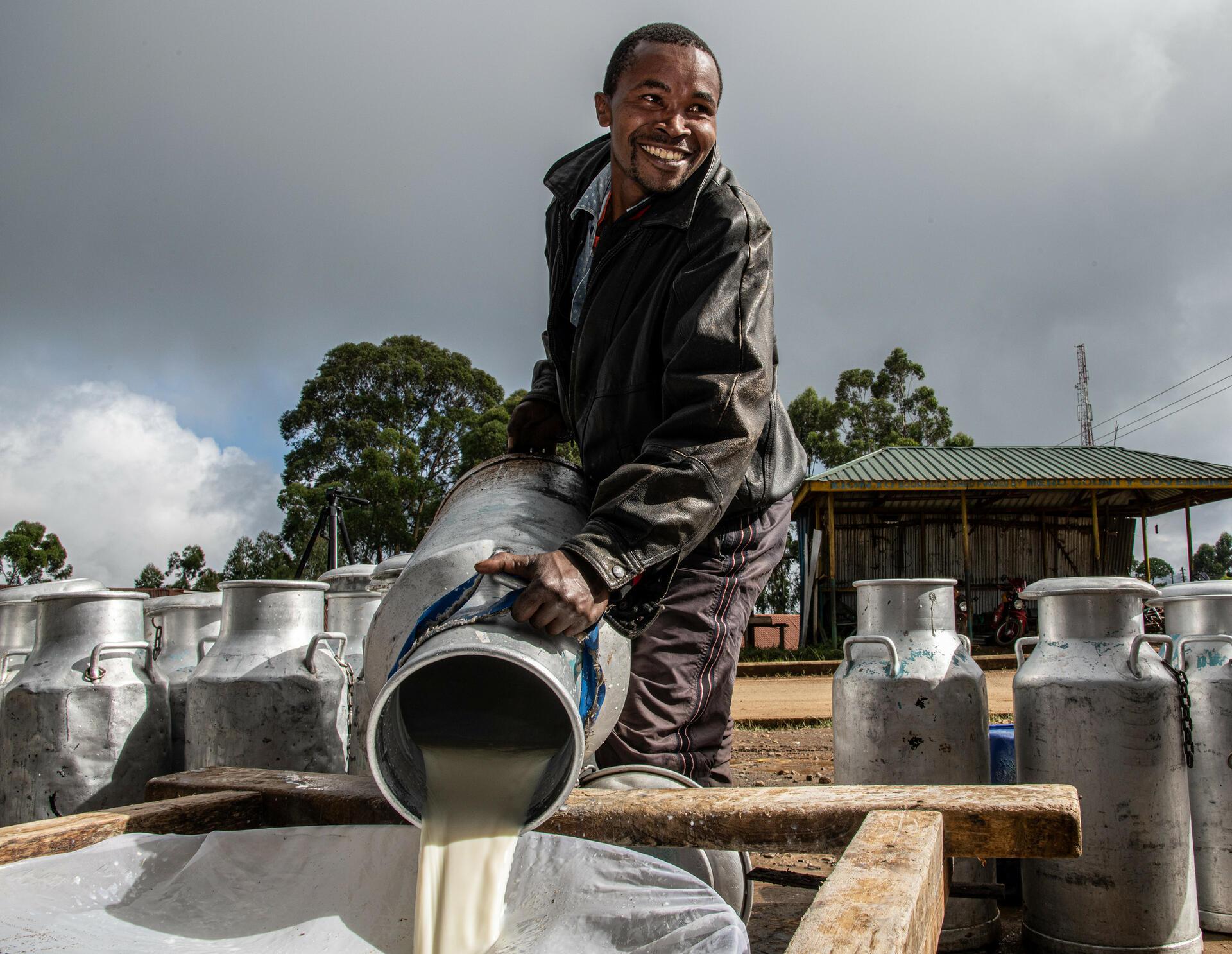
Milk is delivered, filtered and tested in Meru, Kenya, before being sent to the processor. The family is among those who have received training and new technology like the Brachiaria fodder grass varieties to improve milk yields. Credit: G. Smith / CIAT
The missing link: Climate finance
Despite strong evidence, less than 1% of global climate finance currently reaches the livestock sector.
Many climate-smart interventions require upfront investments that smallholders cannot afford. Climate finance can bridge this gap by reducing risk, improving access to capital, and rewarding environmental performance.
The report shows that carbon-linked income can increase returns on livestock investments by up to 1.7 times, improving profitability and access to credit. While carbon revenues alone are modest, they can play a catalytic role.
A practical financing toolkit with clear requirements
A range of financial instruments can support livestock transformation, but each comes with specific requirements. The main report outlines the financing landscape, while the annex provides a practical breakdown of what it takes to operationalize them.
Public climate funds
Mechanisms such as the Green Climate Fund (GCF) and the Global Environment Facility (GEF) are foundational.
They support policy reform, pilot programs, and capacity building. According to the annex, accessing these funds requires:
- Clear identification of mitigation practices (e.g., improved grazing, animal nutrition)
- A strong theory of change linking productivity to emission reductions
- Basic monitoring, reporting, and verification (MRV) systems
- Alignment with national climate strategies and NDCs
These instruments are essential for early-stage investment and risk reduction.
Carbon markets
Carbon markets provide performance-based payments for verified emission reductions. However, the annex highlights that these require more advanced systems, including:
- Robust baselines and proof of additionality
- Advanced MRV systems using models, field data, and remote sensing
- Aggregation mechanisms to include smallholders
- Clear land tenure and carbon rights
These technical and institutional requirements can be a barrier but they are also key to ensuring credibility and long-term impact.
Green and climate bonds
Green bonds can mobilize large-scale capital for livestock transformation, particularly at national or regional levels.
The annex emphasizes that successful bond issuance requires:
- Standardized impact metrics (e.g., emissions reduced, hectares restored)
- Strong reporting and verification systems
- Credible issuers and alignment with international standards
- Sufficient scale and predictable revenue streams
These instruments are powerful but typically out of reach for small, fragmented projects without aggregation.
Blended finance
Blended finance bridges public and private investment, reducing risk and attracting commercial capital.
While not detailed as a separate column in the annex, it connects closely to the requirements outlined – particularly the need for MRV systems, institutional coordination, and bankable project pipelines.
A key takeaway from both the report and annex is that finance alone is not enough. Technical readiness, governance, and data systems are equally critical.
Beyond emissions: Multiple benefits
Climate-smart livestock systems deliver far more than emission reductions.
They improve soil health, enhance biodiversity, strengthen resilience to drought, and increase farmer incomes. These co-benefits are essential for aligning climate action with development goals.
Emerging mechanisms such as payments for ecosystem services can further reward farmers for these contributions, expanding the scope of climate finance.
Building investment readiness
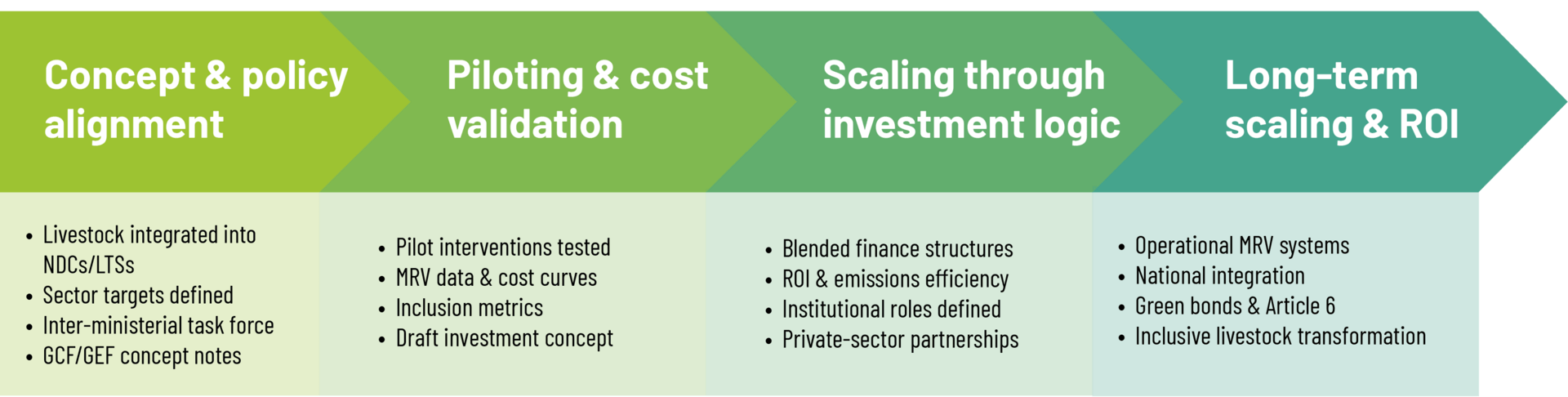
To unlock climate finance, countries must move from isolated projects to structured investment programs.
The report outlines a four-stage pathway:
1. Policy alignment: Integrating livestock into national climate strategies
2. Piloting and validation: Testing interventions and generating data
3. Investment design: Developing bankable, scalable projects
4. Scaling and sustainability: Institutionalizing systems and attracting investment
The report shows how this progression builds the capacity, data, and financial structures needed to attract investment. The annex complements this by detailing the technical, institutional, and financial conditions required at each stage – highlighting that readiness is not just about ideas, but about systems.
From challenge to opportunity
Livestock systems are often seen as a climate problem. But they are also a major opportunity.
With the right investments, they can deliver food security, economic growth, and climate mitigation simultaneously.
The path forward is clear:
- Strengthen monitoring and data systems
- Develop innovative and blended finance mechanisms
- Align policies with climate and development goals
- For many countries, the journey can start simply: plan, pilot, and scale.
Conclusion
Transforming livestock systems in the Global South is one of the most significant opportunities for climate and development action today.
The technologies exist. The benefits are proven. The frameworks are clear.
The annex makes one point especially clear: unlocking climate finance is not just about funding – it is about meeting the technical, institutional, and financial requirements that make investments credible and scalable.
What remains is to mobilize capital at the scale required.
If done right, climate finance can unlock a future where livestock systems are not only more productive, but also climate-smart, resilient, and inclusive – benefiting both people and the planet.
Acknowledgements: This study was financed by the Deutsche Gesellschaft für Internationale Zusammenarbeit (GIZ) GmbH on behalf of the German Federal Ministry for Economic Cooperation and Development (BMZ) within the framework of the LiveSys project (Catalysing Transformation Towards Sustainable Livestock Systems). Additional support was provided by the Low-Methane Forages project, funded by the Bezos Earth Fund and the Gates Foundation, as well as by the CGIAR Science Programs on Sustainable Animal and Aquatic Foods (SAAF) and Climate Action (ClimAct). We gratefully acknowledge all donors who support our work globally through their contributions to the CGIAR System. The views expressed in this study are those of the authors and do not necessarily reflect the views of GIZ, BMZ, or the other donors and supporting organizations.