Blog Selling to feed, adapting to survive: The key role of traditional markets in Senegal

When seasons become unpredictable, roads deteriorate, and food prices soar, food insecurity does not only appear in farmers’ fields. It is also felt in markets.
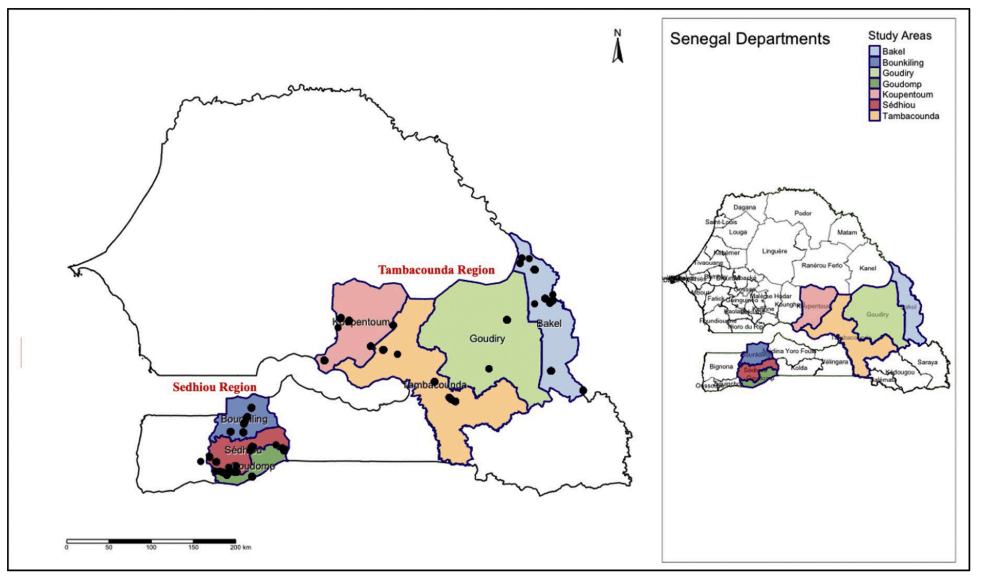
A study conducted by scientists from the Alliance of Bioversity International and CIAT - Cyrus Muriithi, Christine Kiria Chege, Issa Ouédraogo, and Caroline Mwongera - sheds light on an actor too often absent from food policies: market vendors. Based on an in-depth survey of 691 vendors in the regions of Sédhiou and Tambacounda, the research shows how product diversity, when supported by economic and structural capacities, contributes to the resilience of food systems in Senegal. It offers a fresh perspective on those who, every day, sustain access to food in the face of climate and economic crises.
At the heart of crises, markets keep supplying
In debates on food security in West Africa, agricultural production often takes center stage. Yet producing food does not automatically mean eating. For several years, research on food systems has emphasized that access, distribution, and market stability are just as decisive. In Senegal, this reality is particularly visible in the regions of Sédhiou and Tambacounda, where food insecurity remains structural and deeply rooted.
The study shows that more than eight out of ten households in these regions experience severe food insecurity. This situation is not only linked to agricultural yields but to a combination of factors well documented by research: climate variability, weak rural infrastructure, high transport costs, and the isolation of certain areas. In this context, traditional markets become essential spaces of regulation.
Each week, despite degraded roads or supply disruptions, markets continue to function. Vendors play a buffering role. They adjust volumes, split sales into smaller quantities, adapt prices, and maintain a minimum supply of basic products. These practices align with recent analyses that recognize informal markets as pillars of local food resilience, especially where public support systems are insufficient.
The study also shows that markets contribute to household dietary diversity, a key element of nutrition. In times of crisis, vendors are often the ones who maintain access to certain foods, even in small quantities. Without them, climate and economic shocks would have far more severe effects on populations.
Recognizing the role of markets therefore means changing perspective. The fight against hunger is not played out only in national agricultural policies, but also in these everyday spaces where economic constraints, adaptation strategies, and immediate food needs intersect.
Between opportunity and risk, everyday diversification
Dietary diversification is regularly presented as a key solution to crises. In international discourse, it is associated with improved nutrition, reduced risk, and greater resilience. Yet research increasingly shows that diversification is neither automatic nor equally accessible. The study conducted in Senegal sheds light on this gap by examining diversification not at the level of consumption, but at the level of market vendors’ activities, where food access is concretely mediated.
The results indicate that vendors offering a wider variety of products tend, on average, to display a greater capacity to adapt to shocks. In this context, diversification refers to market-level product diversity, rather than dietary diversity among consumers. For vendors, selling multiple products can serve as a risk management strategy: when one product becomes scarce, costly, or unsellable, another may compensate, helping to stabilize income and sustain food availability in local markets. This mechanism supports access to food but should not be conflated with dietary diversity itself, which remains widely recognized as beneficial for consumers’ nutrition.
However, the study also nuances this relationship. Once factors such as access to credit, availability of labor, training, or market type are taken into account, the direct effect of product diversity on adaptive capacity weakens or even disappears. This suggests that diversification is not the primary driver of resilience, but rather a reflection of underlying economic and structural capacities.
This finding aligns with broader livelihood research in West Africa, which shows that diversification is often a constrained strategy, more accessible to vendors who already possess a minimum level of resources. For those with limited capital, expanding product range entails higher investments, storage needs, and exposure to loss. In such cases, diversification can increase vulnerability rather than reduce it, particularly when shocks cannot be absorbed.
Resilience, therefore, does not stem from product variety alone. It is built through the economic, institutional, and infrastructural conditions that shape vendors’ capacity to adapt, and that ultimately determine whether diversification functions as a buffer or a burden.
Women, small businesses and accumulated vulnerabilities
The study reveals marked differences between types of vendors, as well as between women and men, and between rural and semi-urban areas. These differences reflect inequalities well documented in research on the informal economy and development.
Small retailers and vendors in open markets show the highest levels of adaptive capacity. They are more likely to have employees, to extend credit to customers, and to benefit from training. By contrast, mobile vendors accumulate constraints: low margins, high exposure to climate hazards, and dependence on failing infrastructure.
Women, who are the majority in markets, occupy a central place in food supply. Many studies have shown their key role in household food security. Yet they remain more limited in their access to formal credit, training, and support mechanisms. The study confirms that these inequalities hinder their ability to adapt sustainably.
Added to this are heavy structural constraints. Impassable roads, high transport costs, lack of storage facilities, and limited access to water and energy weigh on all market actors. These factors, widely documented in the literature on African food systems, remind us that individual resilience has its limits.
Strengthening market resilience therefore requires addressing these structural inequalities. Without investment in infrastructure and basic services, adaptive capacities will remain unevenly distributed.
From markets to public policy: The missing link
For several years, food policies have emphasized resilience, sustainability, and the transformation of food systems. Yet markets are often relegated to the background. The study calls for closing this blind spot, in line with the systemic approaches now widely promoted by research.
Strengthening food security does not simply mean encouraging product diversification. Above all, it means investing in the conditions that allow vendors to adapt: rural infrastructure, access to finance, training in management and nutrition, and recognition of the economic role of informal markets.
These recommendations align with current debates on food system transformation. Research increasingly shows that sustainable solutions emerge at the local level, where production, distribution, and consumption meet.
By repositioning vendors as central actors, this study goes beyond stating that food accessibility matters and shows why it matters. It demonstrates that the nutritional benefits of dietary diversity cannot be realized without addressing the market inequalities that shape who can sell, what can be sold, and under what conditions. Strengthening food-system resilience therefore requires targeted action on market structures, with women vendors and small-scale traders recognized and supported as key agents of change rather than peripheral actors.
To explore the analysis, methodology, and recommendations in more depth:
Consult the full scientific study published in Sustainable Futures
Keep exploring