
Blog Rethinking land optimization: Balancing nature, people and productivity

With the global population projected to reach around 8.5 million by 2050, the pressure on land is intensifying. Rising demand for food, energy, and urban space, coupled with global challenges such as food security, climate change, and industrialization, is pushing today’s landscapes to their limits.
Landscapes, therefore, must simultaneously produce food, conserve biodiversity, regulate water, store carbon, and sustain livelihoods, often within the same spatial footprint.
Multi-functionality of landscape offers a strategic approach to address these overlapping pressures, providing nature-based solutions that enable humans and ecosystems to coexist harmoniously. This is due to the fact that land itself is an integrator of those global challenges, allowing multiple objectives to be considered together rather than in isolation. Multifunctional Landscapes (MFLs) by definition embraced the coexistence of multiple, sometimes incommensurable functions, dynamic socio-ecological interactions, and diverse stakeholders with varying priorities. Trade-offs are a therefore an inevitable feature of MFLs: expanding agriculture may reduce habitat quality, protecting forests may limit short-term economic gains, and intensifying production may undermine soil health.
Hence, landscape multi-functionality should not be only understood as the existence of multiple functions but also by how trade-offs are identified, negotiated, and managed across space and time. Balancing these competing non commensurable adjectives and trade-off requires deliberate optimization of land use composition and configuration as well as the where, when and how about of land management interventions to enhance multi-functionality across productivity, biodiversity, and resilience. This process reconciling conflicting objectives under dynamic, spatially interconnected, and heterogeneous conditions, and subsequently guides land planners and policymakers by exposing unavoidable compromises while supporting balanced production, ecological restoration, and social equity. These realities indicate that landscape decisions cannot be grounded on presumed production and conservation objectives perse.
Instead, we argue that landscape decisions should begin with diagnosing of socio-ecological realities and explicitly navigating trade-offs to optimize multifunctional systems for both people and nature. This argument rest on three considerations.
- Presumed landscape optimization objectives lack grounded reality and risk ignoring real-world dysfunctions: This approach assumes that the desired outcomes are already known (e.g., forest cover target, a production quota, or conservation mandate ). And this prescriptive logic prioritizes targets over actual socio-ecological realities, turning optimization into an exercise of enforcing goals rather than exploring how landscapes can function effectively under real-world constraints.
- Trade-offs are inherent and must be made explicit: Multifunctional landscapes inherently involve balancing competing objectives. Pre-assumed targets can oversimplify these trade-offs, leading to suboptimal or unsustainable outcomes. Explicitly identifying and navigating trade-offs allows planners to select configurations that balance multiple functions, enhancing transparency, adaptability, and resilience in decision-making.
- Optimization of MFLs requires context-specific, evidence-driven objectives: Multi-objective optimization is effective only when objectives accurately reflect socio-economic and ecological realities rather than imposed assumptions/objectives. By deriving objectives and constraints from diagnosed socio-ecological conditions, the optimization process produces solutions that are feasible, relevant, and implementable in practice.
In sum, this prescriptive approach limits stakeholder engagement, negotiation, and learning, undermining MFLs principles. It ignores the plurality of desirable outcomes, forcing stakeholders toward one assumed optimal configuration instead of revealing multiple viable options. Moreover, fixed goals fail to adapt to dynamic socio-ecological realities, violating the principle of temporal adaptability.
So how do we move beyond presumed objective-based landscape optimization? How do we diagnose the landscape to define the objectives and constraints against which multi-functionality should be optimized? A through diagnosis and a clear understanding of where interventions are most needed, what trade-offs exist, and which objectives and constraints should guide effective multi-functional land scape optimization. This can be done by:
-
Identify ecosystem service shortfalls: Map where key ecosystem services (eg., food production, water regulation, or biodiversity), are insufficient relative to societal or ecological demand. Persistent gaps indicate areas where interventions are most needed, and this shortfall could be taken as objective function for which we should optimize the landscape composition and configuration.
-
Analyze trade-offs and synergies: Understand how different land uses and management options interact. For example, intensifying agriculture may reduce habitat quality, while conservation efforts may limit short-term economic gains. Making these trade-offs explicit helps identify where compromises or balanced solutions are possible.
-
Tracking functional trends: Examine changes in land-use intensity, pattern, and spatial configuration over time. This helps reveal imbalances between development pressures and environmental objectives and highlights areas where ecosystems or human well-being are under stress.
-
Engaging stakeholders: gathering local knowledge on goals, values, and priorities ensures that interventions reflect both societal needs and ecological realities, making decisions more relevant and implementable.
By combining these approaches, diagnosis produces a spatially explicit picture of socio-ecological dysfunctions, highlights critical trade-offs, and identifies priorities that can guide evidence-driven, context-specific interventions. This foundation ensures that subsequent decisions and optimization objectives and constraints are grounded in observable realities rather than assumed objectives.
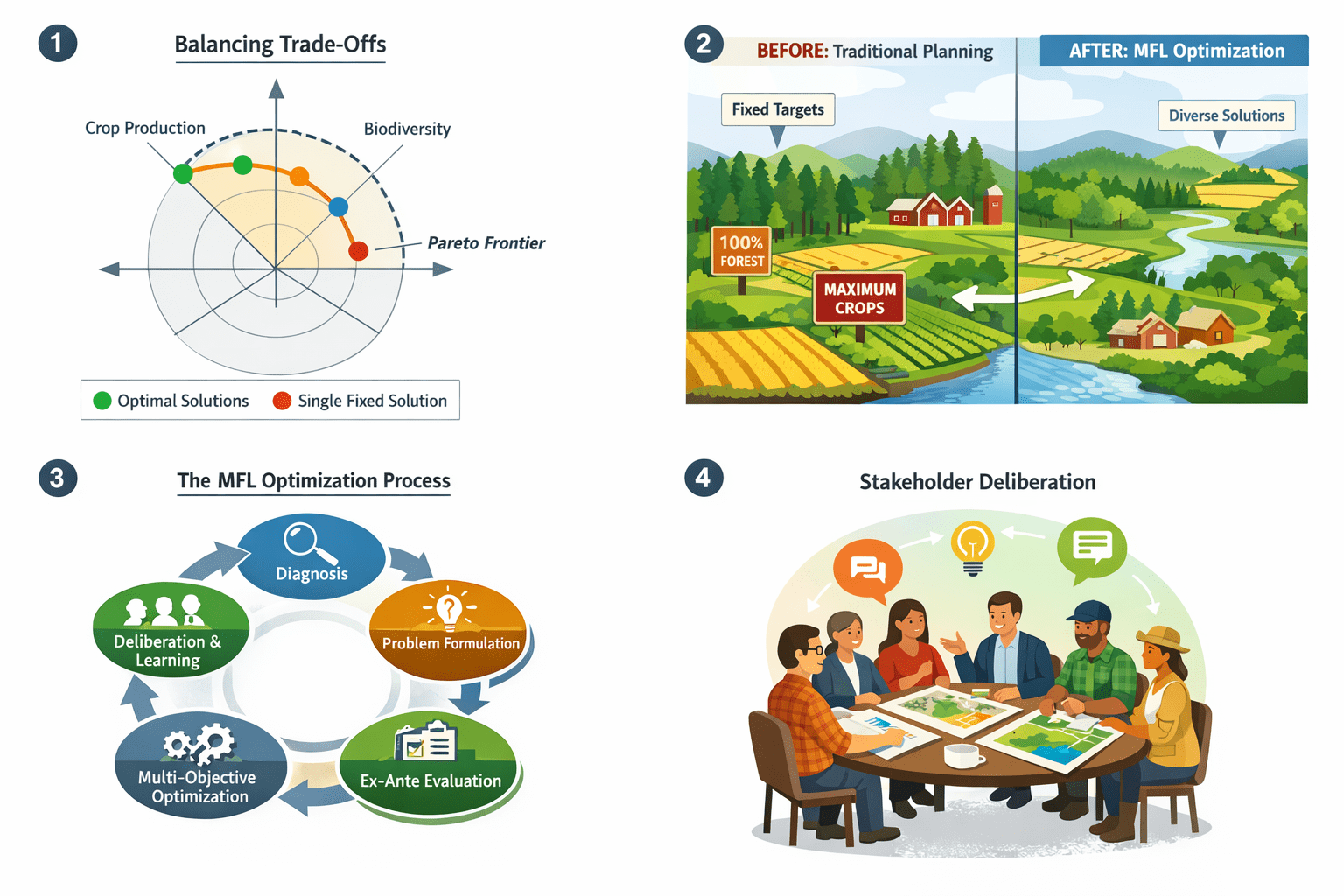
Figure 1| Steps in optimizing Multifunctional Landscapes (MFLs) – from diagnosis to stakeholder-driven solutions.
Why does this matter?
A shift from presumed landscape optimization objectives to diagnosis and trade-off’s explicit objective and constraint definition against which we are optimizing enhances transparency, adaptability, and legitimacy. This is because landscapes are dynamic: climate variability, market shifts, demographic change, and policy evolution continuously reshape pressures and opportunities. An evidence-driven, trade-off-aware framework enables decisions that are not only efficient in the short term, but resilient over the long term. Moreover, balancing nature, people, and productivity is not about prescribing and/or imposing production and conservation objectives. It is about systematically revealing the consequences of different choices and enabling informed, context-specific decisions. Figure 1 shows how optimizing multifunctional landscapes goes beyond presumed targets. This integrated view shows how diagnosing real-world dysfunctions, explicitly navigating trade-offs, and engaging stakeholders collaboratively can produce diverse, context-specific solutions that balance productivity, ecological integrity, and societal benefits.