Blog Leveraging CSA Multi-Stakeholder Platforms for Sustainable Investment and Action: Lessons from Eastern and Southern Africa

The Alliance - through the Accelerating Impacts of CGIAR Climate Research for Africa (AICCRA) project, and with support from the International Water Management Institute (IWMI) - convened a three-day regional workshop in Lusaka, Zambia in August 2024. The workshop brought together various stakeholders in the climate-smart agriculture space to share knowledge and experiences and co-create actionable recommendations to foster multi-stakeholder collaboration that could steer investment decisions on CSA.
By: Yodit Yaregal Seyoum, Lidya Tesfaye, Dorcas Jalango, Brook Makonnen
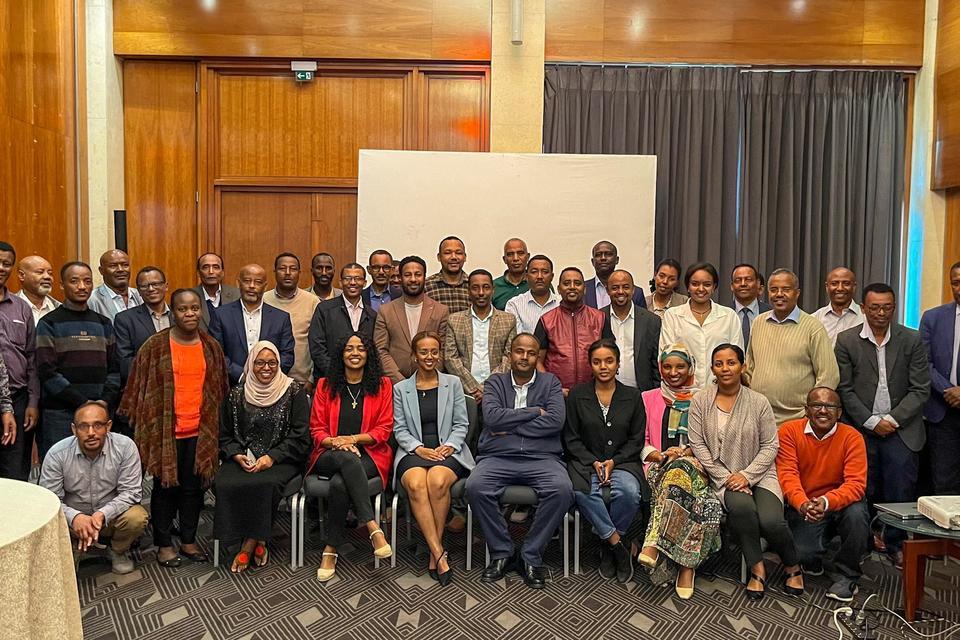
Participants included representatives from government ministries, private sector organizations, and research institutions from Zambia, Ethiopia, and Kenya. Additionally, delegates from various continental and regional institutions were present, including the African Union Commission (AUC), the Association for Strengthening Agricultural Research in Eastern and Central Africa (ASARECA), the Centre for Coordination of Agricultural Research and Development for Southern Africa (CCARDESA), the Southern African Development Community (SADC), the Forum for Agricultural Research in Africa (FARA), and the Intergovernmental Authority on Development (IGAD).
The workshop opened with welcoming remarks from Emely Mwale (Alliance Country Representative) and John Recha from AICCRA's East and Southern Africa Cluster who have highlighted the role, structure and programs of the Alliance and AICCRA in Africa as well as setting the objectives of the workshop.
An official opening speech was delivered by Dr. Chizumba Shepande from Zambia’s Ministry of Agriculture, who reflected on the harsh realities of climate change and the proactive steps taken by Ethiopia, Kenya and Zambia. Further, he reinforced the need for a collaborative approach to address the challenges.
“This workshop provides a timely opportunity for us to come together to share our experiences, promote multi-stakeholder collaboration to find innovative solutions, and engage in policy dialogues to create the enabling environment for CSA investments. These objectives align perfectly with Zambia's Ministry of Agriculture’s priorities, and we are committed to actively engaging in this workshop, contributing to the series of discussions and outcomes.”

Dr. Chizumba Shepande : Director of Agriculture at the Ministry of Agriculture in Zambia
Navigating Climate-Smart Agriculture Investments in East and Southern Africa
An overview of the national CSA Investmet Plans in Kenya, Ethiopia and Zambia pointed out to the role of CSA as key strategy to achieve country-specific climate action goals through scientifically vetted prioritized investment areas. It also highlighted its impact on enhancing household well-being through increased agricultural productivity and yield, suggesting stronger stakeholder collaboration in its implementation. Key lessons from successful case studies of CSA investment activities from the three countries included:
- Domestication of policies aimed at institutionalizing CSA, with national governments playing a significant role
- Enhancing coordination of national and county level governments
- Inclusive voluntary participation and incentivization projects
- Linkage of farmers research and extension practitioners
- Mobilization of finance for identified CSA investment priorities
Discussions from the event's plenary session also highlighted gaps in identifying local investment options, financing for adaptation and access to markets for CSA products.
Challenges in accessing climate finance and navigating climate finance complexities were also mentioned. Some of the innovative approaches for CSA finance recommended included:
- Decentralized models like Kenya's Financing Locally Led Climate Action (FLLoCA) program
- Creating enabling environments through national policies such as the climate acts and sectoral action plans for climate change fundraising
- Cross-sectoral approach to CSA financing
- Enhancing public-private partnerships
- Market and infrastructure development
- Business-case creation
- Capacity building
- De-risking mechanisms for greater investment to lower interest rates
- Meeting the Malabo commitment as a prerequisite for accessing climate finance

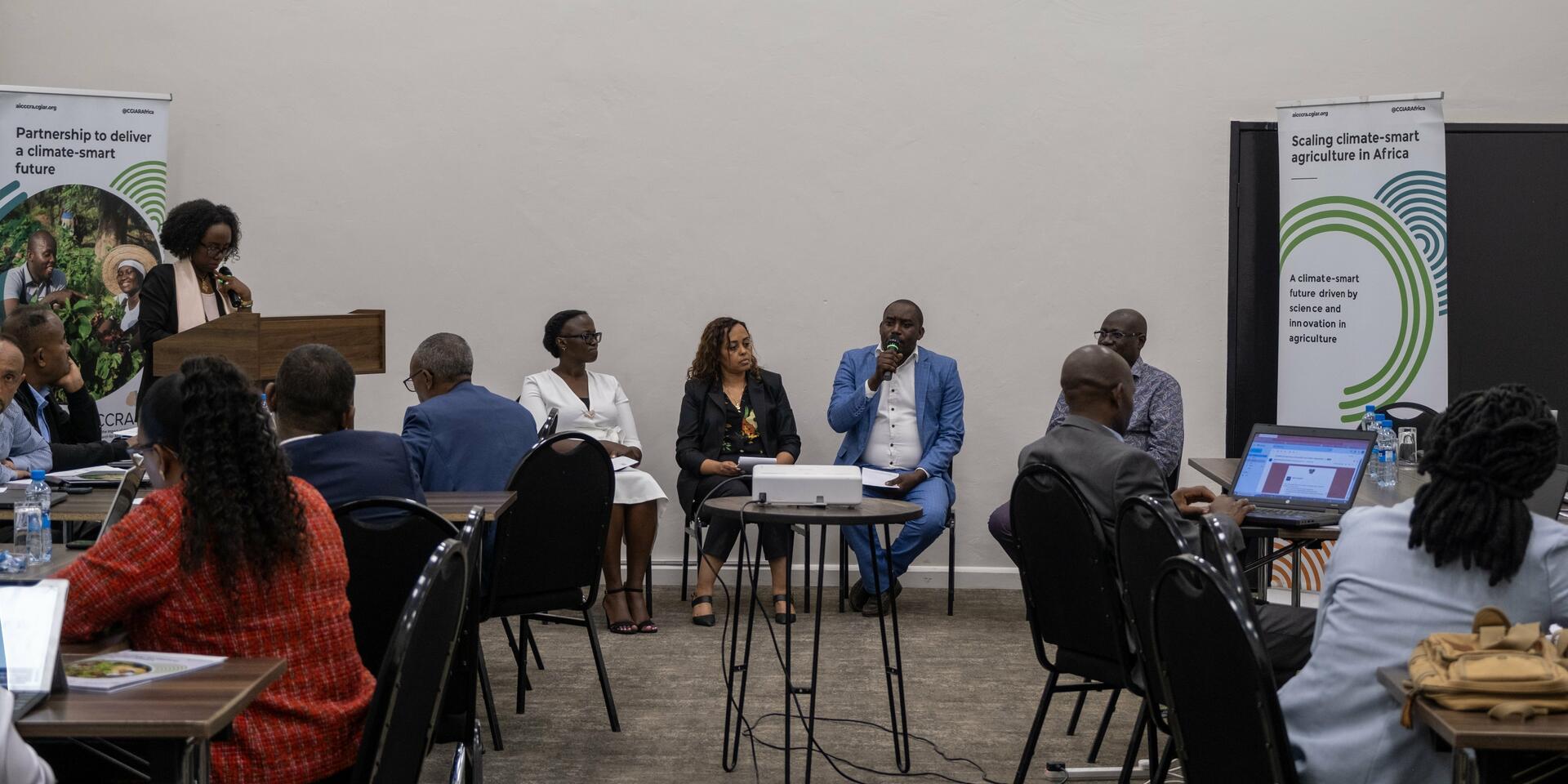
Panel discussion on Innovative financial models and mechanisms for CSA interventions
Enhancing Multistakeholder Collaboration for CSA
Regional CSA multi-Stakeholder platforms in East and Southern Africa presented their programs, projects, and initiatives. Presenters included ASARECA, CCARDESA, SADC, FARA, IGAD, and AUC. The role of knowledge and information hubs such as Comprehensive Africa Agriculture Development Program ex Pillar 4 (CAADP-XP4), commercialization of CSA technologies, harmonization of climate change policies and actions, creating strategic alliances and the prioritization of food systems resilience programs were highlighted.
Presentations from national multi-stakeholder forums - that is Kenya CSA Multi-Stakeholder Platform, Ethiopia National CSA Multi-Stakeholder Forum, and Zambia CSA Alliance - provided an overview of governance, membership, resource mobilization and knowledge sharing strategies. Government leadership emerged as a key strength, while addressing membership management, commitment and awareness about CSA among stakeholders was highlighted as critical. There is also a need to continue building human and institutional capacity, continental mapping of CSA initiatives across the regions leveraging monitoring and reporting platforms like the Biennial Africa CSA Stakeholder conference and the Kampala Process, CSA value chain enhancement through demand-driven, adaptive research, and establishing regional CSA communities of practice.
Strategic Advocacy for CSA Investments
On the last day, participants delved into activities that focused on strengthening policy advocacy, communication and outreach strategies aimed at creating an enabling environment for CSA investments. In line with those objectives, participants learned about the current policy landscape in Kenya, Ethiopia and Zambia as well as best practices for policy advocacy and strategic communication were shared.
Key lessons included:
-
MSPs role in devolving CSA initiatives and investments from global to sub-national levels and providing advocacy mechanisms from local to international frameworks
-
The role of a homegrown economic agenda in driving the reform to mainstreaming CSA practices
-
Integrating CSA into high school curriculums
-
Research-based tailored approaches to identify gaps and action-oriented advocacy
Reflection and Next steps
Over the three days, participants from Kenya, Ethiopia, and Zambia engaged in dynamic discussions, showcased successful examples of CSA investment planning, and explored ways to promote stronger partnerships and collaborative frameworks to scale up and cascade down the implementation of prioritized CSA initiatives. The workshop also provided a platform for policy dialogue, focusing on creating supportive policy environments and innovative financing mechanisms to support long-term CSA investments.
The workshop was wrapped up by representatives from Kenya, Ethiopia and Zambia, and the respective regional partners engaged in a fruitful co-creation process. This process helped in identifying critical gaps and challenges that hindered effective coordination, resource mobilization and CSA investment plan implementation, followed by the development of a strategic action plan to address these issues.

Co-creation session on CSA investment plan implementation
Participant reflections from the workshop:
Morton Mwanza, Ministry of Agriculture Zambia – Zambia CSA Alliance:
“The engagement was very significant as it informed me on the advances made in advancing CSA from both public sectors, CSO (CSAAZ) and the private sector. It highlighted the challenges, bottlenecks and opportunities in the implementation of CSA in Zambia. It also offered a learning platform to discover what other countries are doing to advance CSA.”
Meron Buta, Deputy Managing Director at MaKoBu Enterprises of Ethiopia:
“The private sector can play a significant role in supporting and financing part of CSA capacity-building efforts. It can also contribute to CSA adoption strategies by providing training for development agents and smallholder farmers, supplying improved seeds and high-quality yield boosting products, offering farming equipment, and providing risk mitigation methods such as insurance or agro-advisory services.”
Lidya Kimani, Agribusiness for African Markets-AfAM – Kenya CSA MSP:
“The engagement in Zambia was insightful because it provided a platform to share lessons and understand what works concerning the CSAIP and what could work better. It was encouraging to learn that the CSA-MSP in Kenya had inspired the setup of the CSA-MSP in Ethiopia: this is an opportunity for mentorship, helping to strengthen the CSA-MSP in Kenya.”
Addisu Negash, Ministry of Agriculture Ethiopia – Ethiopia CSA Forum:
“For effective implementation of CSA it is crucial to develop robust coordination and collaboration, the exchange of ideas and partnerships, which in turn address climate targets and Sustainable Development Goals (SDGs).”