From the Field Hunting the witch: A scientific expedition in French Guiana

In 2024, three researchers from the Alliance of Bioversity International and CIAT arrived in French Guiana following a warning sign: witches' broom, a devastating cassava disease, may have crossed the ocean. This is the story of the expedition to hunt down the witches' broom.
For a long time, witches were figures of superstition, caught between popular fear and imagination. Some people swore they had seen them, but they almost always lived on in distorted accounts and fanciful tales.
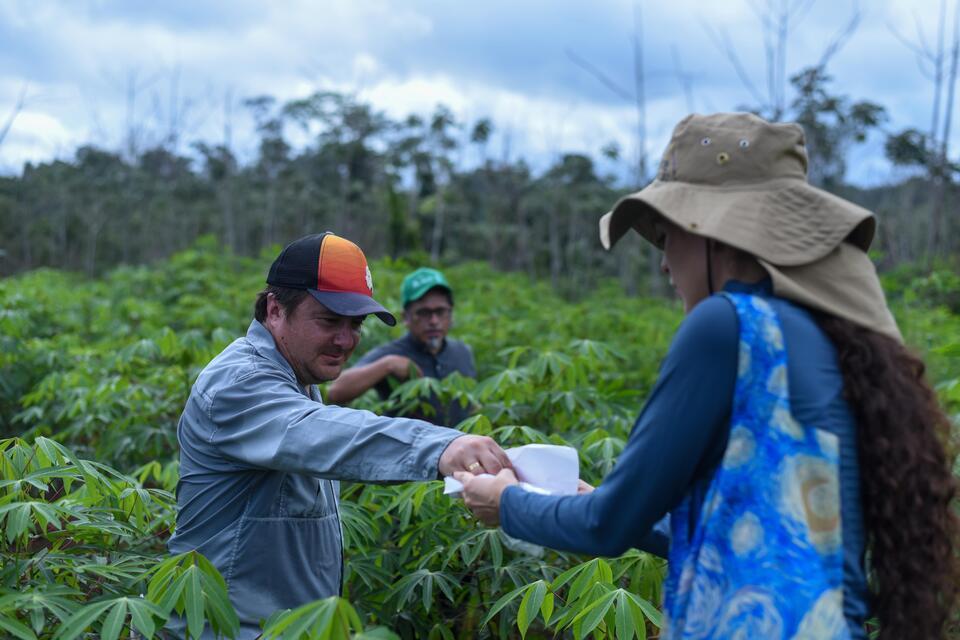
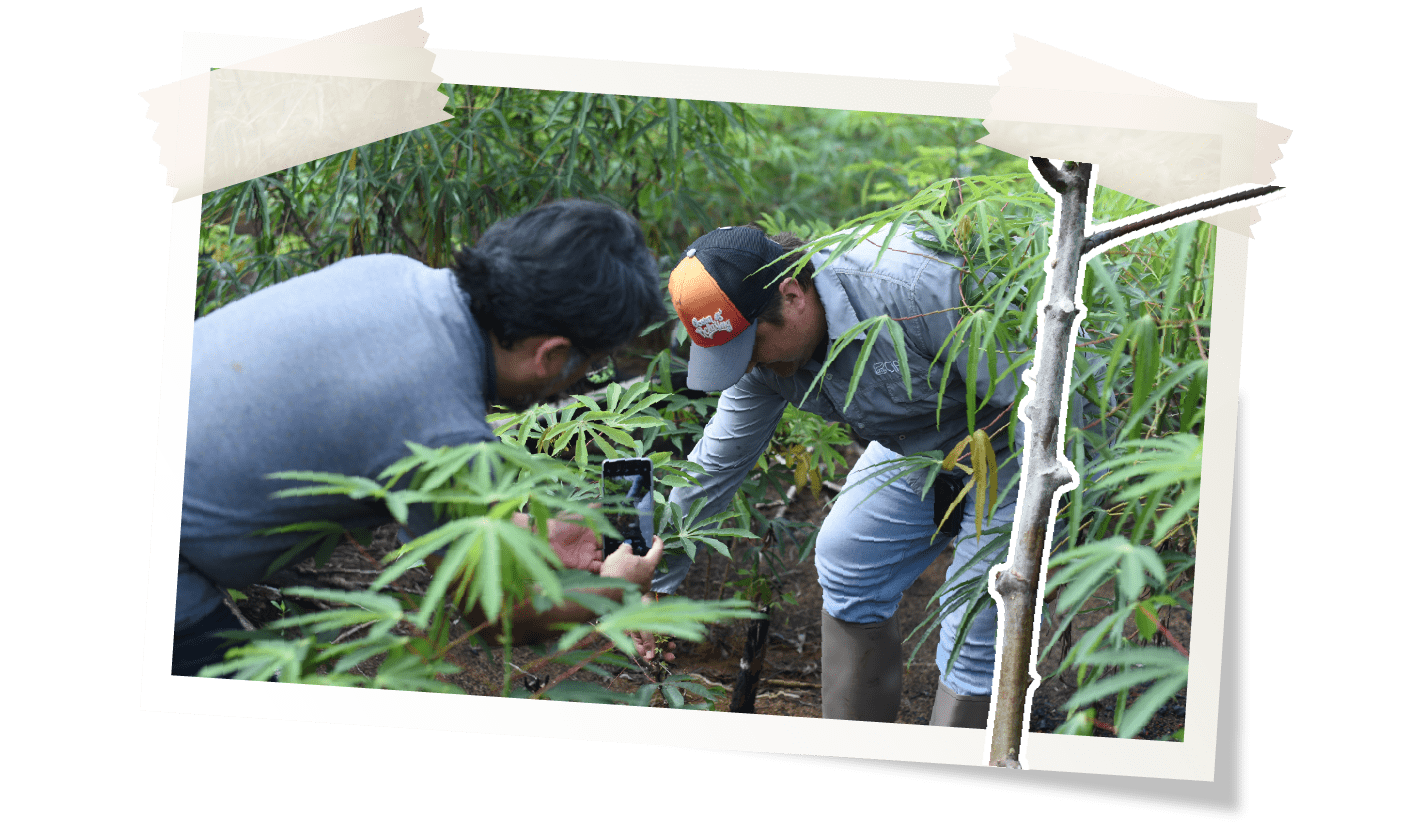
However, when Juan Manuel Pardo, still without getting out of the car and from the passenger seat, looked at the cassava plants in the distance, he did not hesitate: "I'm absolutely sure it's a witch's broom," he said with the certainty of an experienced hunter. Thus began the expedition to hunt the witch for the first time in South America, in the remote fields of French Guiana.
Day 1: How do you hunt a witch in the 21st century?
In 2023, cassava farmers in remote areas of French Guiana watched their crops wither. They pulled decayed stalks out of the ground and, instead of finding large bunches of cassava, they found barely carrot-sized roots. Local agencies (FREDON in French Guiana and Rurap in Brazil) reported the extent of the problem to the official agricultural research agencies working in the region, and, in 2024, researchers from the Alliance undertook a scientific expedition to answer a single question: had the witch hazel arrived on the continent?
The journey from Colombia to French Guiana was long and exhausting: 27 hours, four flights and three countries. The tropical, humid climate was felt on the skin, seeping into the pores and forming a second layer: sticky, dense, as if the jungle, which makes up 80% of the country, clung to the body. Although geographically part of South America, Guyana is an overseas territory of France bordering the Brazilian Amazon and Suriname. It is not surprising that the witch has decided to hide there, in the last corner of the continent.
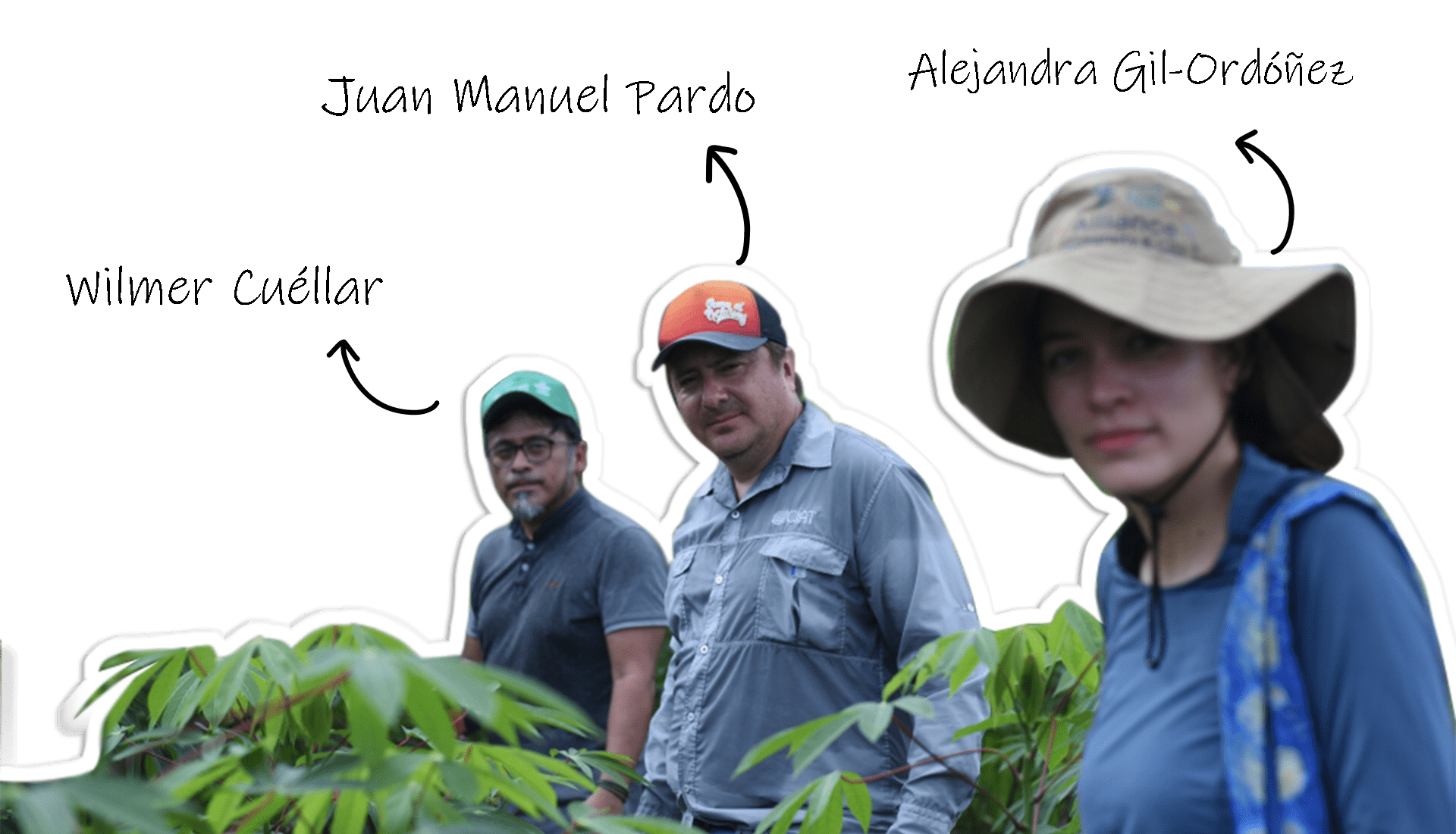
At 4 a.m., FREDON colleagues, along with the Alliance team, were already on their feet. Juan Manuel Pardo, Alejandra Gil-Ordóñez and Wilmer Cuéllar put on their boots and, with the pressure of the clock, set out to hunt witches in the field. They had just four days to do it all: collect samples, analyze them, present their findings, and return.
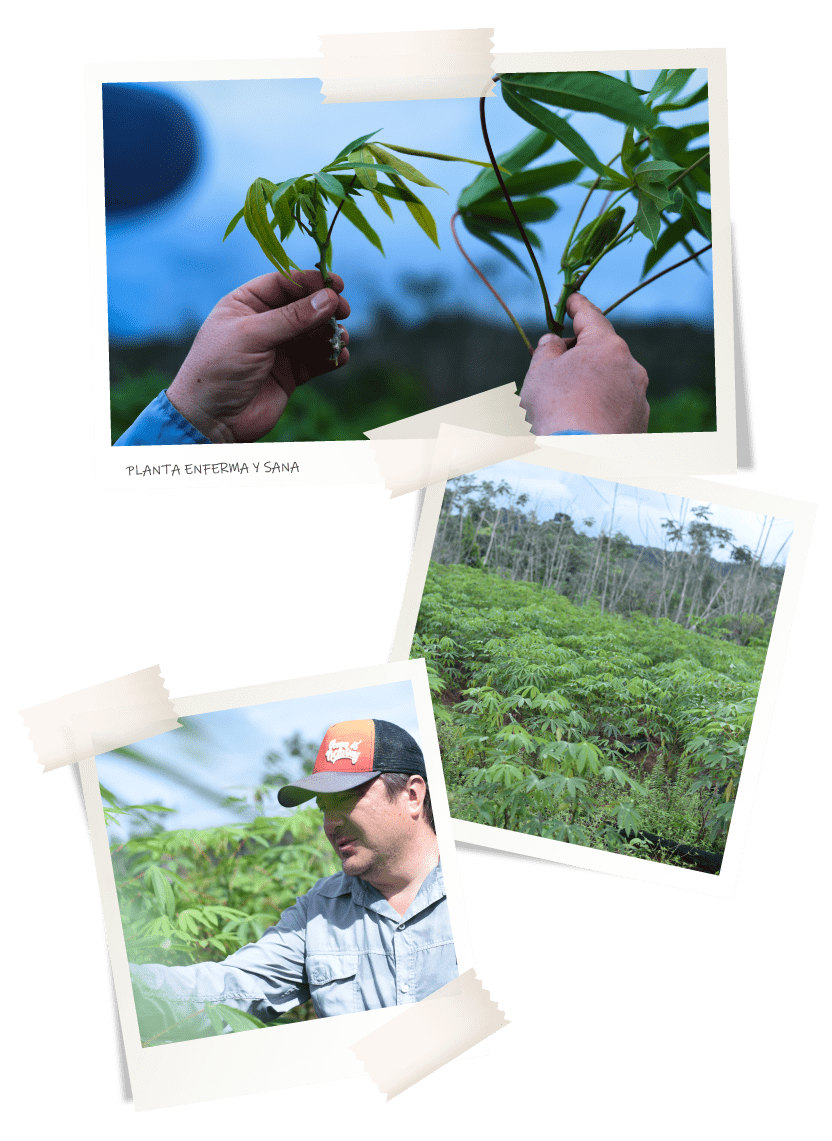
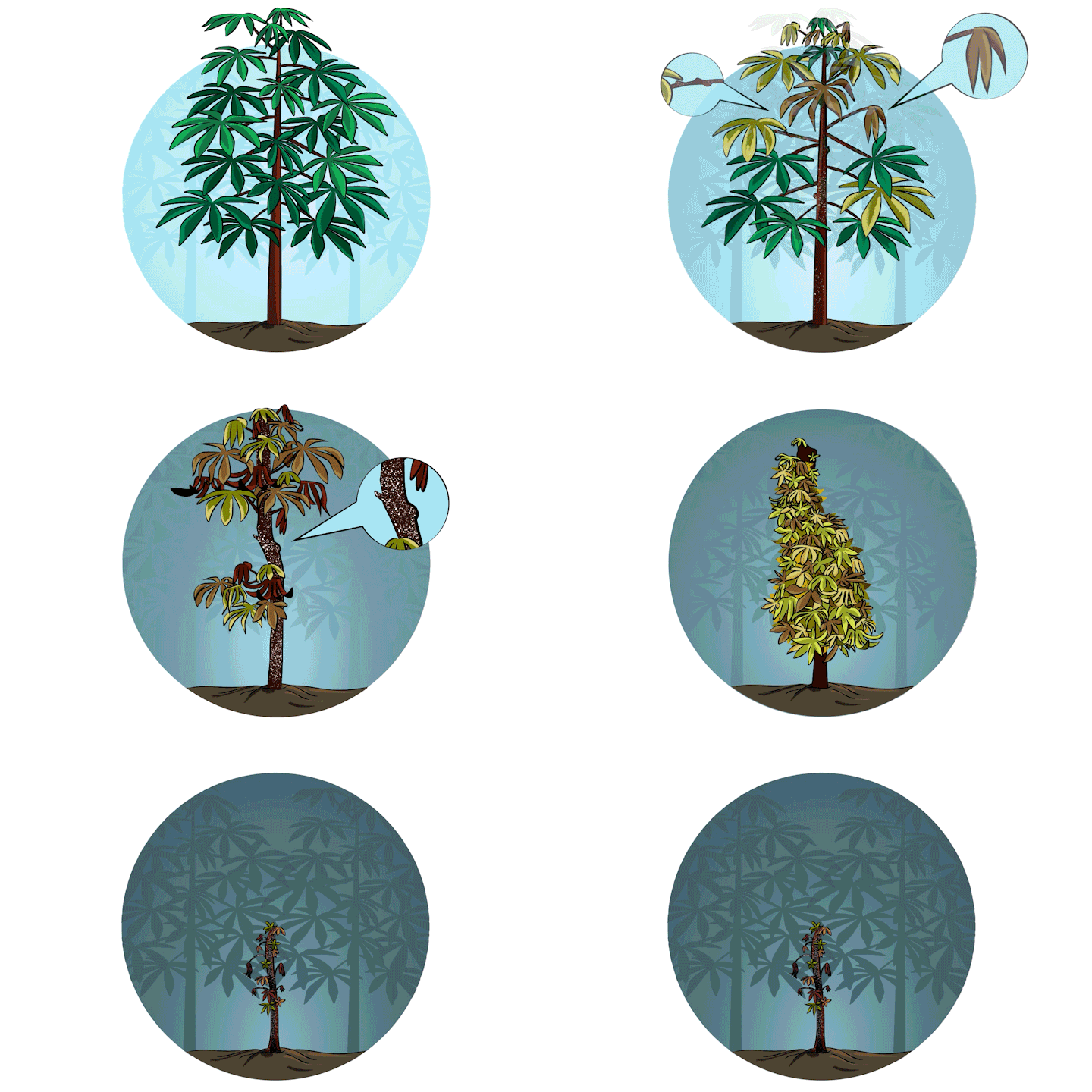
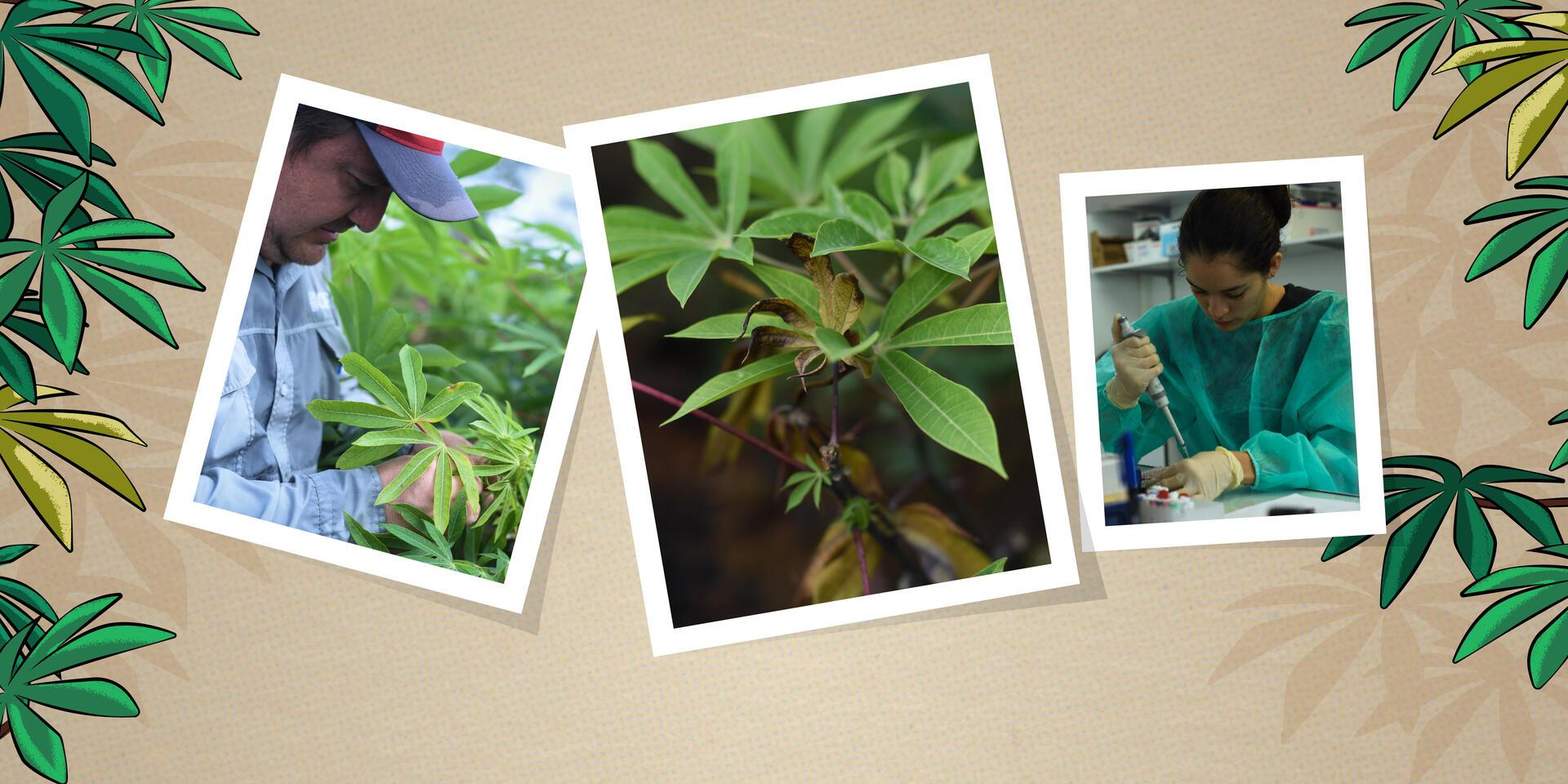
Plants with different degrees of witches' broom disease.
Design created by Ximena Hiles / Alliance Bioversity & CIAT
When they reached the field after a four-hour drive, the sun was already at its peak. A cassava crop that, at first glance, seemed normal, was transformed into a frantic hunt.
They had traveled enough fields in Asia, where the disease was first identified in 2008, to identify the witches' broom by its appearance: the way the plants are deformed, their abnormal growth, the dwarf branches that look like brooms... Since early 2020, the crop protection team of the Alliance, together with international partners, has been working on the identification and management of witches' broom in Southeast Asia. In 2022, Wilmer moved for four months to Southeast Asia, where he was able to understand the problem better and from where he led the team that, thanks to a mix of classical plant pathology and modern DNA sequencing, managed to elucidate one of its many mysteries: the true culprit was a fungus with a proper name: Ceratobasidium theobromae.
Yet the researchers swept the field from start to finish, collecting random samples from plants in French Guiana. "This is the first time I've seen this symptom in this part of the world," said Juan Manuel Pardo, a microbiologist and plant pathologist on the team. He has been trying to understand witches' broom for more than a decade, a pursuit that also took him first to Southeast Asia, where in countries such as Laos, Cambodia, Vietnam, and Thailand the disease has reached incidences of up to 90% in some regions, severely affecting cassava production.
Day 2: The witch's DNA
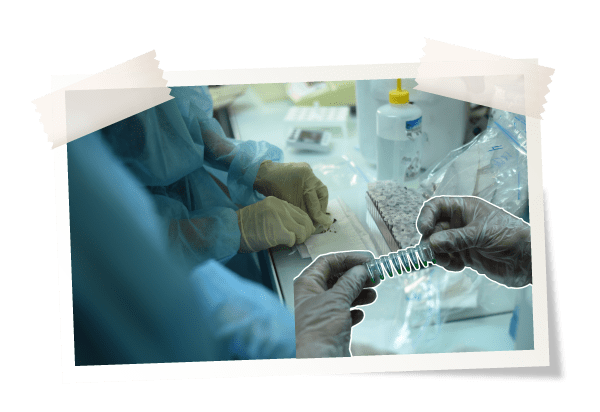
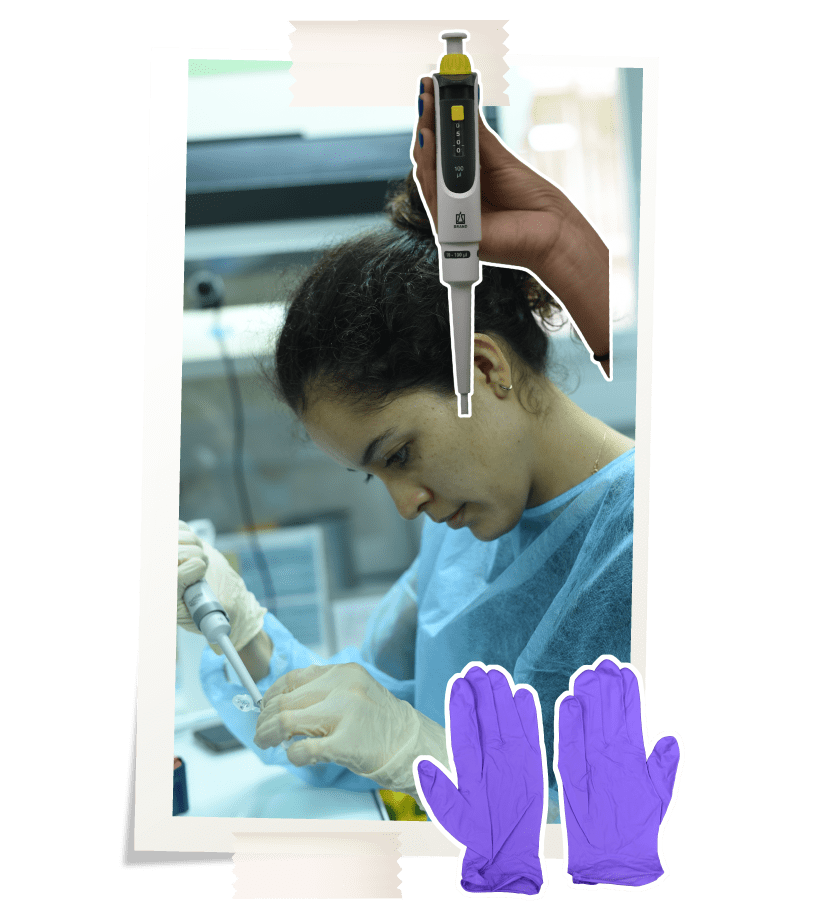
The light blue, thin, translucent robe covered them like a second layer of clothing. Gloves on, absolute concentration: a silent, microscopic battle to unmask the witch. As they made sure they had everything in order to reveal the witch's DNA, they realized that something essential was missing: liquid nitrogen. They had everything else: the field samples, the protocol with every step of the procedure, the excitement. Everything but that. Without nitrogen, you couldn't freeze the tissue, you couldn't grind it, you couldn't extract the DNA. Nothing could move forward.
For a moment, the entire mission was put on hold. If they didn't get it in time, the expedition —days of travel, effort, and planning— could fall apart. They reorganized tasks. They reviewed protocols. They waited.
When it finally arrived, boiling cold, covered in white vapor, the journey began. "Liquid nitrogen is like frying in reverse," someone said. It doesn't heat, but it freezes so fast and so violently that it burns. At -196 °C, it stops everything: enzyme activity, cellular decomposition, DNA degradation....
The scene was almost surgical. Alejandra Gil, researcher and bioinformatician, was at the helm of the procedure. Precise, methodical. Juan Manuel was assisting her, and together, they hummed a song that broke the technical silence of the place. From the back, Wilmer watched like a doctor behind the scenes, making sure that the protocol designed in Southeast Asia was followed to the letter.
Samples taken in the field the day before were frozen with liquid nitrogen and then crushed into a fine powder. From there, the real extraction began: breaking cells and releasing the DNA. The process, repeated for all samples, had to be fast, before the liquid nitrogen evaporates.
After six long hours, the DNA had finally been extracted. It was the turn of PCR (polymerase chain reaction), a technique that allows a tiny fragment of genetic material to be copied millions of times. Thus, the invisible becomes visible. If the witch were there, hidden among the genes, PCR would force her into the light.
Day 3: The moment of truth
The humidity of Cayenne, the capital of Guyana, was relentless. And it wasn't just the weather that was making the team of researchers sweat: now it was the anxiety to know the result. They had been working at their limit for two days.
The day was progressing at a surgical pace. Between tubes, micropipettes, and reagents, the emotional charge of the moment could be felt. At that point in the trip, physical fatigue was evident, but the concentration was still intact.
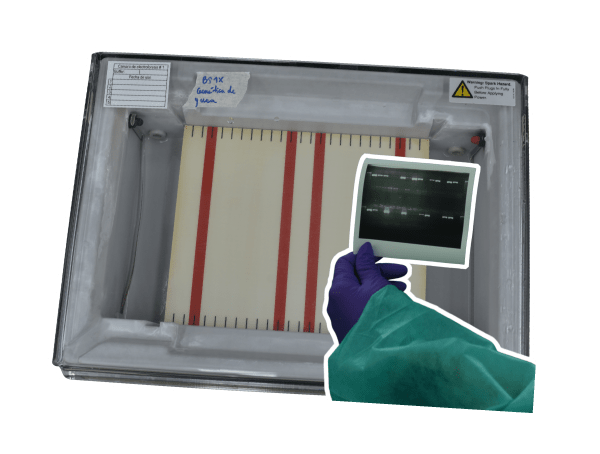
The most intense moment came with the electrophoresis of the diagnostic PCR products, a technique that allows to know if the extracted DNA belongs to the same pathogen found in Southeast Asia.
For that, the team had designed a molecular key: a specific sequence that only serves to open a very particular door, that of Ceratobasidium theobromae DNA. It's like trying to open a door with a custom-made key. Each organism has its own, and the diagnosis is the attempt to open it. If the key is the right one, the door opens. And a band appears.
Several bands can be seen in the gel. But if one of them emerges just in the expected position, it means that the key worked. That the witch's DNA is in the sample.
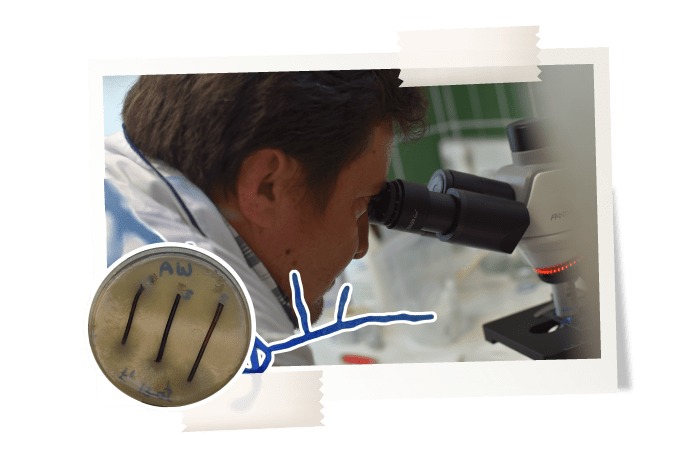
And that's what happened. A precise, sharp signal, in precisely the right place. It still needed to be seen under the microscope, sequenced completely. But something had changed.
The witch was no longer a suspicion or a myth. She was a presence, a reality.
Day 4: Has the witch crossed the ocean?
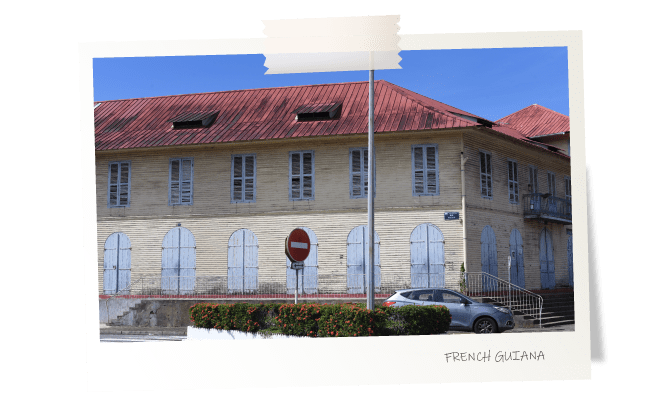
For researcher Juan Manuel, Cayenne is strikingly and suspiciously similar to Vietnam. Not only because of its low, one- or two-story buildings with sloping copper-brown sheet-metal roofs, but because the same menace inhabits both places: the witch.
The roofs aren't just aesthetics: they're designed to withstand heavy rains, dense heat, and constant humidity. "It's the perfect climate for the disease," Juan Manuel had commented on the first day in the field. Everything seemed to conspire in favor of the pathogen. A coincidence that sounded like a warning from the beginning.
Team
Related Content