Blog Agrovoltaics in Colombia: producing food and clean energy in the same territory
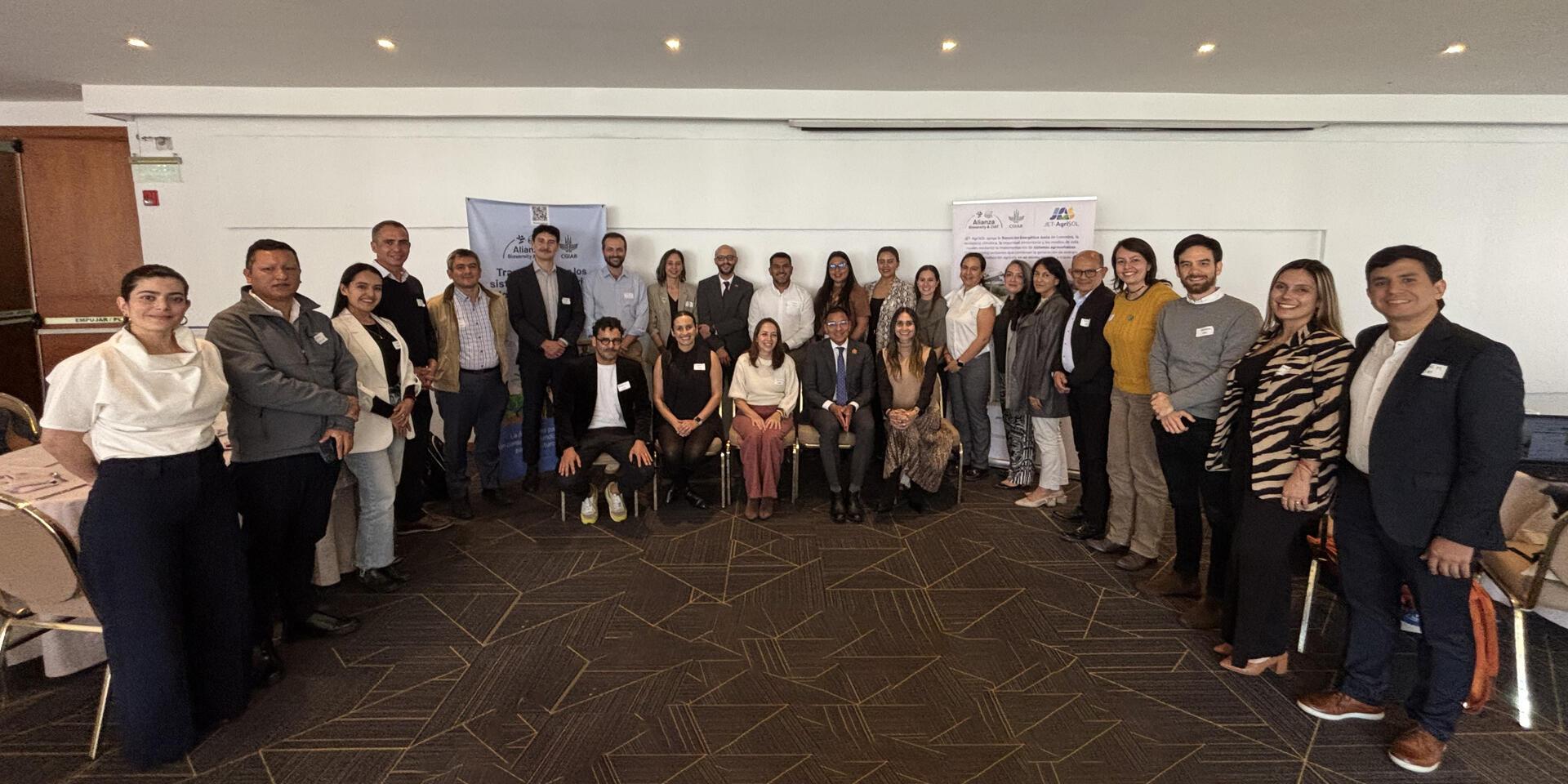

On 14 May in Bogotá, the Alliance Bioversity & CIAT launched JET-AgriSOL, a German-supported initiative to boost agrovoltaics in Colombia and bring together food security, clean energy and rural development.
The energy transition often brings to mind rooftops covered with solar panels or solar farms stretching across vast areas of land. But in Colombia, where land use is marked by longstanding tensions between agricultural production, conservation, access to land, and rural development, the conversation is more complex. The question is not only how to generate more renewable energy, but how to do so without displacing food production, increasing pressure on land or excluding the rural communities that most need new opportunities.
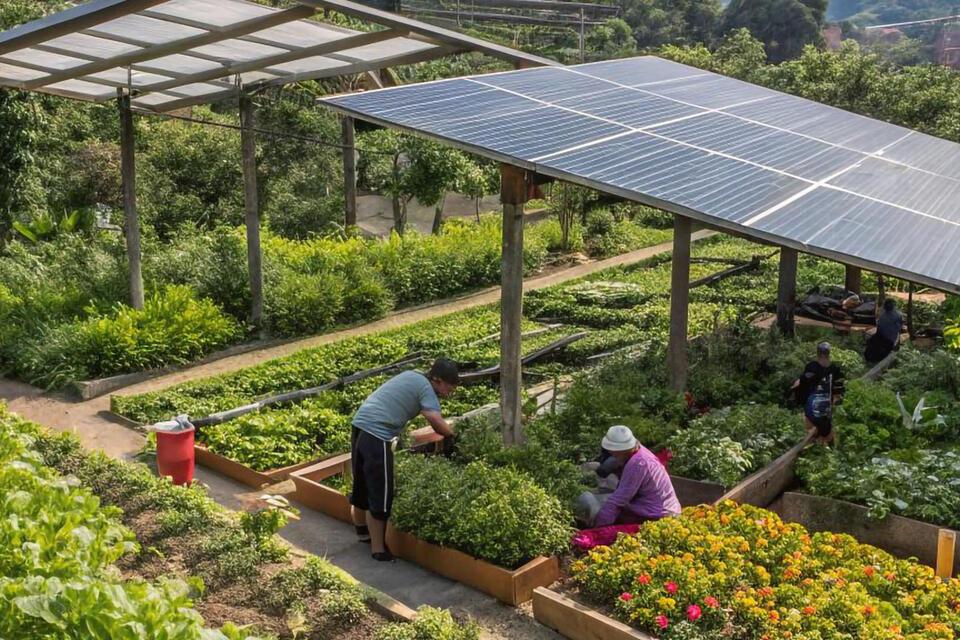
That question was at the heart of the official launch of JET-AgriSOL, a project led by the Alliance of Bioversity International and CIAT with support from the German Federal Government. The project aims to introduce agrivoltaic systems and adapt them to the Colombian context. It is funded by Germany’s Federal Ministry for the Environment, Climate Action, Nature Conservation, and Nuclear Safety (BMUKN) through the International Climate Initiative (IKI), with Colombia’s Ministry of Environment and Sustainable Development serving as its political partner. The initiative is built on an idea as simple as it is transformative: producing food and generating solar energy on the same land.
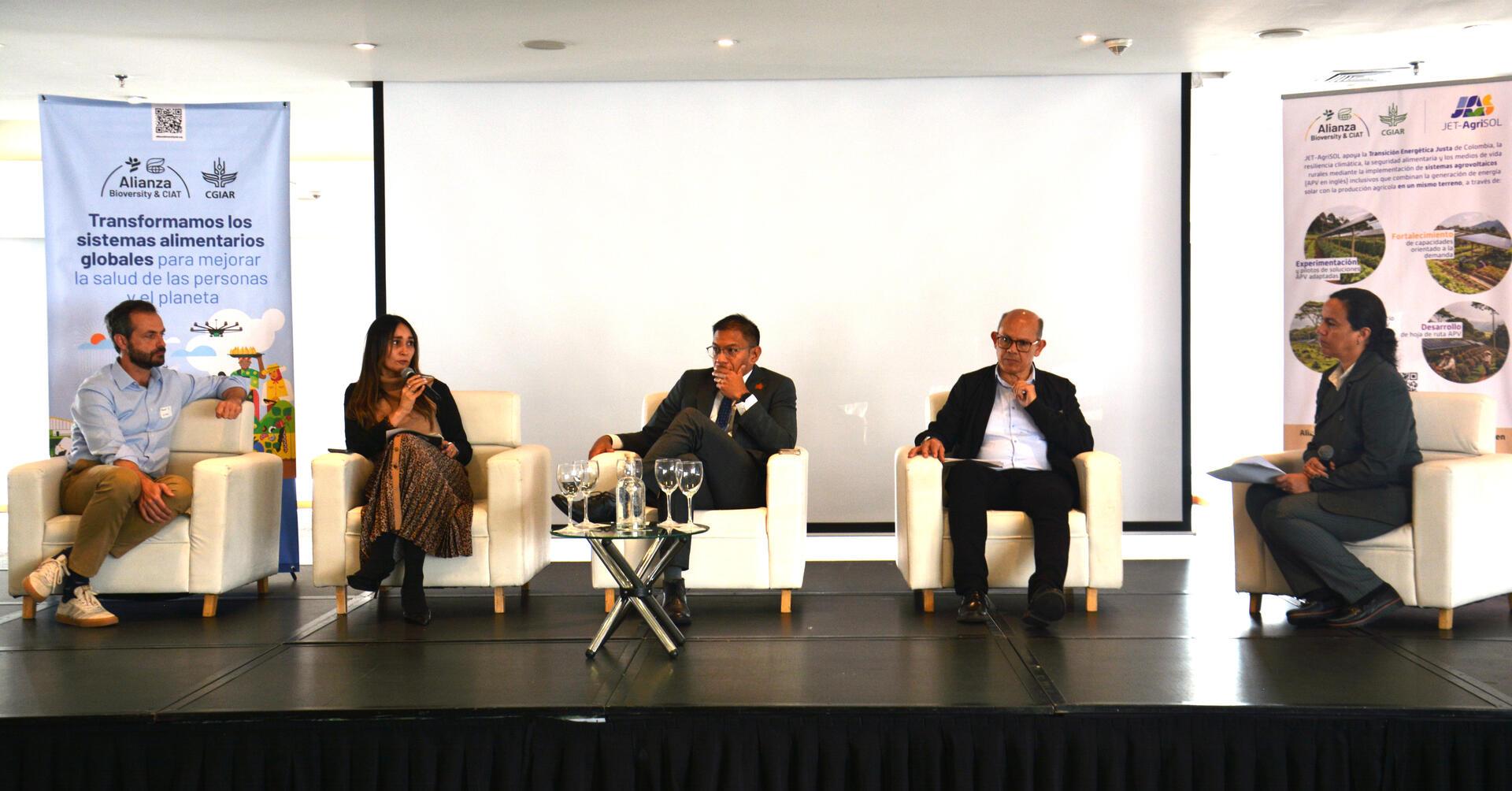
A panel of experts on agrovoltaics in Colombia: opportunities and enabling conditions for scaling solutions that integrate energy, agriculture, livestock, and rural development was held during the event. Photo: CIAT/JL Urrea
The launch brought together representatives from government, international cooperation, the private sector, academia, research centers, and organizations linked to rural and energy development in Bogotá on 14 May. More than just presenting a new technology, the meeting opened a necessary conversation on how to connect the energy transition with food security, climate resilience, and rural livelihoods.
Colombia has committed to reducing its greenhouse gas emissions by 51% by 2030 and achieving carbon neutrality by 2050. At the same time, the country faces structural challenges related to rural inequality, food insecurity, climate vulnerability, and persistent gaps in energy access. In many rural areas, especially in non-interconnected territories, electricity remains limited, expensive, or unstable. There, discussing the energy transition also means discussing refrigeration for food preservation, water pumping for irrigation, connectivity, product transformation, collection centers, and productive opportunities that still do not reach many communities reliably.
For Marcela Quintero, associate general manager of Research and Innovation Strategy of the Alliance of Bioversity & CIAT, "The challenge cannot be understood solely from the energy sector. Agrovoltaics invites us to look at the territory in a holistic way: as a space where food production, clean energy generation, climate change adaptation and the possibility of creating fairer conditions for those who live and produce in the countryside converge."
JET-AgriSOL comes at a key moment. Although agrovoltaics has advanced in other countries, it remains an emerging innovation in Colombia. There are still gaps in information, regulation, financing, and practical experience that limit its adoption and scaling. For this reason, the project does not simply aim to install solar panels on crops or livestock systems. Its aim is to generate evidence, build capacities, and co-design models that respond to the real conditions of Colombian territories.
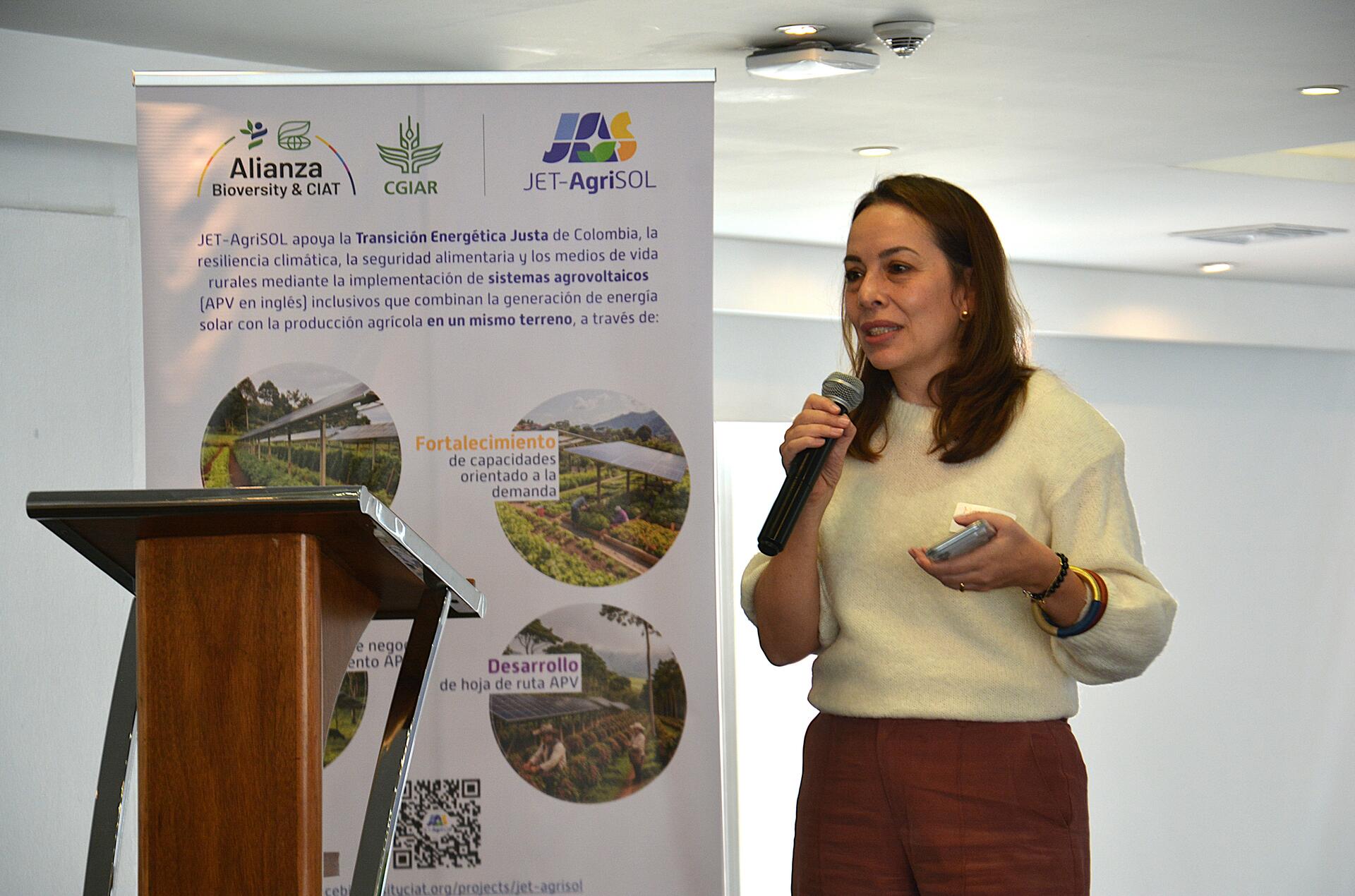
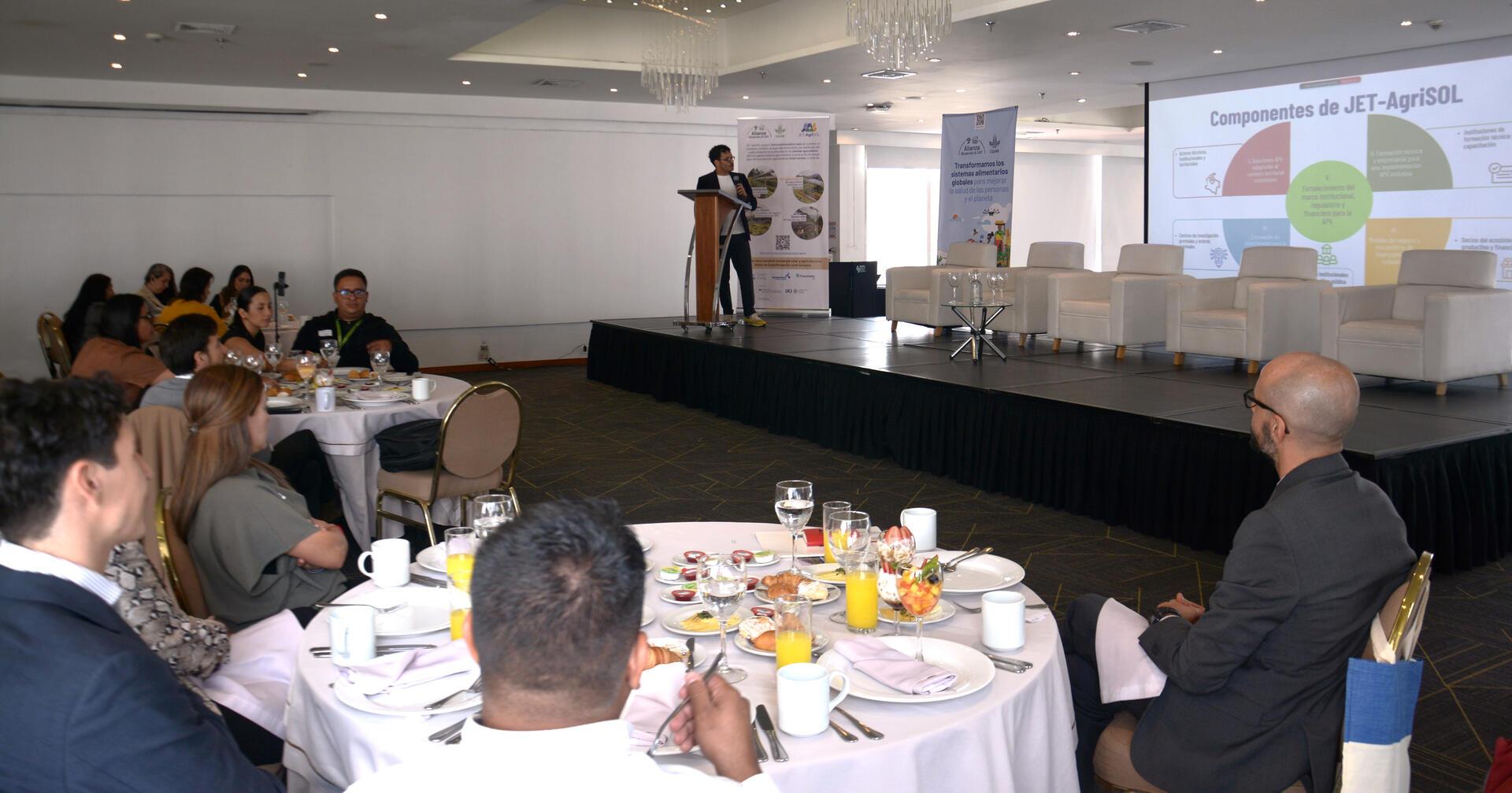
Manuel Narjes, JET-AgriSOL leader, presenting the project: vision, scaling, and impact. Photo: CIAT/JL Urrea
El proyecto es implementado por la Alianza Bioversity & CIAT junto con Colibri Energy SAS, el Instituto Fraunhofer de Sistemas de Energía Solar (Fraunhofer ISE), y Perspectives Climate Research. La combinación de experiencia científica, conocimiento técnico y trabajo territorial será fundamental para evaluar qué sistemas funcionan mejor en diferentes contextos agrícolas, pecuarios y climáticos del país.
Uno de los componentes centrales será la creación de un laboratorio agrovoltaico en el campus de la Alianza en Palmira, Valle del Cauca. Desde allí, y junto con la instalación de sistemas agrovoltaicos en distintos territorios, el proyecto generará evidencia sobre rendimiento productivo, generación de energía y viabilidad económica. Estos aprendizajes se traducirán en herramientas de decisión para orientar futuras inversiones, políticas públicas y modelos de escalamiento.
Los territorios priorizados reflejan parte de la complejidad rural del país. En departamentos como Caquetá, La Guajira, Cesar y Chocó, las comunidades enfrentan simultáneamente riesgos climáticos, brechas de acceso a infraestructura, exclusión financiera y limitaciones energéticas. Mujeres, jóvenes, comunidades indígenas y afrocolombianas suelen ser quienes enfrentan con mayor fuerza estas barreras. Por eso, el enfoque de género e inclusión no será un componente adicional, sino una condición para que la innovación tenga sentido social.
El proyecto promoverá la participación equitativa en consultas comunitarias, procesos de formación y diseño de modelos de negocio. Al menos el 30% de las personas participantes en consultas serán mujeres, y al menos tres de los 16 modelos de negocio agrovoltaicos previstos serán liderados por mujeres. Además, la información generada será analizada con indicadores desagregados por sexo y edad, para entender quiénes participan, quiénes se benefician y qué ajustes son necesarios para que los resultados sean más inclusivos.
El potencial va más allá de la generación eléctrica. En zonas donde las comunidades dependen de generadores diésel o enfrentan altos costos energéticos, los sistemas renovables descentralizados pueden reducir emisiones y mejorar el acceso a energía para usos comunitarios y productivos. También pueden fortalecer cadenas de valor locales mediante riego eficiente, refrigeración, procesamiento de alimentos, conectividad o pequeñas agroindustrias rurales. En algunos casos, los excedentes de energía podrían incluso venderse a través de sistemas interconectados, abriendo nuevas fuentes de ingreso para productores y organizaciones locales.
El Ministerio de Ambiente y Desarrollo Sostenible de Colombia es un socio político clave en este proyecto. Cecilia Medina, de la Dirección de Cambio Climático y Gestión del Riesgo, comentó:
“Qué inspirador ver cómo la agrovoltaica empieza a consolidarse como una solución real para impulsar la transición energética justa y el desarrollo rural en Colombia. Desde el Ministerio de Ambiente acompañamos y apoyamos iniciativas como JET-AgriSOL, que integran agricultura, energía renovable y resiliencia climática, especialmente en territorios rurales donde la interconexión eléctrica aún representa un gran desafío. Estos modelos no solo aportan a la descarbonización y a la seguridad alimentaria, sino que también abren oportunidades para fortalecer comunidades energéticas, mejorar la calidad de vida y promover un desarrollo más inclusivo y sostenible para las comunidades rurales del país.
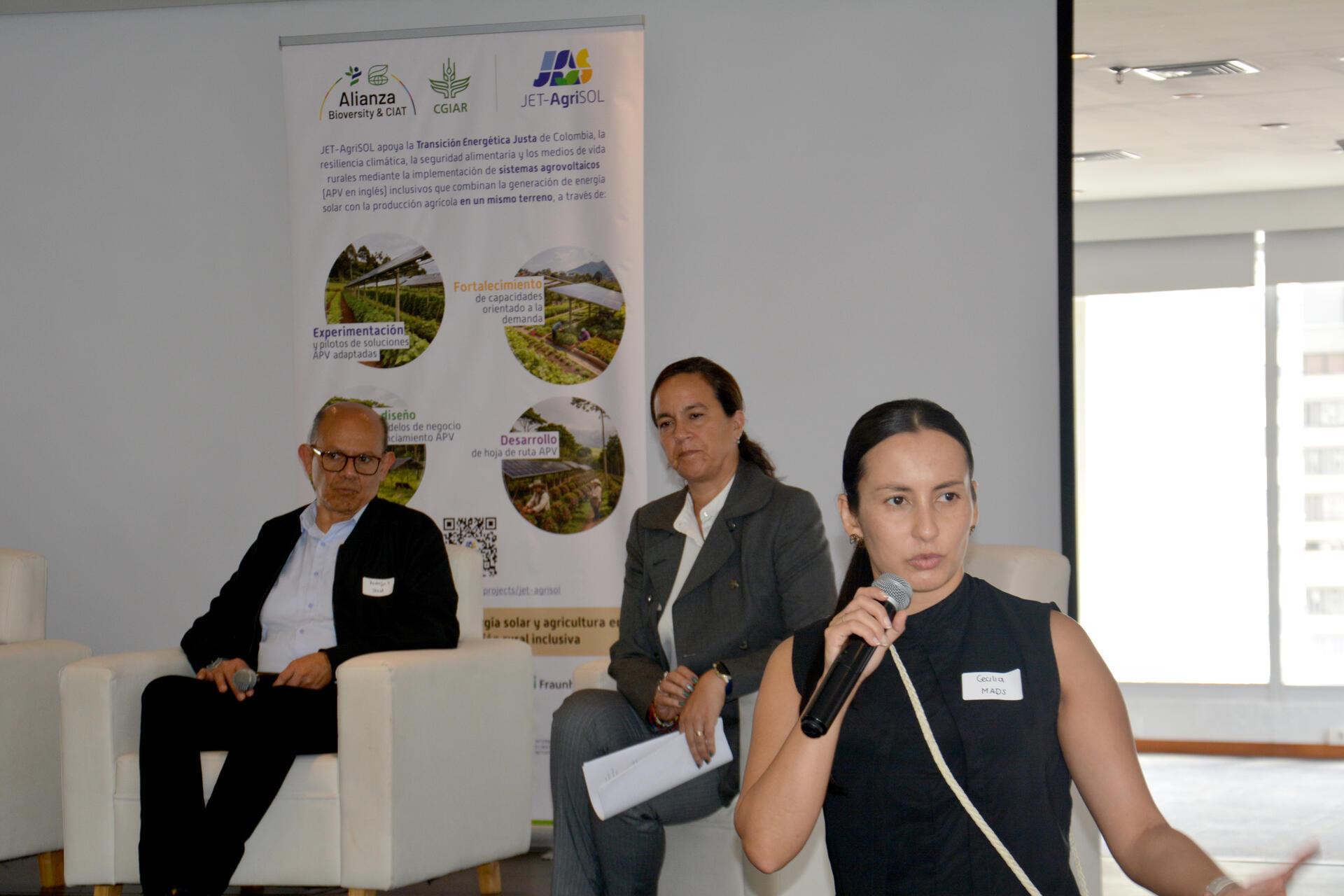
Representatives of the Ministry of Environment, Ministry of Mines, Ministry of Agriculture, SENA, and Agrosavia participated in the dialogue on how to implement agrovoltaics in Colombia. Photo: CIAT/JL Urrea
The launch of JET-AgriSOL marked the formal start of that conversation. It is a conversation about more than the energy and agricultural sectors: it is about the kind of country Colombia wants to build—one where the energy transition does not compete with food security, where innovation is developed with communities in mind and where rural areas can play a leading role in climate solutions that deliver economic, social and environmental value.
At a time when the world needs to accelerate climate action, Colombia has an opportunity to explore its own approach to agrivoltaics in tropical conditions. JET-AgriSOL does not offer a definitive answer, but it provides a platform to learn, test, adapt, and build an evidence base alongside those who know the land best. If this effort takes hold, producing food and clean energy on the same land could move beyond a technological promise to become a practical tool for rural development, climate resilience and a just energy transition.