Blog Empowering agri-food innovation ecosystems: The International Innovation Hub launched a two-year initiative in West Africa
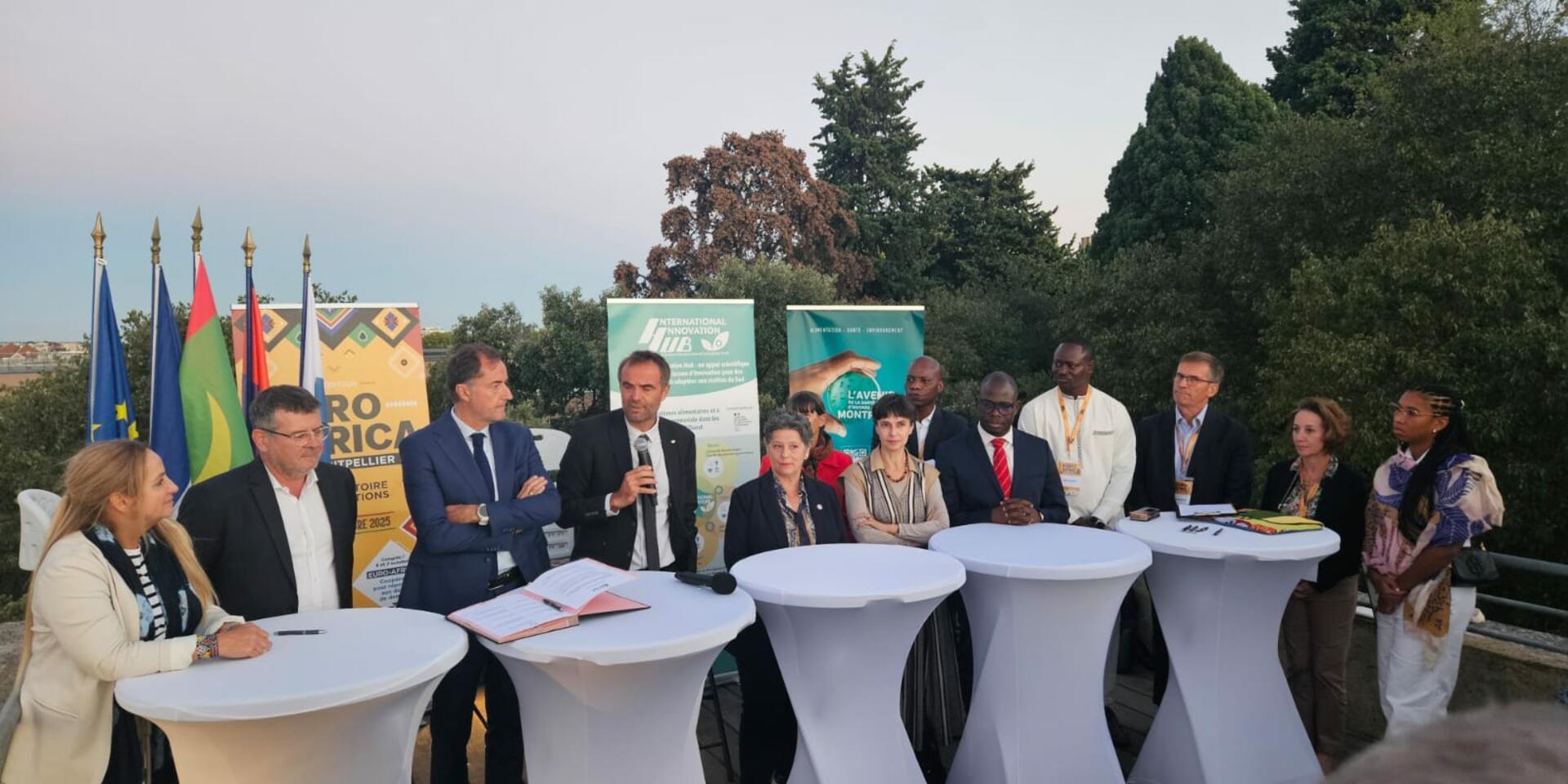

The International Innovation Hub (IIH) launched a collaborative initiative with research institutions and university-led incubators to support sustainable food systems and entrepreneurial innovation in West Africa.
The initiative will be implemented over two years in Benin, Senegal, and Côte d’Ivoire, and brings together a strong consortium of 12 research and innovation organizations including Agropolis International, Institut Agro Montpellier, CIRAD, IRD, CGIAR through the Alliance of Bioversity International and CIAT, Afric’Innov, and universities in Benin, Senegal, and Côte d’Ivoire.
The collaboration agreement was signed by all partners at the Maison des Relations Internationales in Montpellier during the Euro-Africa Biennale last October. Supported by the French Ministry of Europe and Foreign Affairs and held under the patronage of MedVallée Montpellier, the initiative will officially launch in early 2026, beginning with a regional workshop in Benin.
An international innovation hub for sustainable food systems
Food systems today face a range of complex challenges including food and nutrition insecurity, biodiversity and health impacts, and climate change. Now more than ever, addressing these challenges requires scientific expertise to work hand in hand with a wide range of stakeholders, from the public sector to private entities, to develop innovations that are tailored to the market and local needs.
Yet in many parts of the world, such collaborative approaches encounter significant obstacles: limited financial, material, and human resources; restricted access to technology; insufficient institutional capacity to support start-ups and entrepreneurs; and insufficient connections with the market.
To help overcome these obstacles, academic stakeholders from Montpellier, the Metropolitan Area and CGIAR, fueled by the MedVallée dynamic, have joined forces to create the International Innovation Hub, with the aim of fostering entrepreneurial innovation in association with research, for sustainable global food systems.
Supporting food systems and entrepreneurial innovation in West African countries
Financed through a Fonds Equipe France (FEF) of the French Ministry of Europe and Foreign Affairs, the objective of the International Innovation Hub’s new initiative is to structure - at a regional level - a network of entrepreneurship support organizations (ESOs) to facilitate a transition toward sustainable food systems in three countries: Benin, Senegal, and Côte d’Ivoire. Building upon the scientific regional Hub of Montpellier, this project will focus on the three following components:
Component 1: Formalizing a strong innovation ecosystem for sustainable food systems at the national and regional levels in West Africa, based on a jointly developed and shared vision that strengthens the links between research, ESOs and entrepreneurs.
Component 2: Developing the capacities of local ESOs in the innovation continuum, covering incubation for entrepreneurs, technical and scientific support from research institutions, knowledge transfer and the creation of synergies between stakeholders.
Component 3: Supporting the operationalization of the International Innovation Hub in West Africa via a regional Innovation Challenge, following the methodology of the CGIAR Accelerate for Impact Platform.
The project targets a broad range of stakeholders within West Africa’s innovation ecosystem. Its direct beneficiaries include entrepreneurship support organizations (ESOs), which will receive capacity-building and professionalization support. The project will additionally support entrepreneurs and project leaders by offering technical assistance and scientific mentorship to 45 startups through a regional Innovation Challenge. Researchers, academic institutions, and institutional actors will gain from enhanced collaboration and strengthened capacities in research valorization. Ultimately, the project’s final beneficiaries are young and women entrepreneurs, farmers, local communities, and investors, who will benefit from the economic, ecological, and social impacts generated.
Partners of the International Innovation Hub
- Agropolis International
- The Alliance of Bioversity International and CIAT
- CGIAR
- Montpellier Méditerranée Metropolitan Council
- CIRAD (French Agricultural Research Centre for International Development)
- Institut Agro (French Institute for higher education & research in Food, Agriculture & the Environment)
- INRAE (French National Research Institute for Agriculture, Food and Environment)
- IRD (Institut de Recherche pour le Développement)
- CIHEAM-IAMM (International Centre for Advanced Mediterranean Agronomic Studies - Mediterranean Agronomic Institute of Montpellier)
- University of Montpellier
West African partners in the project to support structuring and capacity building among innovation players:
- Abomey Calavi University / Agricultural Science Faculty - UAC/FSA (Benin)
- Institut national polytechnique Félix Houphouët-Boigny / Ecole Supérieur d’Agriculture - INP-HB/ESA (Ivory Coast)
- Sine Saloum El-Hâdj Ibrahima University NIASS - USSEIN (Senegal)
- Gaston Berger University, Saint Louis / incubator - UGB (Senegal)
- Délégation Générale à l'Entreprenariat Rapide des Femmes et des Jeunes (general delegation for rapid entrepreneurship among women and young people) - DER/FJ (Senegal)
- Afric’Innov (Senegal)
Want to know more about the International Innovation Hub’s new initiative in West Africa?
Reach out to Camille Loiseau, Communication and Project Support at the Alliance of Bioversity International and CIAT: [email protected]
About CGIAR’s Accelerate for Impact Platform (A4IP):
CGIAR Accelerate for Impact Platform is the venture space that leverages CGIAR’s legacy in research and innovation to co-design, accelerate, and de-risk the development and deployment of science-based solutions for sustainable agriculture and climate action. A4IP entrepreneurs pioneer models to bridge research products from lab to market, create demand for CGIAR science, and strengthen its role in the innovation ecosystem. The initiative plays a catalytic role for entrepreneurial scientists, startups, and other strategic partners, driving innovation that will make our agrifood systems healthier, more equitable, and more sustainable. A4IP is an initiative powered by the Alliance of Bioversity International and CIAT; a CGIAR Research Center.