Blog After the emergency: how to decide what to rebuild and how to go about it

In the first instalment of this series, we explored how an earthquake can affect food systems beyond the visible damage: from farms and markets to the families that depend on them. Now we take it a step further: what information can help us decide how to recover and how to reduce future risks? From emergency to resilience. Part two
After an earthquake, the first questions are usually urgent: how many casualties? What has been damaged? How much has been lost? What needs to be repaired?
But as the recovery begins, another question emerges – one that is less obvious and more complex: how can we rebuild without being exposed to the same risks again?
For Deissy Martínez-Barón, a researcher with the Bioversity International and CIAT Alliance and regional leader of the Climate Action in LAC, part of the answer lies in looking beyond the physical damage.
“The first thing that happens isn’t always the most visible: the physical damage to crops, soils and infrastructure is there for all to see, but the disruption to the agricultural cycle runs much deeper. A farmer who loses their seed loses an input and also loses the starting point for the next season”, says Deissy.
An emergency can disrupt years of work. It can affect seeds, infrastructure, access to markets or the knowledge networks that enable a community to respond to climate change, for example. And when these elements are lost, the capacity to cope with what lies ahead is also weakened.
Recovery therefore presents another challenge: understanding what was working before the disaster, what was failing, and what capacities remain.
“The key question before intervening is ‘what was failing here before, and why?’”, notes the researcher.
From damage to risk
Answering that question requires information about the region and the conditions that may increase risks in the coming months. This is where tools such as agroclimatic modelling and climate forecasts come into play.
Camilo Barrios, a researcher at the Alliance and leader of the agroclimatic modelling team within the Climate Action, explains that following an event such as the magnitude 7.4 earthquake that struck western Colombia on 10 August, these tools can help predict how variables such as rainfall, temperature and the water balance will behave, whilst communities reorganise their productive activities.
They can also help identify periods of drought or heavy rainfall that exacerbate problems in soil affected by the earthquake, and determine the best times to sow or harvest.
Having the data presents another challenge: converting it into useful information for decision-making, ranging from when to sow, which variety to use, and how to protect an undamaged crop, to determining where it is best to reinvest.
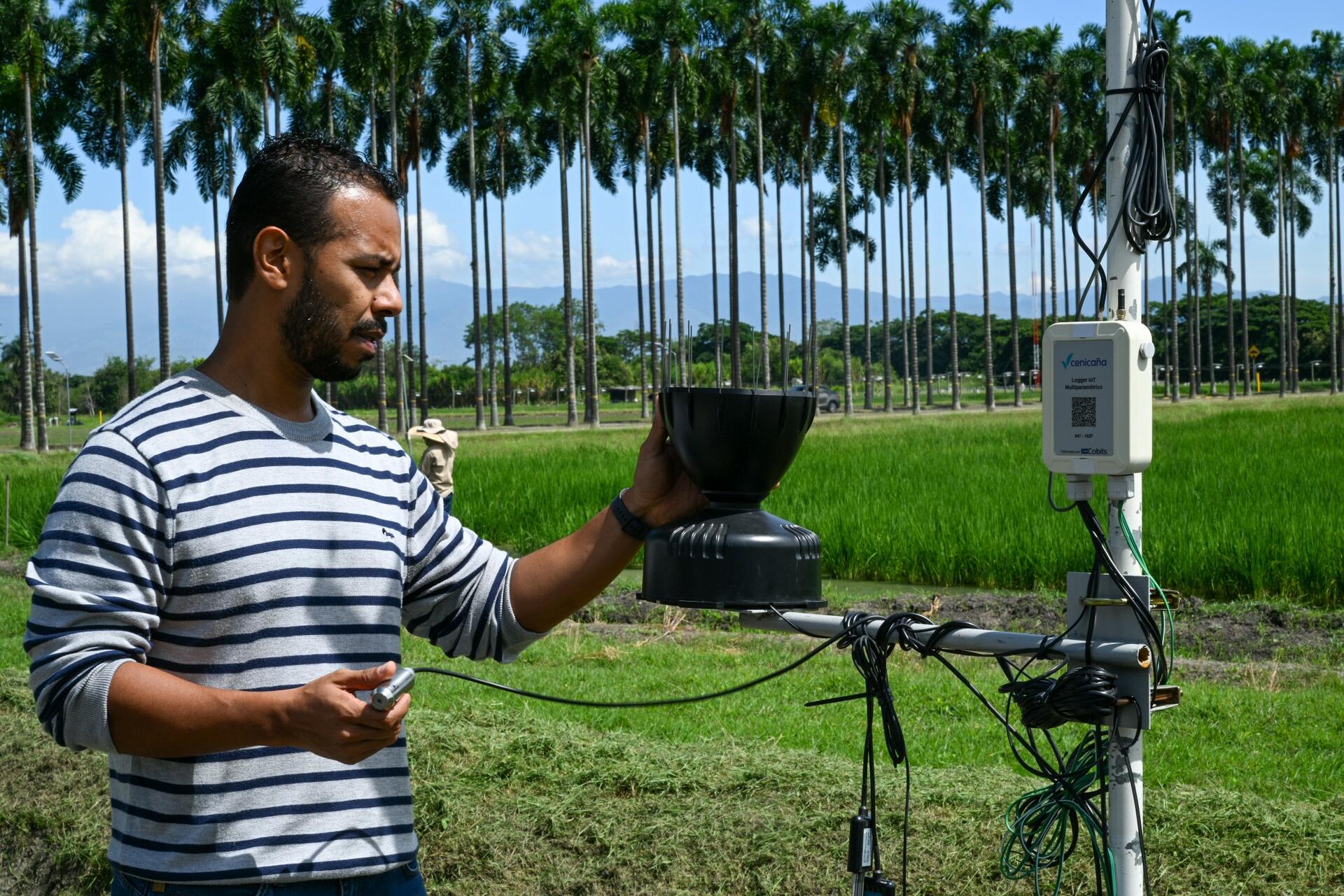
Camilo Barrios, a researcher at the Alliance, at a digital plot where agroclimatic variables are monitored to support decision-making in the field.
“The key is to translate technical data into useful or actionable products that are easy to interpret”, explains Camilo. This may include risk maps, early warnings and agronomic recommendations, developed in collaboration with local authorities and trade associations to ensure they meet the region’s actual needs.
Rebuilding is also a learning process
Moving from data to decisions means changing the way we view recovery.
Camilo Barrios frames the challenge as a shift from a descriptive approach – finding out how much was lost and where – to a forward-looking one: using that information to build scenarios and decide what to do next. “Effective reconstruction is not just about replacing what was lost, but also about using the available evidence to make decisions that reduce future exposure,” says the researcher.
Where does it make sense to rebuild infrastructure exactly as it was, and where would it be necessary to redesign it? Which crops offer the best balance between resilience and economic livelihood? What alternatives can reduce risks without affecting families’ livelihoods?
For Deissy Martínez, these decisions cannot be made solely from the outside either. An innovation may be technically sound, but it will not work if it does not meet the needs of those living in the area. That is why, she says, “recovery also means listening to what existed before the disaster and what capacities remain”.
These include the networks of knowledge and trust that underpin much of rural life: neighbours exchanging information about rainfall, women’s groups sharing seeds, and local leaders bringing communities together.
“A disaster can sever those networks without them even appearing in a damage report. And that fabric is often the most important asset a community has for its recovery. Without it, any external intervention has to start from scratch,” Deissy Martínez concludes.
Recovery involves deciding what is worth restoring, what needs to change, and what information can help reduce vulnerability to future extreme events.
Science can contribute precisely in this area: by linking data, local knowledge and evidence so that recovery decisions are more targeted and better informed.
Because ‘building back better’ means learning from what has happened in order to make better decisions about what lies ahead.
Scientists
Deissy Martínez-Barón
Regional Lead, Climate Action in Latin America and the Caribbean