Blog Visualization tool for CIS-CSA interventions in Ghana to support CSA implementation by donors and development partners

Institutions, organizations, and stakeholders in Ghana, including NGOs, government entities and donors have been working to implement climate-smart agriculture (CSA) interventions to address the impacts of climate change and promote sustainable agricultural practices. To address challenges such as lack of coordination among CSA institutions, limited accessibility for farmers and insufficient stakeholder collaboration, a comprehensive visualization tool has been developed.
By: Sandra Sawdiatu Inusah, Wuletawu Abera
This tool includes a dashboard and an interactive map, summarizing CSA projects implemented across Ghana from 1971 to 2023. It provides detailed information such as project titles, implementing organizations, timelines, sponsors, geolocations, summaries, beneficiaries, technologies, thematic areas and contact persons. Enhanced with features such as Venn diagrams, network analysis, and density maps, the tool streamlines access to information and fosters collaboration. By identifying where CSA technologies have been implemented and highlighting the contributions of various institutions, the dashboard promotes synergy among stakeholders, enhances farmer awareness and supports the effective implementation of CSA practices across Ghana. It is accessed through this dashboard and this leaflet.
For generations, humans have relied on the land and sea through traditional fishing and agriculture, but as the years passed, weather patterns became increasingly erratic, with fiercer storms and shifting seasons, which is now recognized as impacts of climate change. Amidst these challenges, CSA emerged as a transformative solution. CSA integrates sustainable practices that boost productivity, strengthen resilience, reduce emissions and support food security, offering a path towards a more adaptable and secure agricultural future, as defined by the Food and Agriculture Organization of the United Nations.
Many organizations and individuals have been crucial in advancing the understanding of CSA and developing technologies to combat climate change. In Ghana, institutions have actively worked to bridge the knowledge gap on CSA, introducing various technologies and systems to promote it and mitigate climate change impacts across the country. However, significant challenges remain, including a lack of synergy among CSA institutions, limited farmer accessibility and awareness, and the need for improved stakeholder collaboration and knowledge dissemination. Although some institutions have collaborated on CSA projects, they often work on different technologies, resulting in separate reports with varied findings, highlighting a lack of coordination among them.
To address these challenges, CSA projects introduced in Ghana from 1971 to 2023 have been summarized, and a dashboard and interactive map has been created to simplify information retrieval. The dashboard includes project titles, implementing organizations, start and completion dates, sponsors, geolocation (agroecological zone, region, districts, and community), project summaries (this includes the links to all the documents or project reports), beneficiaries, CSA technologies, systems, thematic areas, and contact persons. Additionally, various analytical tools are provided to streamline the information, such as Venn diagrams, network analysis, maps, bar charts, histograms, and more.
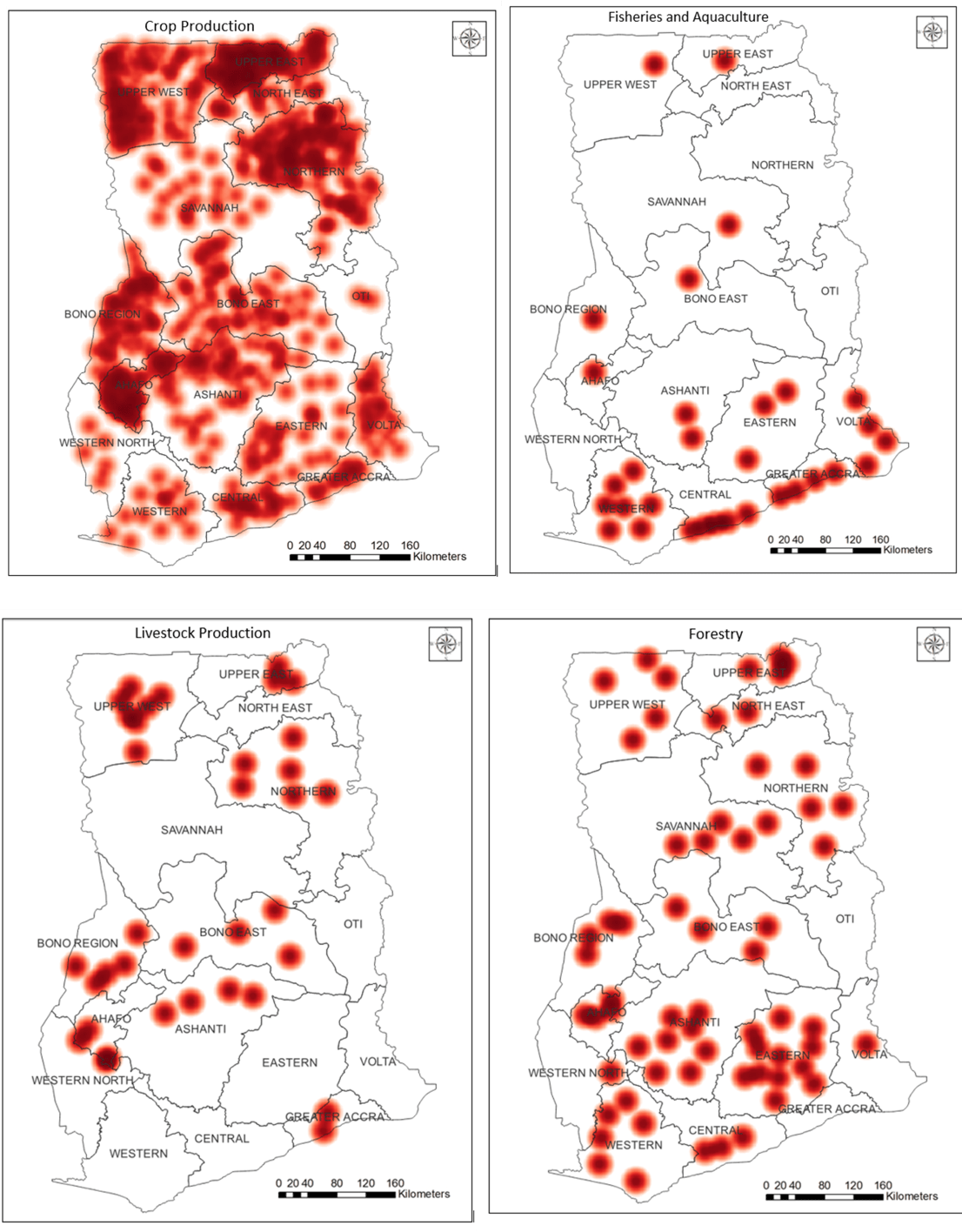
A density map illustrating the intensity of projects focusing CSA systems across Ghana.
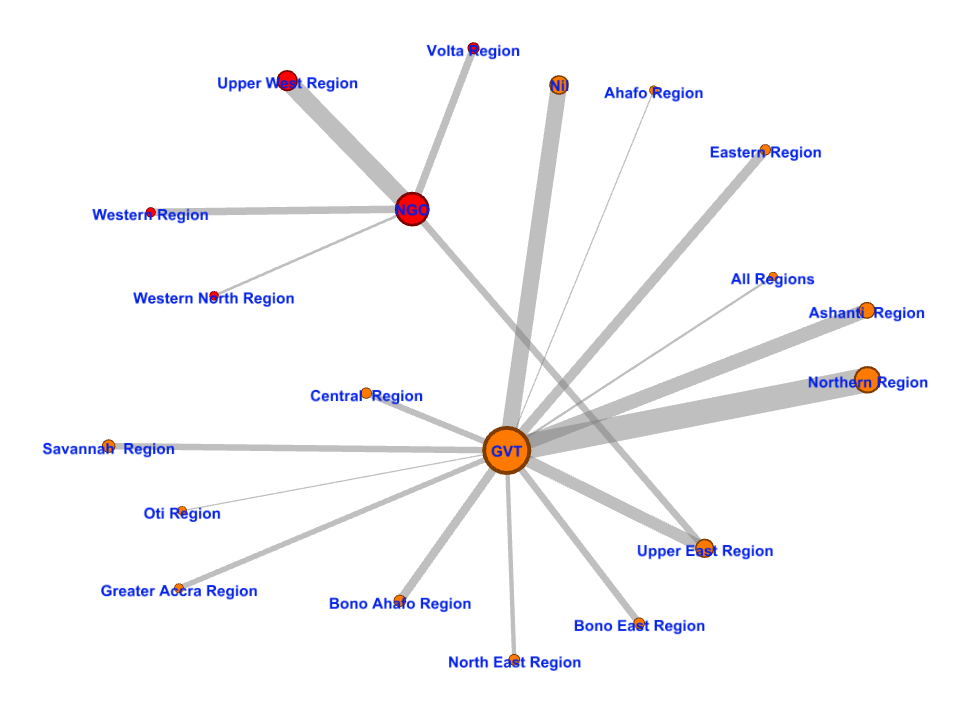
A network analysis showing the distribution of organizations (for both NGO and government) involved in implementing CSA interventions across the various regions in Ghana.
The dashboard and interactive map aim to disseminate information about the established CSA technologies, identify the locations where these technologies have been introduced, and highlight the contributions of various institutions. This tool is designed to provide a comprehensive overview of CSA efforts in Ghana, facilitating easier access to information and promoting greater collaboration and awareness among stakeholders.
This link provides access to the dashboard including different visualization options (dashboard) and an interactive map (leaflet) showcasing the various CSA projects across Ghana, along with detailed information on each project.