Blog What is being said in the Peruvian and Colombian Amazon? Narratives that shape environmental cooperation

This blog presents a new study on the Colombian-Peruvian Amazon network, examining how environmental narratives influence cooperation among conservation organizations and shape governance dynamics in the region.
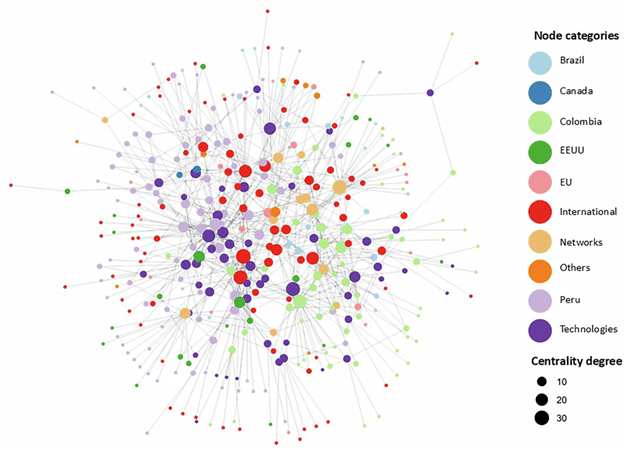
In the blog on institutional networks protecting the Colombian and Peruvian Amazon, we showed that environmental governance in the region depends on a broad network of organizations and technologies, but with clear fragilities: low network density—that is, limited direct interaction among many nodes—strong dependence on a few highly connected actors, and limited articulation between institutions in Colombia and Peru. Additionally, we observed that international organizations function as key bridges that partially compensate for these gaps, connecting national and local actors that would otherwise remain more isolated.
Our paper Navigating the Map of Environmental-policy Narratives and its Influence within the Conservation Network of the Colombian-Peruvian Amazon we ask what institutional narratives actors use—that is, the organizations that operate or intervene in the Colombian–Peruvian Amazon—and how these discourses influence cooperation.
The key question is:
Do organizations working on the conservation of the Colombian–Peruvian Amazon cooperate because they share the same narratives, because they have complementary narratives, or because their discursive focus is closely tied to their actions in the territory? To answer this:
- We identified 17 environmental narratives (Communities, Research and Education, Politics, Technologies and Innovation, Economy, Water, Climate, Agriculture and Livestock, among others) that group together the themes and approaches most frequently used by organizations to describe their roles, priorities, and relationship with the Amazon. Each narrative functions as a different way of interpreting the territory and guiding institutional action.
- We analyzed how each organization positions itself in relation to these themes using text-mining techniques applied to information collected through web scraping of their websites and public documents. This made it possible to build a narrative profile for each actor, identifying which narratives they emphasize and which remain secondary.
- We then evaluated whether the similarity or distance between these narratives—what we call narrative concordance, meaning the degree to which two actors share discourses, themes, and priorities—helps explain the likelihood that two actors cooperate within the Amazonian network.
More than a technical analysis, this study offers a strategic reading. To understand how narratives influence cooperation, we applied a statistical network model of the ERGM (Exponential Random Graph Model) type, which allows us to evaluate which factors—such as narrative similarity, structural position, or type of organization—increase or reduce the probability that two actors cooperate. In simple terms, the model allows:
- Comparing the real network with thousands of simulated networks.
- Evaluating which characteristics (for example, sharing narratives, belonging to the same country, or being an international actor) make cooperation between two organizations more likely.
- Expressing each effect as a coefficient that indicates whether a factor increases (+) or decreases (–) the probability of forming a tie.
In other words, the ERGM allows us to understand not only who cooperates with whom, but why certain ties are more likely based on the narratives that each actor emphasizes. Identifying which discourses bring actors closer together and which create disconnection makes it possible to design more aligned interventions, more coherent policies, and binational projects with greater chances of success. If we want better-governed Amazonia, we need a network that not only connects but also understands itself.
What narratives dominate the Amazonian network?
The first finding is that not all narratives carry the same weight in the network. Three groups stand out:
- Research and education: This is the narrative with the greatest weight. It integrates concepts related to scientific knowledge production, environmental monitoring, applied research, technical and academic training, and the generation of data for decision-making.
- Communities: This is one of the strongest narratives. It integrates references to Indigenous peoples, rural communities, families, women, youth, cultural traditions, local knowledge, and territorial rights.
- Politics: This includes terms related to laws, regulations, public policies, state programs, inter-institutional agreements, and governance frameworks.
These narratives account for about half of the discursive content of the network. Other important dimensions—such as water, fauna, food systems, or energy—are present but with less weight.
International actors show stronger emphasis on research and technology narratives, while Colombian and Peruvian actors emphasize more the communities narrative. Thus, some view the Amazon mainly as a scientific and technological space, while others understand it primarily as a territory inhabited by communities with rights, cultures, and histories of their own.
Narratives that are less visible
Besides these dominant narratives, we also identified a set of narratives with very low representation in institutional discourses, such as energy, fauna, food systems, rural poverty, or risk and disasters. These appear weakly represented or are practically absent. This low visibility does not mean they are irrelevant for the Amazon, but that they are not part of the topics highlighted in the agendas communicated by organizations.
How do narratives influence cooperation?
The study shows that narratives do not function only as descriptions; they help explain how relationships are formed within the Amazonian cooperation network.
Therefore, narrative similarity increases the probability of cooperation. When two organizations share a broad set of themes—for example, Communities, Research and Education, Politics, and Technologies and Innovation—their narrative concordance increases the likelihood that a tie will exist. Likewise, weaker or very different narratives reduce the probability of forming relationships. When an actor’s narrative focuses mainly on themes such as Economy, Challenges, or Networks, without being connected to more operational or territorial themes, the probability of cooperation tends to decrease. Consequently, the network organizes itself into subgroups where shared narratives matter.
| Narrative | What it integrates |
| Research and education | Scientific knowledge, monitoring, applied research, training, environmental data |
| Communities | Indigenous peoples, rural communities, families, gender, traditions, local knowledge, territorial rights |
| Politics | Laws, regulations, public policies, programs, agreements, governance frameworks |
| Technologies and innovation | Digital tools, sensors, monitoring systems, remote sensing, technological innovation for conservation |
| Economy | Productive activities, markets, incentives, value chains, regional economic development |
| Water | Rivers, watersheds, water management, soil moisture, aquatic ecosystems |
| Climate | Climate change, emissions, variability, vulnerability, adaptation |
| Agriculture and livestock | Agricultural systems, land use, agro-expansion, production risks |
| Fauna and flora | Biodiversity, species, ecological conservation, restoration |
| Energy | Energy resources, energy transition, infrastructure impacts |
| Risk and disasters | Floods, fires, extreme events, territorial vulnerability |
| Food systems | Food security, local production, supply chains |
| Governance | Institutional coordination, participation, management capacities, actor roles |
| Challenges | Structural problems, environmental threats, institutional gaps |
| Networks | Institutional interactions, cooperation, nodes and links |
| Territory | Territorial approaches, spatial use, regional planning |
| Culture | Identities, cultural practices, worldviews, Amazonian traditions |
The analysis confirms that the network is not just a set of isolated pairs; it is organized in well-defined subgroups—small, closed cooperation structures—where several actors share similar relationships and narratives. Therefore, the Amazon’s environmental governance system operates in a granular and porous way, more like a mosaic of clusters than a broad, fully integrated dynamic network.
Implications for environmental governance
Based on these findings, several opportunities emerge to improve environmental governance in the Colombian and Peruvian Amazon:
- Use narrative analysis as a management tool, not just an academic one. This helps identify where there is consensus, where gaps exist, and which themes are being overlooked.
- Provide more space for community narratives, linking them with research, technology, and policy agendas instead of treating them as complementary or marginal.
- Design projects and policies that align narratives, not just actors. This implies revising how problems and solutions are framed in documents, calls for proposals, cooperation frameworks, and technological platforms.
A call to action:
The narrative map we analyzed shows that environmental governance in the Amazon does not depend only on who is in the network, but on how the Amazon is described and which themes are placed at the center or the margins of the discourse. Recognizing that institutional narratives are directly related to cooperation dynamics is crucial, because it helps identify where articulation is strong, where it is weak, and which thematic areas remain unattended. Aligning these discourses can stimulate projects with greater cooperation among nodes, strengthen ties in areas with low interaction, and guide efforts toward strategic gaps. Better integrating the narratives of communities, science, politics, and technology can help build more coherent and effective cooperation in a biome where time to respond is limited.