
Blog Kenya’s coffee sector sounds alarm over EUDR deadline


The Alliance of Bioversity International and CIAT led other stakeholders in the coffee sector in presenting a joint statement to the Kenyan government in Nairobi, highlighting concerns and recommendations on how to comply with the European Union Deforestation Regulation (EUDR). With the January 2026 compliance deadline fast approaching, uncertainty looms, especially for smallholder farmers who produce the majority of Kenya’s coffee.
What Is the EUDR, and why does it matter?
Adopted in June 2023, the EUDR is a legally binding regulation requiring companies that place certain commodities including coffee, on the EU market or export them from the EU to prove that these products are:
- Deforestation-free
- Legally produced
- Fully traceable to their source
For Kenya, where over 55% of its coffee is exported to the EU, the regulation could significantly impact market access, unless the country’s producers, especially smallholder farmers, can meet the requirements.
Shared positions, proposals and practical steps
The statement dwelt which was presented to the Coffee Directorate at the Agricultural and Food Authority (AFA) offices in Nairobi, raised the stakeholders’ shared positions, proposals and practical steps for inclusive, coordinated EUDR compliance.
Among the concerns raised were the financial burden that the EUDR compliance may bring to the coffee sector especially small and medium farmers, estates and cooperatives. “Costs related to traceability systems, precise geolocation mapping and digital technologies are substantial,” read the statement in part. While affirming that these costs must be equitably managed, the stakeholders called for continued consultations across the value chain as throughout the development of financing models and mechanisms.
The stakeholders called for the strengthening and leveraging of the existing traceability systems as part of developing of more robust platforms that enhance accountability and protect Kenya’s position in the global markets.
While recognizing the logistical and technical challenges posed by the requirement for detailed geological mapping, particularly for polygon mapping, the stakeholders called for targeted technical assistance, benchmarking of services and infrastructure improvements to support all sectors in meeting this requirement.
“We believe government involvement and proactive policy support are critical to achieving successful and sustainable compliance with EUDR,” read the statement in part.
It also addressed issues on training, capacity building and sanitization, calling for collaboration and shared solutions, advocated for leadership and coordination responsibility.
Additionally, the statement raised concerns on data management and privacy concerns, calling for a clear framework to guide informed consent, transparency, stewardship and privacy.
While recognizing the importance of EUDR’s environmental goals, the stakeholders raised concern about equity, saying the regulation placed a burden on producers and advocating for consumer countries to also take responsibility.
Voices from the ground: Farmers speak up
Speaking shortly after the statement was handed over, Sarah Nyaga, a farmer from Embu said while the regulations affect most rural farmers, most of them barely understand what it entails and how it affects the dynamics of coffee production and sale.
“Farmers need to understand the EU as a major market, the new requirements such as the geo mapping of individual location of farms. A cooperative society that has 3,000 member farmers for example, need to show the geo location of each farm,” said Ms. Nyaga
This, she added, requires not just resources but also literacy. Digital literacy among farmers, she added is a big challenge especially considering most of them are aged. Additionally, she raised concern over data disclosure such as number of trees, age, size of farm.
“Who is going to host this data, are we safe, are we sure if the data will be used for other purpose beyond access to the EU market?” she questioned.
“Even if I comply and other members of the cooperative do not, we are all affected,” said Ms. Nyaga
She called for collective efforts among all stakeholders including government, cooperatives, traders towards ensuring compliance while addressing the farmers’ concerns.
“I ask the government to bring order because if farmers will not comply, they are likely to hawk their coffee, selling to those who are compliant who in turn will be able to access the lucrative EU market,” said Ms. Nyaga.

Ms. Sarah Nyaga, a coffee farmer, reads part. Photo Credit: Rachel Kibui
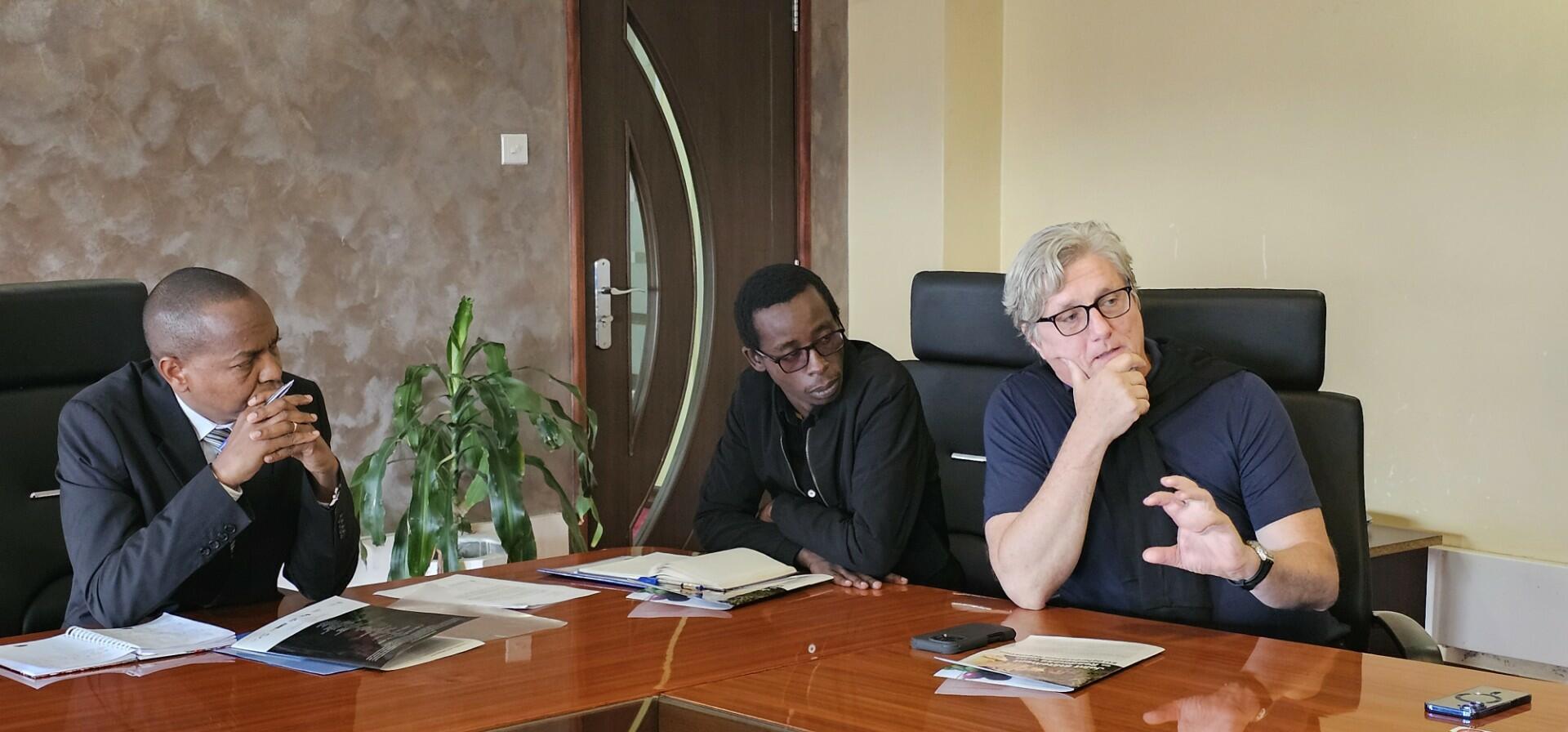
Brian King (right) gives his contribution. Photo Credit: Rachel Kibui
A sector at risk—But still optimistic
The regulation does not affect coffee alone. Other products—cocoa, palm oil, rubber, soya, and wood—are also covered under the EUDR. Experts warn that unless action is taken, entire livelihoods are at stake.
“This is one more shock farmers must navigate,” said Brian King, Senior Manager for Technology Integration at the Alliance. “We need collective action, combining policy, technology, and stakeholder collaboration to ensure smallholders are not locked out of the EU market.”
Balancing Compliance with Conservation
Kenya has committed to growing 15 billion trees by 2030—an ambitious environmental goal aligned with the spirit of the EUDR. However, compliance remains complex in Kenya’s highly fragmented farming landscape.
“Mapping geo points is much easier in plantation economies,” said George Watene, Program Manager at the Global Coffee Platform. “But here, we have over 800,000 smallholder farms contributing to just 50,000 metric tons of coffee.” He noted that while conservation is important, stakeholders must understand and plan for the economic investments required for smooth implementation.


