From the Field Growing trees, growing futures: The impact of the My Farm Trees project

Over the last three years, the My Farm Trees project has evolved from a bold idea into a transformative model for forest-landscape ecosystem restoration, socio-economic empowerment, climate action and improved livelihoods.
Grow Trees. Grow Futures.
Restore landscapes with farmers.
The world is pledging to restore forest landscapes - but empowered farmers and local communities should be centric to that. MyFarmTrees gives smallholder farmers the science, the tools, and the resources to plant the right native trees, and the blockchain technology to prove every single one grew.
 Donate now
By combining digital technology, indigenous knowledge, and offering incentives, the project has demonstrated that it is possible to restore degraded landscapes while at also improving the lives of smallholder farmers and changing paradigms that stand behind forest restoration.
My Farm Trees (MFT) is a digital platform developed by the Alliance of Bioversity International and CIAT. The platform was funded by the Global Environment Facility (GEF), implemented by the International Union for Conservation of Nature (IUCN) and executed by the Alliance of Bioversity International and CIAT, with additional funding in Cameroon from the Darwin Initiative.
An Earthshot-nominated, blockchain-based app, MFT combines capacity building, monitoring, verification and incentives to empower local communities to become leaders and stewards of tree-based restoration projects that provide immediate short-term benefits – direct digital payments enabled by the platform – and, eventually, the long-term benefits of restored landscapes for improved agricultural productivity, water regulation and climate resilience. MFT emphasizes the use of native tree species to support biodiversity and ensure environmental success, opposite to the potentially detrimental use of invasive, exotic species.
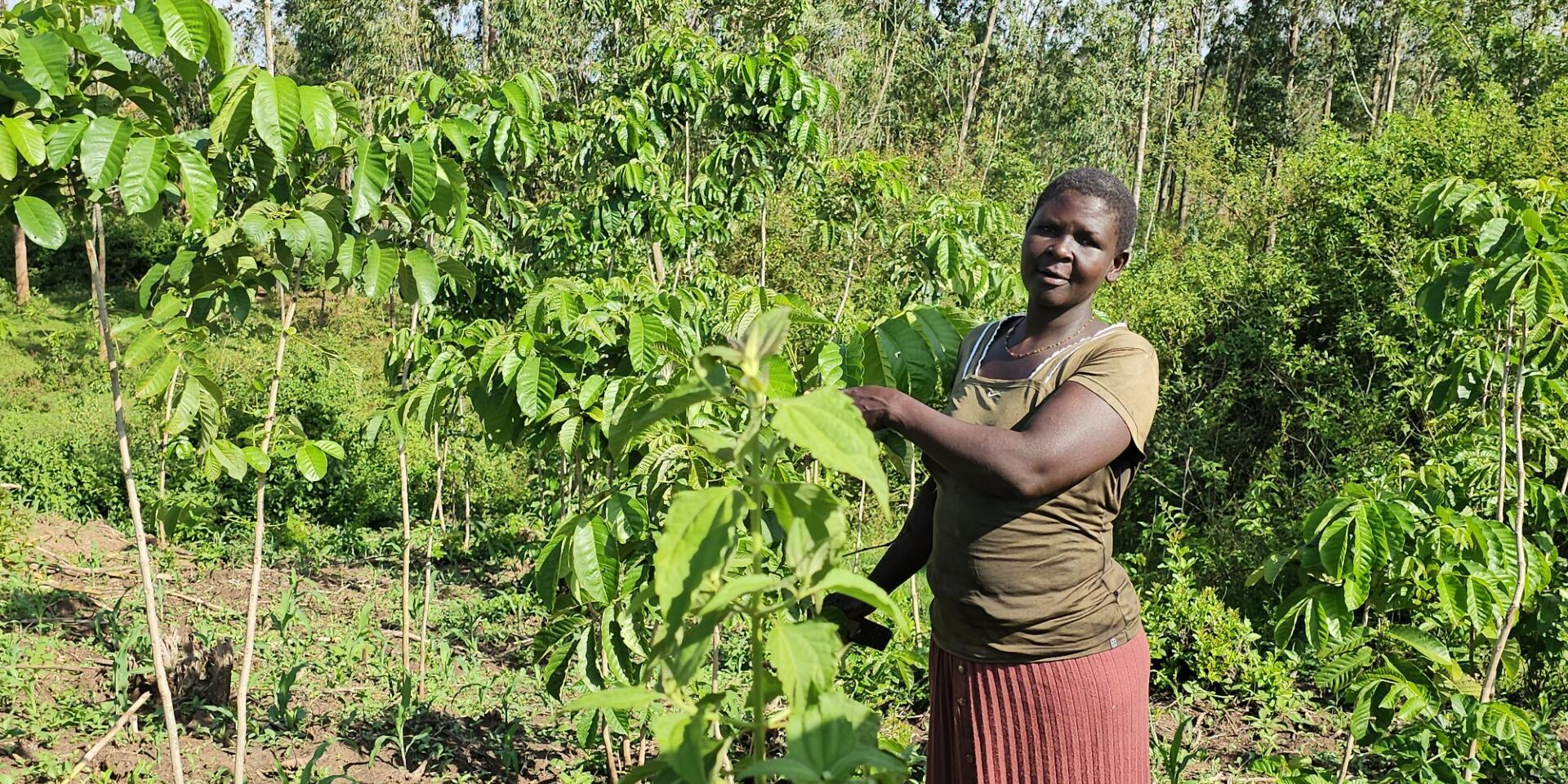
In Kenya’s Siaya County, farmers are already reshaping tangible benefits. Beyond increasing tree cover on their farms, participants have earned incentives that are helping them achieve goals that once felt out of reach.
“It’s the first time that the money from a project has actually reached out to us” one participant said during a recent meeting with the local communities.
A key aspect of this framework has been its inclusivity and attention to integrating, providing access and benefitting youth, women, and marginalized groups for the first time in the implementation areas.
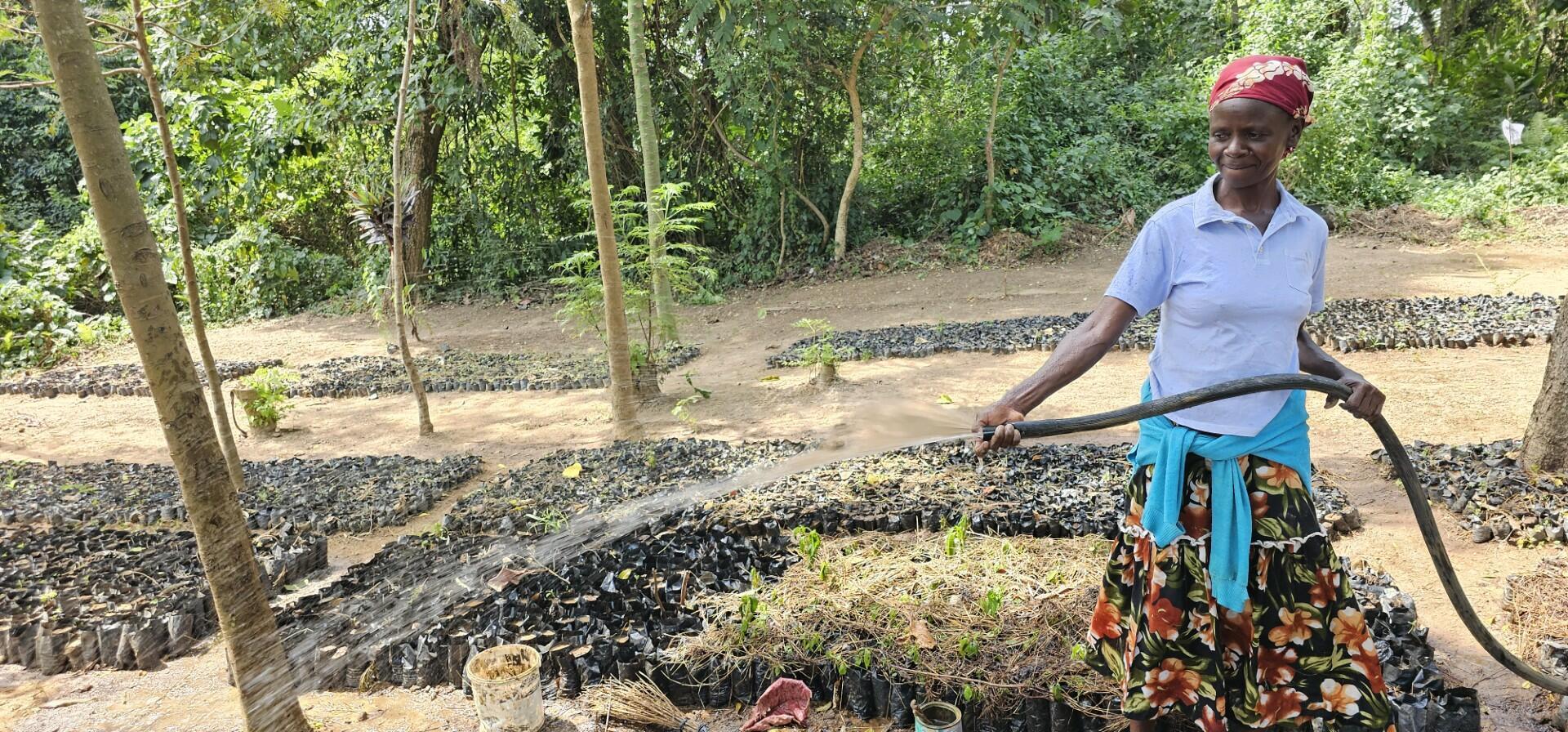
A woman waters tree seedlings in Siaya.
Pathway to empowerment
For many households, tree growing has become a pathway to dignity, resilience, and financial stability.
Alice Anyango, a widow and the sole provider for her family, carries the weight of multiple responsibilities. For years, she lived in fear that her aging house would collapse, yet competing needs made it impossible to rebuild. Watching neighbours and relatives construct permanent homes felt like a distant dream - until tree restoration changed her story.
“I received KES 48,000 ($373 USD) for my first incentive and bought construction stones and sand. I also paid a deposit for cement at a local hardware,” says Alice.
She is optimistic that with her next payment, construction will begin, and the constant fear of her old house collapsing will finally end.
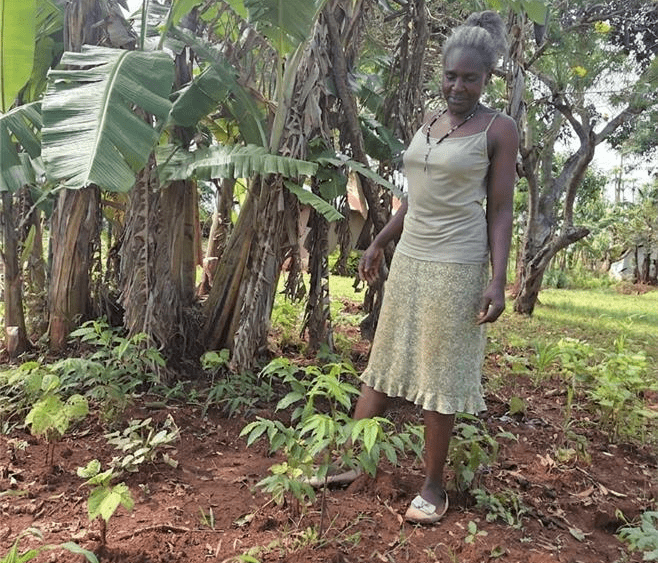
Alice Anyango (Farmer).
For Erick Onyango, the project unlocked long-held entrepreneurial ambitions. He had always wanted to rear dairy cattle and start a clothes business but lacked the capital to do so. That changed through My Farm Trees.
“I received the first KES 54,000 ($419 USD) and bought two cows. My second tranche amounted to KES 93,000 ($721 USD), which I invested as capital in a clothes business which is now thriving,” he says.
Access to water was the top priority for Joseph Ouma. With incentive payments amounting to KES 29,000 ($225 USD), he invested in piping and a water tank.
“I now have ample water which I use to irrigate my trees,” he explains, demonstrating how incentives are reinforcing both livelihoods and environmental outcomes.
Hellena Otieno’s journey reflects a quiet but powerful transformation. Initially hesitant to join the project, she now marvels at how far she has come.
“I wonder how I got here, a point where I have managed to build a house and own two sheep” she says, acknowledging how My Farm Trees reshaped her outlook and opportunities.
Restoring degraded landscapes, strengthening community resilience
These grassroots impacts align closely with Kenya’s policy direction. The country has in place a National Ecosystem Restoration Strategy (2023–2032) that provides a clear framework for restoring degraded landscapes while strengthening community resilience and livelihoods. Anchored on five pillars, the strategy prioritizes tree growing alongside improved governance and inclusive economic models that place communities at the center of restoration efforts.
According to Peterson Kamau, the Deputy Director-Programs, Projects and Strategic Initiatives at the Ministry of Environment and Forestry, My Farm Trees project fits squarely within Kenya’s national vision, particularly in counties with low tree cover such as Siaya, Laikipia and Turkana, in which the My Farm Tree project was implemented.
“When we are planting trees, besides achieving a clean and healthy environment, we also have mechanisms in place to ensure communities benefit through sharing frameworks,” he notes.
This signals a policy shift that views trees not only as ecological assets, but as engines of rural resilience.
Siaya County currently ranks 44 out of 47 counties, with an estimated 5.26% tree cover, compared to the national average of 12.13%.
Kamau emphasizes that the project’s focus areas were well informed, noting,
“The footprints identified by My Farm Trees were well informed, especially for Siaya, which is among the counties with the lowest tree cover in the country.”
Under national targets, Siaya is expected to plant 15 million trees per year.
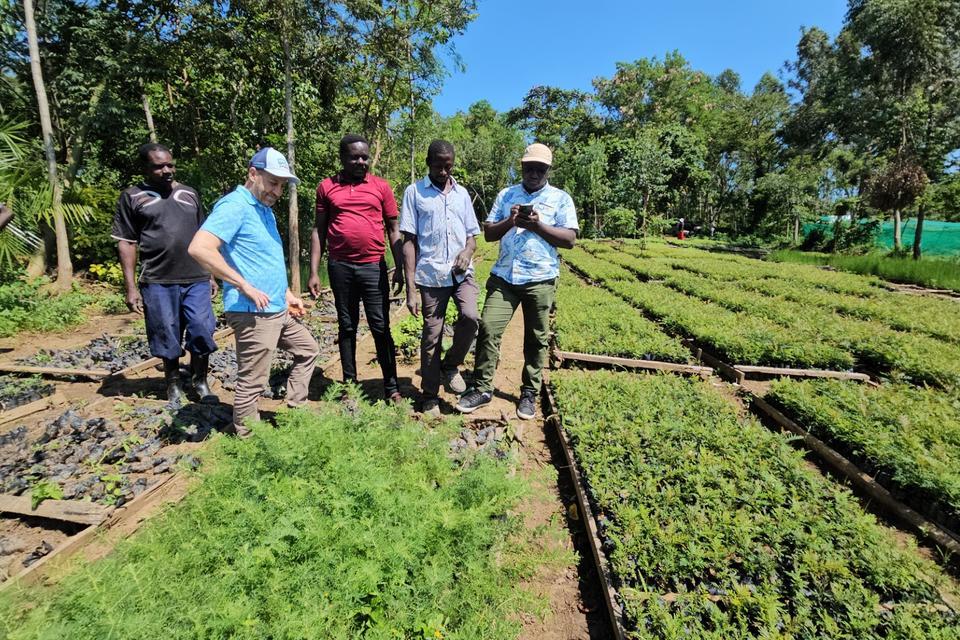
Lawrence Aguda, a tree nursery operator was not only able to but a solar-powered water pumping system, but also employ 10 mope people at his nursery, thus contributing to job creation and improvement of livelihoods.
What sets My Farm Trees apart is its incentive-based model that directly motivates farmers to participate in restoration. Kamau observed that farmer testimonies clearly demonstrate the power of this approach.
“Its amazing to hear how incentives have enabled women and other vulnerable groups to take children to school, buy household goods, and even build houses,” he said, adding that replication and scaling are now key priorities.
Exciting environmental project
For Joshua Schneck - the GEF and Green Climate Fund (GCF) Portfolio Manager for Global Programs at IUCN - the project stands out for restoring ownership to communities. Said he,
“By providing direct payments to farmers, schools, and communities, the project unleashes creativity, entrepreneurship, and real ownership of restoration work,” calling it one of the most exciting environmental projects he has worked on.
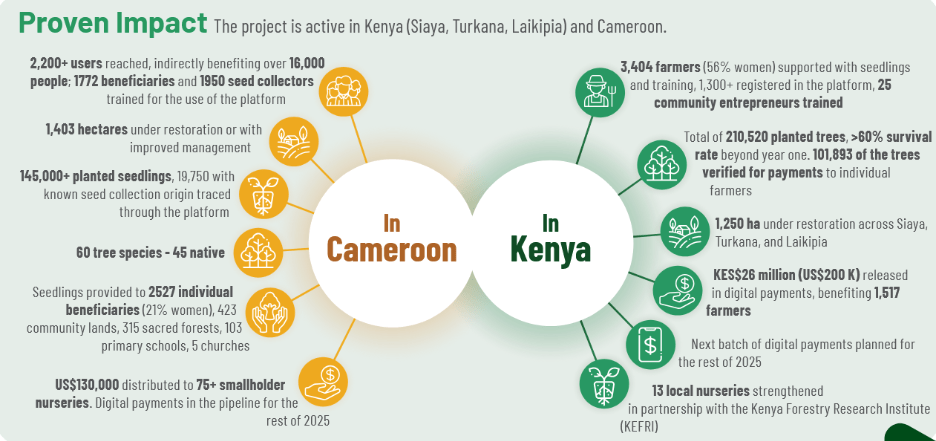
In Cameroon, My Farm Trees has strengthened restoration from seed to farm. The project has supported planting of over 70 native tree species, trained more than 2,200 seed collectors, and worked with about 350 nurseries. Direct engagement with small nursery operators many of them women as made the system fairer and more inclusive.
Reflecting on the overall journey, Dr. Chris Kettle, the Global Project Lead, describes My Farm Trees as is more than a tree-planting initiative.
“We’ve been on a real journey using the My Farm Trees digital platform not just to incentivize farmers, but to improve the whole system - from seed collection and nurseries to tracking, tracing, and paying farmers fairly for their restoration efforts,” he explains.
Looking ahead, the combination of technology, dignity, and community ownership continues to fuel optimism that My Farm Trees can scale across countries growing trees, restoring ecosystems, and building more resilient futures.
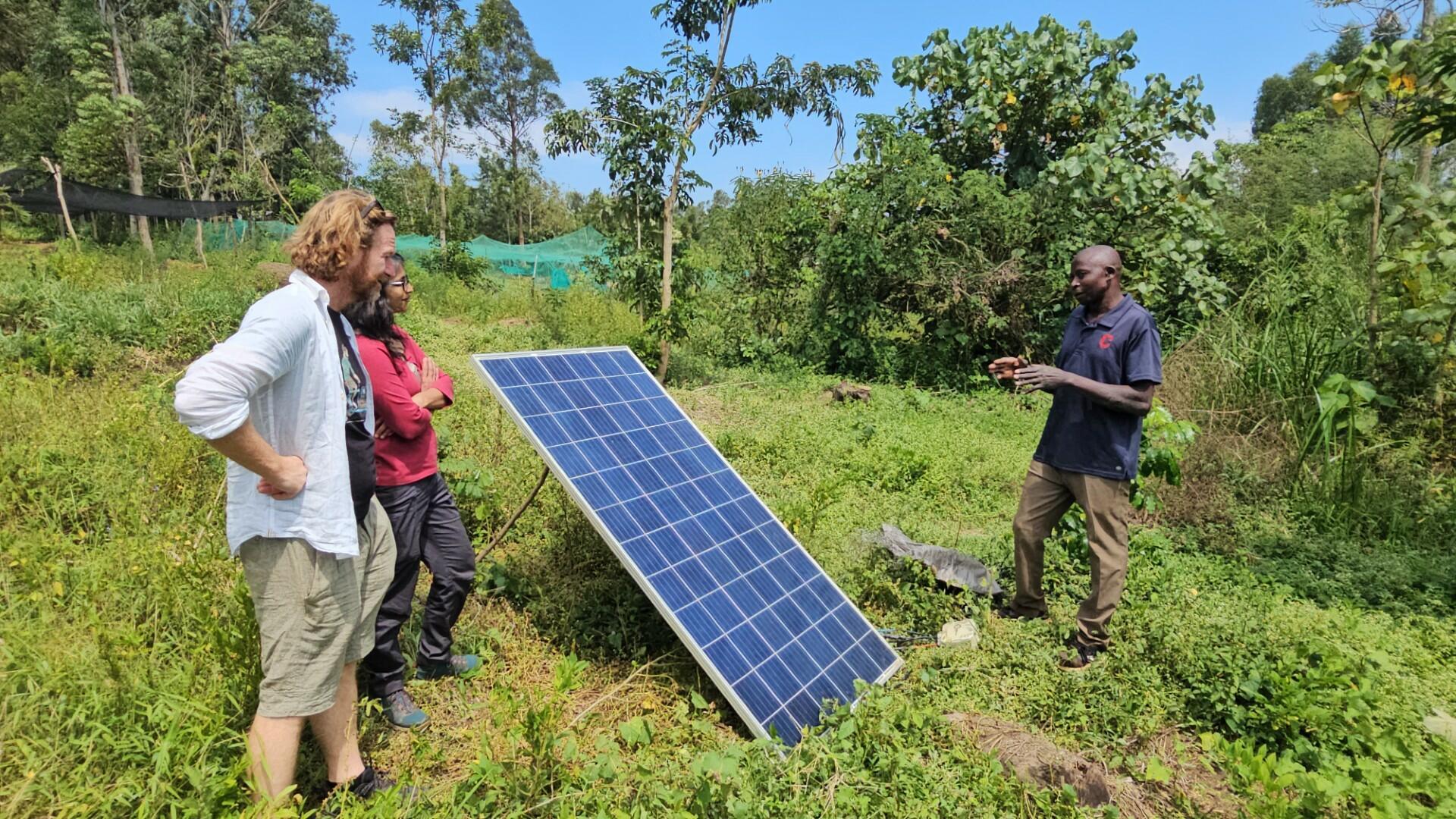
Lawrence Aguda shows his solar-powered system.

Chris J Kettle
Principal Scientist, Lead Tree Biodiversity for Resilient LandscapesImpact