Blog Discover how environmental and technological governance is woven across the Amazon of Colombia and Peru
Our new paper maps 392 organizations and 793 cooperation ties (2021–2023) in the Colombia–Peru Amazon, revealing fragile governance: reliance on a few hubs/tech platforms and weak cross-border links.
The Amazon, the most biodiverse biome on the planet, faces increasing pressures from deforestation, illegal mining, agricultural expansion, and extreme climate events that exceed local response capacities. It is not enough to look at isolated policies or projects; it is essential to understand how the different institutions working to address these challenges connect with each other.
In the Colombian and Peruvian Amazon, there is a wide range of government actors, local organizations, universities, international NGOs, research centers, and technological networks working on environmental issues and collectively forming a cooperation network that supports environmental governance in the biome. But how solid is this network? Who connects to whom? Where are its strengths and weaknesses?
Our recent article, Institutional network relationships and environmental governance in the Colombian and Peruvian Amazon, we analyzed this institutional network by identifying 392 actors and 793 relationships between 2021 and 2023. In this analysis, an actor is understood as any institution, organization, or platform that participates in information exchange, cooperation, or decision-making within the environmental governance system. We focused on cooperation relationships, use of technologies, and knowledge transfer based on interviews with 131 experts from 60 organizations and institutions operating in the Colombian and Peruvian Amazon (full node details are provided in the following dashboard).
- Central actors structuring the network: Platforms and organizations such as SERVIR Amazonía-International (an international program providing satellite information and geospatial tools), the Alliance of Bioversity International and CIAT (a research center linking science and environmental technologies), and the Amazon Scientific Panel–Network (a scientific network integrating experts to generate knowledge about the Amazon) appear with the highest centrality. They connect local, national, and international nodes and are essential for enabling the circulation of information, methodologies, and technologies across the network.
- Technologies as collaboration bridges: We identified 51 technological platforms among them MapBiomas (a regional platform that generates land-use maps using satellite images), Geobosques (the Peruvian deforestation monitoring system), and SMByC (the Colombian system that reports changes in forests and carbon) which account for nearly 44% of interactions. These tools not only provide data but also act as meeting points for diverse actors, facilitating cooperation and supporting strong institutional connectivity.
- Different national networks and limited cross-country connection: In Peru, there is greater internal cohesion among environmental agencies, research institutes, and regional governments. In Colombia, the network depends on a few hubs, such as Corpo Amazonía and IDEAM. Despite sharing a biome, a border, and a language, direct connections between Colombia and Peru on Amazon-related issues are scarce in the data analyzed.
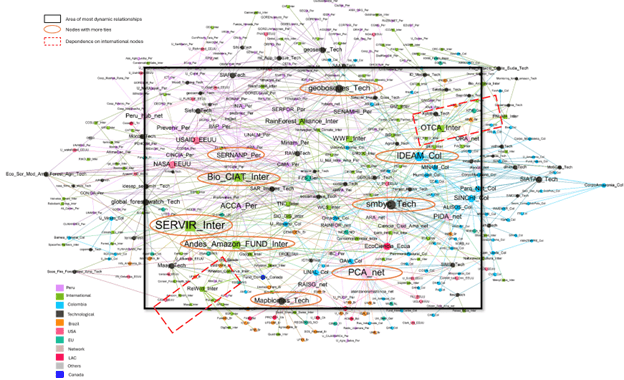
Colombian and Peruvian Amazon Network
Fragility of the network and risk scenarios
To assess how vulnerable this network is, we used an information diffusion simulation model inspired by epidemiological models (of the “susceptible–infected–recovered” type). Instead of simulating disease transmission, we simulated how information and knowledge spread when certain nodes activate or lose their connections.
The results show that:
- If the 30 most central nodes (approximately 8% of the network) are removed, the capacity to transmit information and resources decreases by up to 38%.
- Technological nodes function as bridges within the network links. In an extreme scenario where these technologies fail, 73 organizations would become completely isolated (zero connections), and dependent nodes would disconnect, revealing the network’s fragility to technological disruptions.
- International actors contribute 37% of the links, bringing resources and capacities but also creating asymmetries: many key decisions are made outside the biome, and local and Indigenous priorities do not always remain at the center.
herefore, the network works, but it depends on a few actors and specific technologies, making it fragile in the face of sudden changes.
Implications for environmental governance
We propose three priorities to strengthen environmental governance in the Amazon of Colombia and Peru:
- Develop or integrate digital platforms that make it possible to monitor who cooperates with whom, which technologies are used, and where gaps in connection exist, enabling the identification of isolated zones or actors and guiding resources more effectively.
- Strengthen Colombia–Peru cross-border cooperation to promote binational projects that integrate information, technologies, and joint actions in the Amazonian border region, where the institutional network is currently weak.
- Optimize the efforts of Colombian and Peruvian actors by strengthening their links with other countries, adopting environmental technologies, and reinforcing relationships and capacities with local and Indigenous organizations through training, financing, and technologies adapted to the territory.
A call to action:
The network map we present shows that the Colombian and Peruvian Amazon is protected by a broad institutional framework, but one with unequal connections and clear vulnerabilities. Recognizing the central role of certain organizations and technologies is useful, but it also highlights a risk: if these nodes fail, much of the cooperation weakens. Strengthening ties among local actors, consolidating cross-border alliances, and using technological platforms more strategically can help move from a fragile network to more resilient governance, less dependent on a handful of actors. In a biome as critical as the Amazon, these decisions of institutional articulation are just as important as the technical decisions about what to conserve and how to do it.