
Blog Artificial Intelligence built with Africa’s bean farmers, not just for them
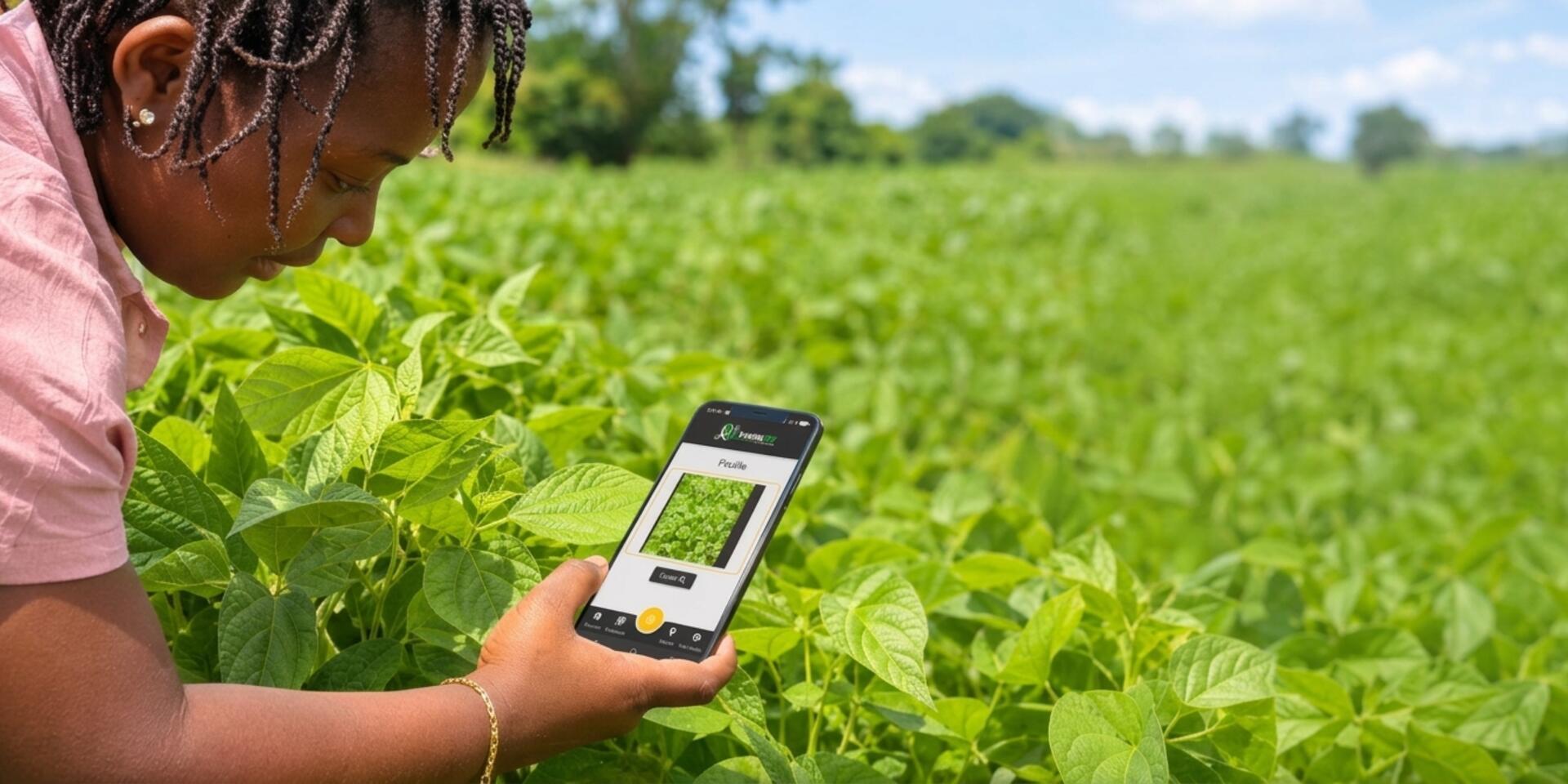

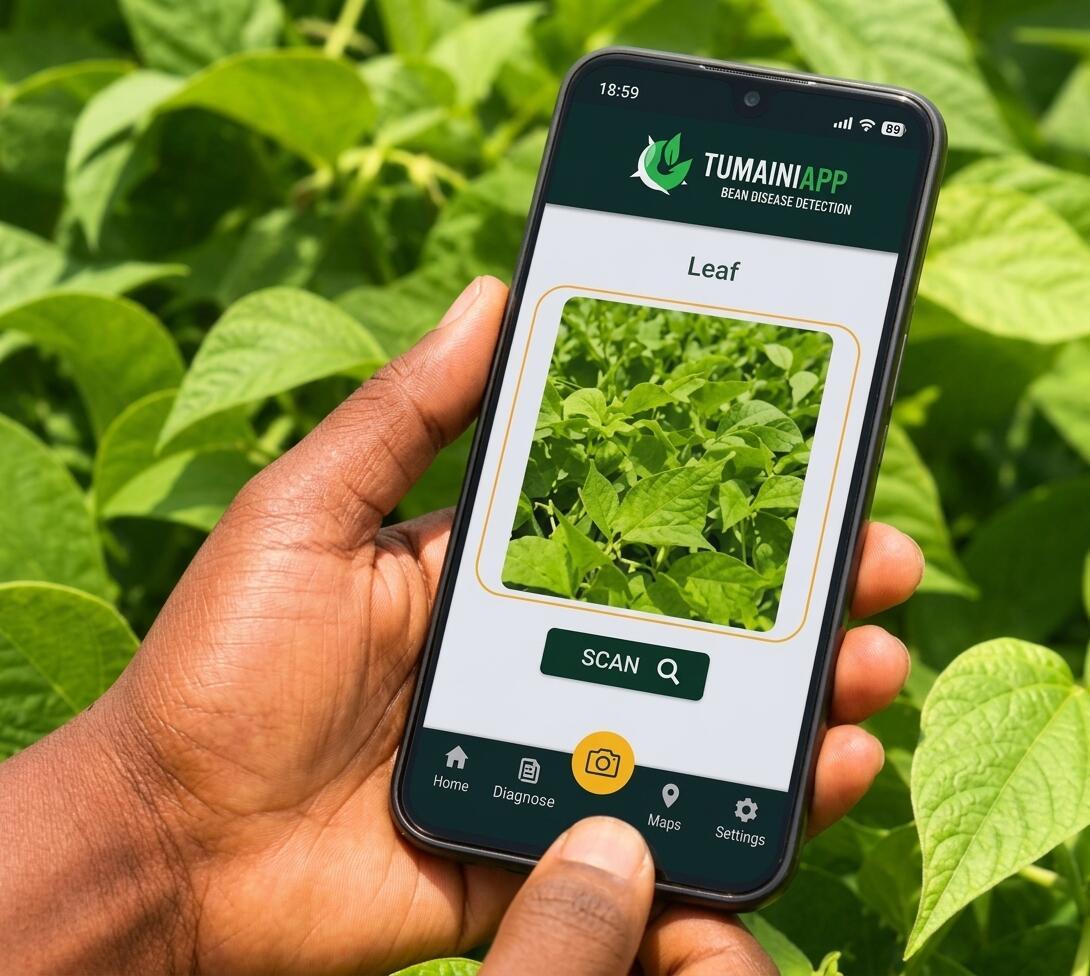
A farmer photographs a damaged bean leaf. Seconds later, the app names the likely disease and suggests how to manage or control it. That one gesture is the entry point to something larger: a digital service that the Alliance of Bioversity International and CIAT and PABRA partners are building to carry a farmer from identifying symptoms in the field to the right variety, the right seed and the right market.
Common beans feed and sustain millions of smallholder households across Africa. Disease pressure, low access to timely agronomic advice, and difficulty in obtaining suitable, good-quality improved varieties hold production below its potential. The TUMAINI Beans app tackles the first of these constraints today, while creating a credible pathway towards addressing the others.
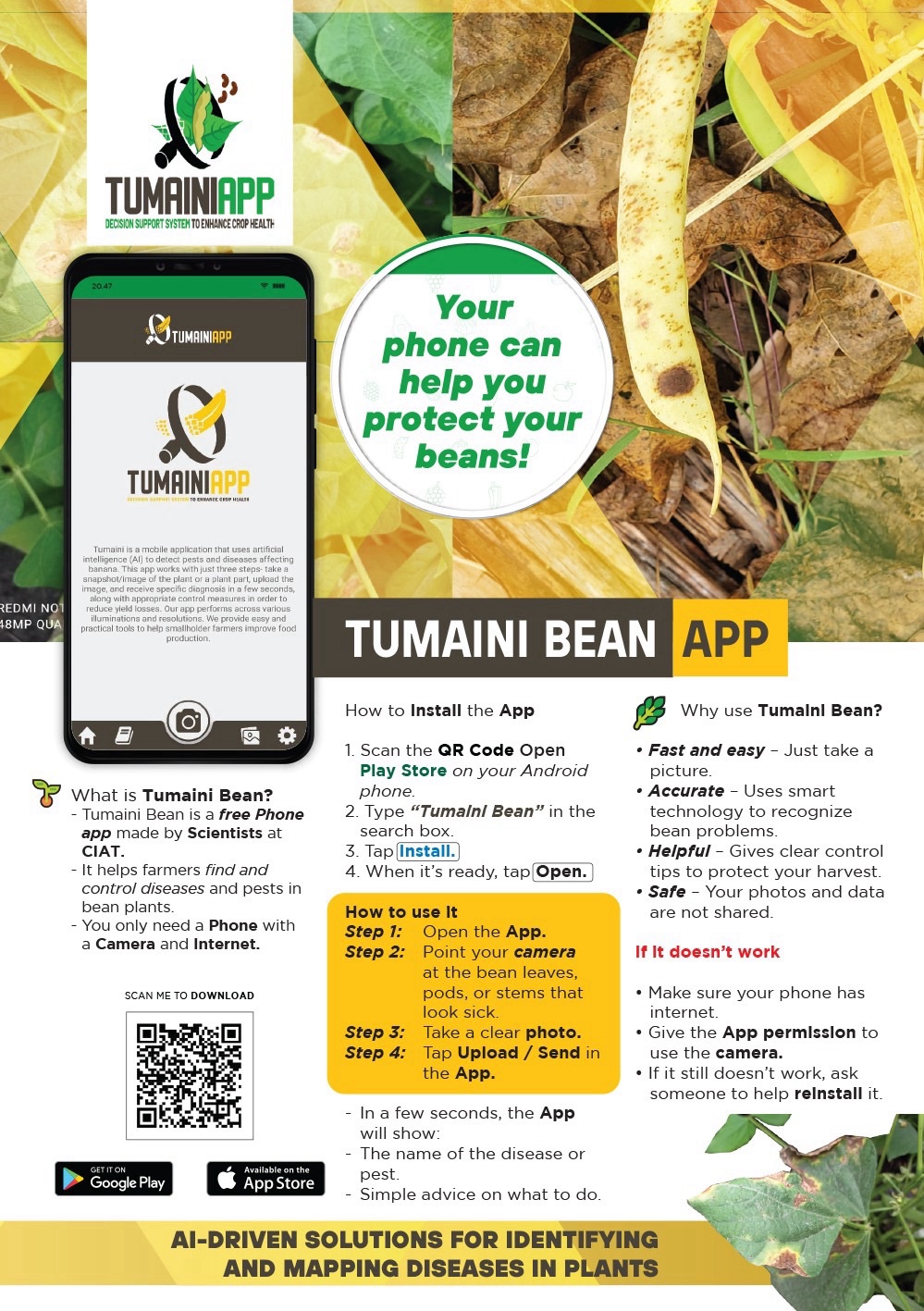
Download the infographic and see how the TUMAINI Beans app works
One photo, a first answer in seconds
TUMAINI Beans is a free smartphone application built by Alliance scientists. It applies artificial intelligence (AI) to images of bean leaves, pods and stems, and returns the likely disease or pest together with practical control measures. A smartphone with a camera and an internet connection is all a farmer or extension agent needs.
The approach is built on an existing, field-tested innovation. TUMAINI was initially developed for banana farmers. The original application was piloted in six countries and has reached approximately 3,000 farmers. The bean version adapts this approach to a crop that plays a vital role in household nutrition, food security and livelihoods across Africa.
“The application can be used directly in the field, reducing the time needed to obtain an initial indication and making extension agents’ work easier.”
Mulonda Lydie Wabiwa, Senior Research Associate, Seed Systems, Alliance of Bioversity International and CIAT
From symptom to advice: linking each image to its field
A label on a photograph is not yet a decision. What to do about a disease depends on the variety grown, the growth stage, the condition of the plot and the options a farmer can realistically reach.
The Alliance and PABRA are therefore integrating TUMAINI Beans with ONA, the platform used to capture farmer and field records. Each AI observation is being tied to the variety grown, the seed source, the location and plot conditions, the management practices and the farmer’s own notes. Where a diagnosis is uncertain, the system is designed to request further images or route the case to an extension specialist rather than guess. This is the step that converts a detection tool into an advisory service, and it is the step now being built.
“A disease alert becomes more useful when it is considered alongside the variety a farmer grows, the seed they can access and the locally available advice. With PABRA partners, we want to test whether bringing these kinds of information together can help farmers make better-informed decisions, leading to increased productivity, stronger economic empowerment for women and improved food security at household and community levels.”
Bola Amoke Awotide, Research Team Leader and Country Representative for the Democratic Republic of the Congo, Alliance of Bioversity International and CIAT

Bola Amoke Awotide
Research Team Leader, Country Representative for the Democratic Republic of the CongoWhen disease alerts begin to strengthen the entire seed system
Here the return on each observation multiplies. By combining georeferenced disease records with PABRA’s knowledge of varieties, resistance and seed systems, it will be possible to show where particular resistant varieties would pay off. Over time this can guide variety targeting, inform seed multiplication plans and strengthen the connections between farmers and verified seed suppliers. It also gives breeders valuable insights into how different varieties perform under real field conditions and disease pressure.
The delivery channel already exists. Through its Bean Corridor approach, built on six years of implementation in Sub-Saharan Africa, PABRA reports connecting more than 250,000 East African bean farmers to a digital marketplace. Smartphone assessment of grain quality, including visible defects, damage and mixtures, is a plausible extension of the same channel, subject to further validation and partner agreement. In other words, one photo library can support crop protection, breeding and trade at the same time.
Responsible artificial intelligence, grounded in the expertise of African partners
PABRA partners are currently testing the integrated TUMAINI Beans and ONA workflow under field conditions. These tests are expected to expose any weak points in recognition accuracy, image capture, data entry, usability and technical integration. They will be followed by validation across production environments, varieties, symptom types and handset models. National research and extension partners set the priorities and supply the agronomic judgement, so the service stays relevant to the communities it serves.
The data layer is being planned with the same discipline. FAIRGROUNDS, the Alliance environment for data management and machine learning, could hold TUMAINI observations, ONA records, PABRA seed-system information and environmental data in one interoperable place, with governance and privacy safeguards built in. The result would be reusable infrastructure rather than another isolated app.
“AI can offer a useful first indication from a crop image, but responsible advice requires more than a label. We need good field data, careful validation and local agricultural expertise. That combination is what can make digital crop-health tools more relevant to farmers.”
Dr. Michael Gomez Selvaraj, Leader, Digital Agriculture Platform, Alliance of Bioversity International and CIAT

Michael Gomez Selvaraj
Leader, Digital Agriculture PlatformBeanWISE Africa: the horizon that partners across the chain are drawing
BeanWISE Africa, the concept now being shaped with PABRA, brings this work together in one programme of AI-powered disease advisory and seed-system intelligence to support smallholder bean farmers. The programme is built around five interconnected research directions:
- AI disease detection paired with locally validated farmer advisory;
- participatory surveillance built on georeferenced field observations;
- variety and seed-system intelligence for resistant-variety targeting and quality seed access;
- exploratory smartphone grain-quality assessment and market connectivity;
- research on adoption, advisory effectiveness and agricultural impact.
The programme is closely aligned with the Alliance Strategy 2026–2030, particularly its focus on agricultural resilience, agrobiodiversity, digital knowledge systems and inclusive food economies. It also builds on the Alliance’s existing capabilities (its Digital Agriculture Platform and its expertise in seed systems) and on PABRA’s three-decade network of national research and extension partners.
Where support goes next, and what it would make possible
Three areas would be significantly accelerated with additional backing: validation at scale across a wide range of environments, bean varieties and mobile devices; the advisory layer that translates a disease diagnosis into nationally approved guidance; and the data infrastructure that allows disease observations to inform breeding and seed delivery. Each is a defined step, not an open-ended ambition, and each is already under way at a smaller scale.
The programme relies on complementarity. The Alliance brings capabilities in AI, digital phenotyping and agricultural data science. PABRA brings expertise in bean breeding, seed systems and a continental partner network. African national research and extension partners bring the field judgement that decides whether any of it is adopted.
Partners, funders and researchers interested in the technology are welcome to test the app themselves: search for “TUMAINI Beans” on Google Play or the App Store, point the phone camera at a bean plant and see the result.
Keep exploring

Artificial intelligence meets agriculture
Smartphones can survey crops and listen to farmers. This is AI designed for the hands of breeders, extension workers, and farmers.