Blog Fairgrounds in action: How the CGIAR forages research team is simplifying machine learning operations

In the Tropical Forages program at the Alliance of Bioversity and CIAT, researchers Andres Ruiz and Juan Andres Cardoso are exploring new frontiers in plant phenotyping: using computer vision to analyze images from drones, satellites, and other remote sensing tools. Their goal is to better understand growth, traits, and environmental responses of forage crops by automating image analysis through machine learning.
However, like many researchers across CGIAR, Andres and Juan have faced a familiar challenge: limited access to computing power and administrator permissions on their computers. “Sometimes we can’t get access to what we need, or some of the tools require administrator permissions we don’t have,” they explained. “It makes it difficult to develop and deploy a full machine learning operations (ML-OPS) pipeline on our computers.”
That’s where Fairgrounds is making a difference. Fairgrounds is designed to provide always-available computing resources on the cloud and to make it easier for teams to build, train, and deploy machine learning models collaboratively. For Andres, this represents a significant step forward.
“With Fairgrounds, the idea is to make everything simpler,” he said. “We can train machine learning models using resources that aren’t limited to our local machines, and we can re- use models we’ve already developed. That’s really important because model development is iterative. You’re always refining and retraining.”
Fairgrounds also supports “transfer learning,” allowing teams to adapt existing models for new datasets or related research tasks. For research groups such as Tropical Forages, which work across many environments and species, this flexibility is key to scaling and accelerating research.
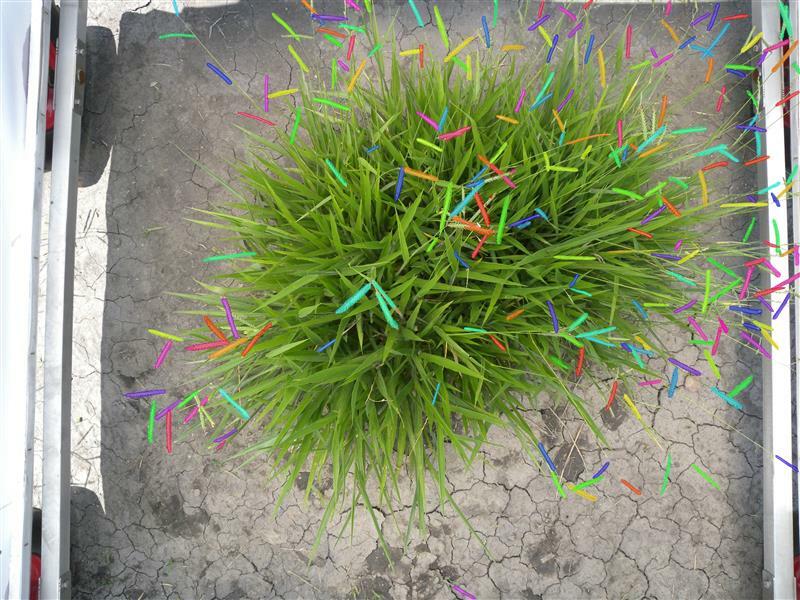
For example, Fairgrounds offers the tools to automate image analysis through machine learning that detects and counts the total amount of racemes in tropical forages (Urochloa spp.) through a web or a desktop-based application. Datasets and models will be available following FAIR principles (findable, accessible, interoperable, and reusable) Credits: D. Arrechea / CIAT"
Experimenting with new tools
“Databricks makes things easier than running locally,” he said, “and Roboflow is especially valuable for computer vision work. It helps organize the entire workflow, from dataset creation to training and deployment, in a way that’s very intuitive for new users.”
For newcomers to machine learning on computer vision applications, Andres believes Roboflow is an easy and approachable starting point, while Databricks provides advanced flexibility for data science experts. He also highlighted the value of shared examples and peer learning within CGIAR, as Databricks continuously evolves with new features and capabilities.
Learning from each other
Beyond the technical benefits, Andres sees an important community-building opportunity. Across CGIAR, many scientists are exploring deep learning and computer vision for agricultural research: “There are probably many people across CGIAR centers doing computer vision work, but they don’t always know what others are doing,” Andres said. “It would be helpful to bring this group together so we can share knowledge and examples. We learn a lot by seeing what other people have done.”
This aligns with Fairgrounds’ plan for building a community of practice as more users join the platform. One idea is for community-sourced workflows showing complete processes from dataset creation through deployment. This could inspire other teams and provide valuable learning and replication material.
Open science and shared value
For the Tropical Forages Program, the benefits of shared platforms go beyond efficiency. They speak to a deeper scientific principle: openness.
“In scientific research, the idea is to share what you learn,” Andres said. “Others can see it, maybe have a different perspective, and find new uses or value in what you’ve done. That’s good for research.”
While some researchers may hesitate to share datasets externally, the Tropical Forages Program team views Fairgrounds as a step toward more open, collaborative science, where data and tools are democratized across disciplines and geographies.
Andres summed it up simply: “The Fairgrounds infrastructure provides the best way to organize and deploy machine learning pipelines. People may not realize that at first, but once they start using it, they’ll see the benefit.”
About Fairgrounds
Fairgrounds is a collaborative data platform initiated in 2025 by CGIAR. The platform is built on FAIR principles (findable, accessible, interoperable, and reusable) and aims to transform how agricultural datasets are accessed, shared, and applied across CGIAR and the broader global research community. Fairgrounds (formerly AgPile) provides researchers with scalable computing resources and tools for data science and machine learning applications.
Fairgrounds is facilitated by IFPRI, led by the CGIAR Accelerator on Digital Transformation, and developed alongside pilot collaborators from CGIAR research centers, including the Alliance of Bioversity and CIAT, CIMMYT, IRRI, and IITA. By connecting research teams,
Fairgrounds aims to make scientific computing more accessible, collaborative, and reproducible.
Visit www.fairgrounds.ai
The team

Andrés Ruiz
Research Associate