Blog How to enhance women’s land and resource rights? Reflections on co-creating gender transformative approaches

Lasting progress on gender equality requires more than simply reaching or benefiting women. It demands transforming the very systems that shape their access to land and resources. Perspectives from the 2025 CGIAR GENDER Conference session co-hosted by the Alliance.
An initiative to address the norms underpinning women’s rights
Over the last five years, IFAD’s global initiative “Securing Women’s Land and Resource Rights through Gender Transformative Approaches”, implemented with CGIAR partners, has piloted gender transformative approaches (GTAs) across six countries to strengthen women’s tenure security and voice in natural resource governance.
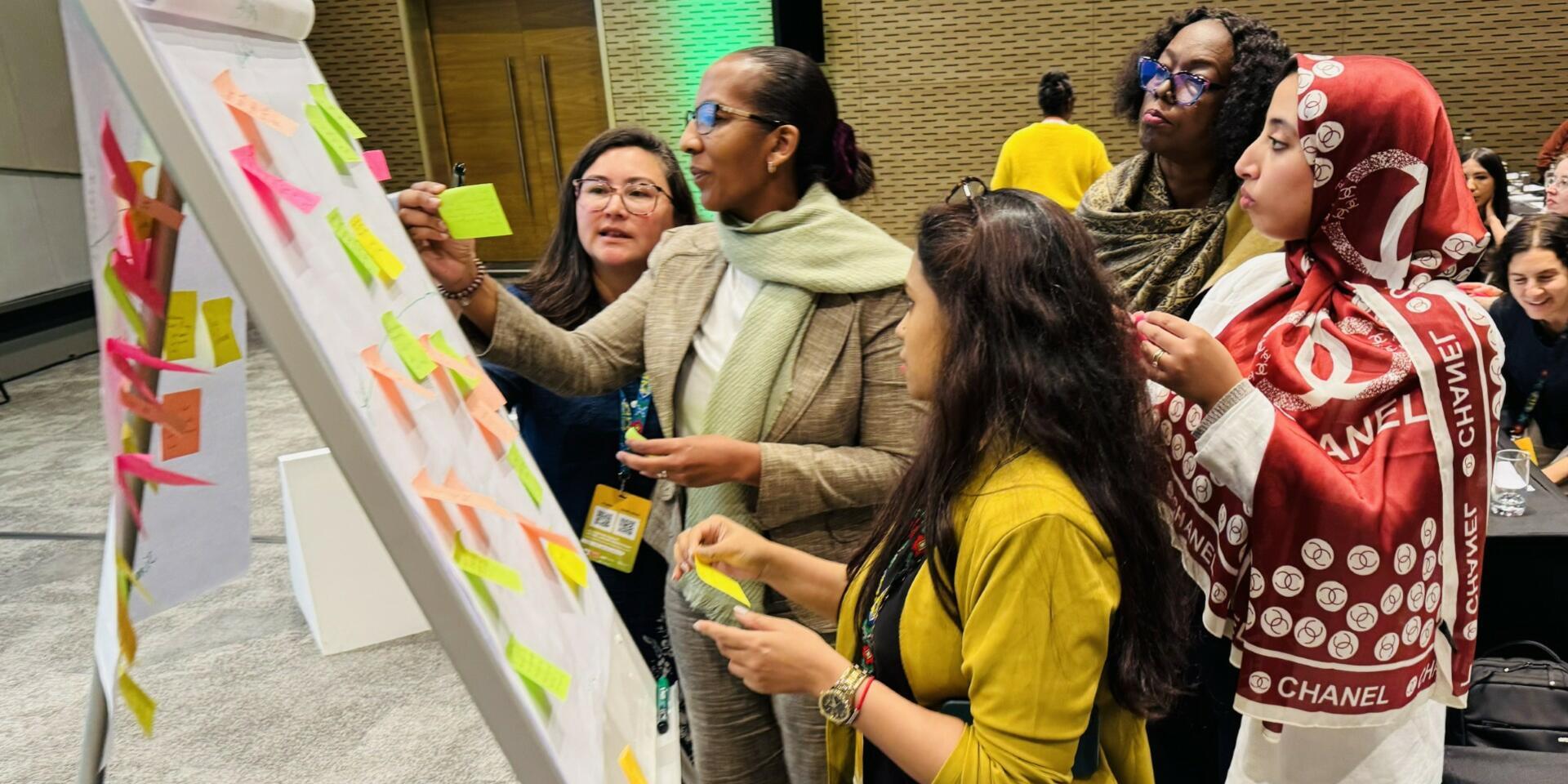
The 2025 CGIAR GENDER Conference in Cape Town was an opportunity for researchers to reflect on the initiative. The Alliance of Bioversity International and CIAT, CIFOR-ICRAF, and IFAD co-hosted a capacity development session titled “Co-creating gender transformative approaches to enhance women’s land and resource rights”.
Tshering Choden (IFAD) described the origins of the initiative.
“We realized that even with large investments in rural development, we were not achieving the results we wanted for women’s access to land”, she said.
“It was clear that we had to address the underlying norms and barriers that limit women’s rights.”
Launched in 2020, the initiative worked in collaboration with national governments and community partners in 6 countries in Asia, Africa, and Latin America with active IFAD projects. Detailed in-country field work and co-creation processes generated a wealth of knowledge products and tools and insights shared at learning events, which are summarized in a How-To-Do Note on securing women’s resource rights through GTAs.
Choden highlighted that this session was so valuable to share some of the GTA tools and approaches, as one of the most important lessons from the initiative was that investing in gender equality directly strengthens IFAD’s mandate to support smallholder farmers.
“Projects that previously struggled with gender performance improved substantially once these approaches were applied,” she reflected.
Tools for Reflection and Action
Two complementary tools, tailored to women’s land and resource rights as part of the initiative, were central to the discussion.
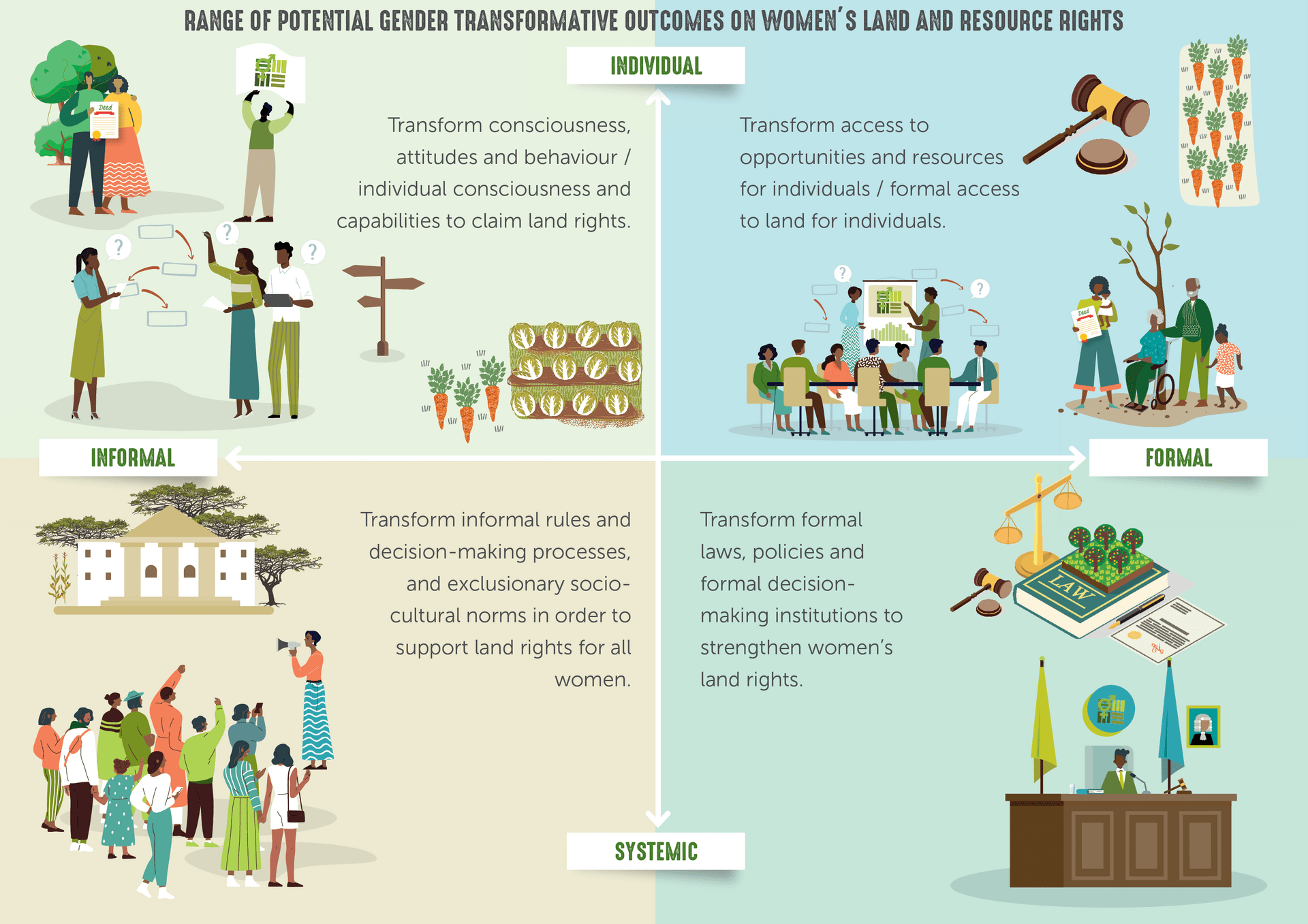
First, an adaptation of the original Gender at Work Framework was presented as a tool to identify and analyze the formal and informal barriers that prevent women from realizing their land and resource rights. Participants mapped out barriers in their own contexts, such as inheritance laws, cultural norms, lack of legal knowledge, or gender-based violence, then discussed strategies to address them.
These strategies ranged from tenure policy reforms to community dialogues challenging discriminatory customs.
“Not all barriers sit in the same quadrant,” explained Miranda Morgan (Alliance of Bioversity International and CIAT). “It’s important to think about the different types of barriers that exist and to act across both formal and informal barriers. The framework helps make that visible.”
The participatory exercise underscored a key message: transformation requires both systemic and personal change. As one participant from Kenya reflected,
“When I grew up, women couldn’t inherit land. The Land Act changed that, but change also needed to happen in people’s minds.”
Tracking gender transformative change
Anne Larson (CIFOR-ICRAF) guided participants in use of the second tool; an adaptation of the original Reach-Benefit-Empower-Transform (RBET) Framework. In the context of the initiative, the RBET Framework was used as a planning and evaluation tool, to help track how interventions move from engaging women to transforming the systems that sustain unequal land and resource rights.
“We’re often asked to show impact, but what we really need to measure is the depth of change,”
Larson noted. “The RBET framework helps us do that, by connecting actions to the shifts in power and norms that make equality sustainable.”
By bringing the two tools together and thinking through what “reach,” “benefit,” “empower,” and “transform” look like across the four quadrants of the Gender at Work framework, participants could visualize how change happens and where it stalls.
Key Takeaways
Ana Maria Paez Valencia (Alliance of Bioversity International and CIAT) led a reflective discussion on key takeaways with participants:
- Transformation is a process, not a project. It evolves through co-creation, reflection, and adaptation.
- Formal reforms are essential but insufficient. Without shifts in norms, attitudes, and consciousness, legal progress can remain symbolic.
- Partnerships matter. Collaboration with local governments, civil society, women’s organizations, as well as men as allies is vital for embedding change.
- The right tools can support collective reflection. Tools such as those presented provide structure for collective reflection and planning, helping teams identify where efforts need to go deeper.
As one participant from Uganda put it,
“It’s about meeting people where they are and walking the journey together.”
Closing the session, Marlène Elias (Alliance of Bioversity International and CIAT) reflected on why the use of such frameworks and tools matters.
“These tools make invisible barriers visible. They help us connect what we do at the community level with the structural changes we need to see at national and institutional levels.”
The session “Co-creating gender transformative approaches to enhance women’s land and resource rights” was organized under the CGIAR Gender Equality and Inclusion Accelerator, with support from the CGIAR Trust Fund Donors.