Blog Why sustainability is the future of Africa's grain markets

At October's Africa Grain Trade Summit, leaders urged for investment in SMEs to scale regenerative agriculture, strengthening Africa's fragile grain markets for food security.
"We need to invest in SMEs that are scaling regenerative practices. They are the link between farmers and consumers, and the future of African grain trade." Arnaud Petit, Executive Director, International Grains Council.
This powerful call to action set the tone for the 11th Africa Grain Trade Summit in Zanzibar. Under the theme 'Resilient Grain Markets: Unlocking Africa's Food Security Potential', leaders from across the continent gathered to address a critical challenge: how to transform Africa's grain sector in the face of climate shocks, market volatility, and rising food insecurity.
The message was clear: the path to resilience runs through sustainability, and small and medium-sized enterprises (SMEs) are the key drivers of this transformation.
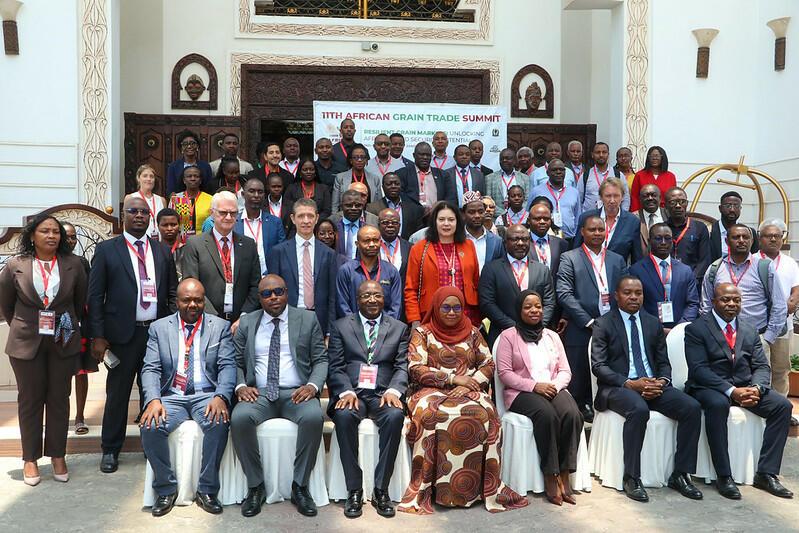
The event was attended by Eng. Zena Ahmed Said, Chief Secretary and Secretary of the Revolutionary Council, Government of Zanzibar; over 500 delegates joined the event, including policymakers, private sector leaders, researchers, and development partners working along the grain sector from Africa and beyond.
SMEs are the backbone of Africa’s food systems, accounting for 85% of Africa’s agrifood value chains and contributing up to 60% of employment. The SMEs play a critical role in aggregating and distributing grain across rural and urban markets, supplying inputs and services to smallholder farmers, driving innovation in processing, packaging, and logistics, and facilitating cross-border trade and regional integration. Yet, these SMEs face persistent challenges such as limited access to finance and climate-smart technologies, inconsistent policy environments and vulnerability to climate shocks and supply chain disruptions.
On the other hand, over 70% of agricultural production comes from smallholder farms, typically less than 2 hectares in size. These farms are predominantly rain-fed, making them highly vulnerable to climate variability. Agriculture is labor-intensive with limited mechanization, and yields are generally below global averages due to climate change, declining soil health, and poor agronomic practices.
Assessments show that 65% of African soil is degraded, and 77% suffers from soil erosion, with the annual soil loss costing about $4 billion USD.
Almost all countries have negative soil nutrient balances due to erosion, leaching, continuous crop harvests, and low application of inorganic and organic fertilizers. Africa's fertilizer use averages 21 kg/ha compared to the global average of 156 kg/ha. Soil organic carbon is below 1.5% and rapidly declining due to crop harvests and other losses. Cultivated croplands have the lowest biodiversity compared to undisturbed or less disturbed soils. Approximately 30% of soils in sub-Saharan Africa have pH < 5.5, mainly in sub-humid areas, and over 80 million ha of soils have pH > 8.5, commonly in arid and semi-arid areas.
There is an urgent need to develop resilient grain production systems that can prepare and plan for, absorb, recover from, and adapt to adverse events. Adopting regenerative agriculture is one key step to achieving value chain resilience and ensuring long-term sustainability.
“Resilient grain markets powered by regenerative agriculture offer a pathway to sustainable food security and trade,” observed Dr. Boaz Waswa, a soil health researcher at the Alliance of Bioversity International and CIAT.
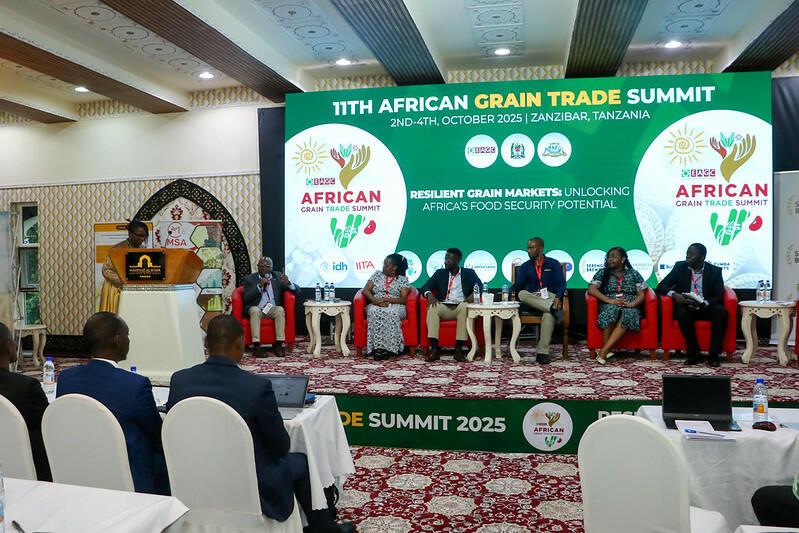
Panel discussion on building resilient grain production systems.
Why sustainability matters for business
In today’s rapidly changing world, sustainability is critical to the success of any business. For grain SMEs, adopting regenerative agriculture and climate-smart logistics reduces vulnerability to shocks and builds resilience. Sustainable practices help businesses mitigate climate risks such as droughts, floods, and soil degradation while ensuring supply chain stability through regenerative agriculture sourcing. They also enable compliance with evolving regulations and help avoid penalties. Consumers and buyers are increasingly demanding traceable, ethically produced, low-carbon, and eco-friendly products, along with certifications such as organic, fair trade, and climate-smart. Embracing sustainability helps businesses meet these demands, opening doors to premium markets, carbon finance, and global trade. Grain SMEs using regenerative agricultural practices often report higher yields and lower costs over time along production chains. Businesses adopting sustainability also have opportunities to create new revenue streams, such as carbon credits, circularity, and environmental payments. Those with strong sustainable sourcing and processing profiles tend to attract more funding and investment.
The call for resilient and sustainable grain markets aligns with the goal of Growing Together, a program led by The Sustainable Trade Initiative (IDH) and funded by NORAD. The program seeks to transform local food markets, improve food security and local economies, and increase the income of smallholder farmers. As a partner in the program, the Alliance of Bioversity International and CIAT is supporting SMEs in Tanzania and Ethiopia to integrate climate resilience and regenerative agriculture into their production systems. This is achieved through climate risk value chain assessments, capacity building for value chain actors, and helping SMEs design data-driven regenerative agriculture interventions along commodity value chains and business operations.
By embracing regenerative agriculture and leveraging trade innovations, Africa’s grain entrepreneurs can lead the way toward a more secure, sustainable, and inclusive food future.
Call to action
- The is a need for the grain businesses to prioritize sustainability as part of their production strategies
- There is a need to build in traceability, which will mean working with and influencing the entire value chain: production, processing and marketing
- There is a need for more financing and investment essential to transition business to sustainability