Blog No one has to lose: rethinking power in the data economy of food systems
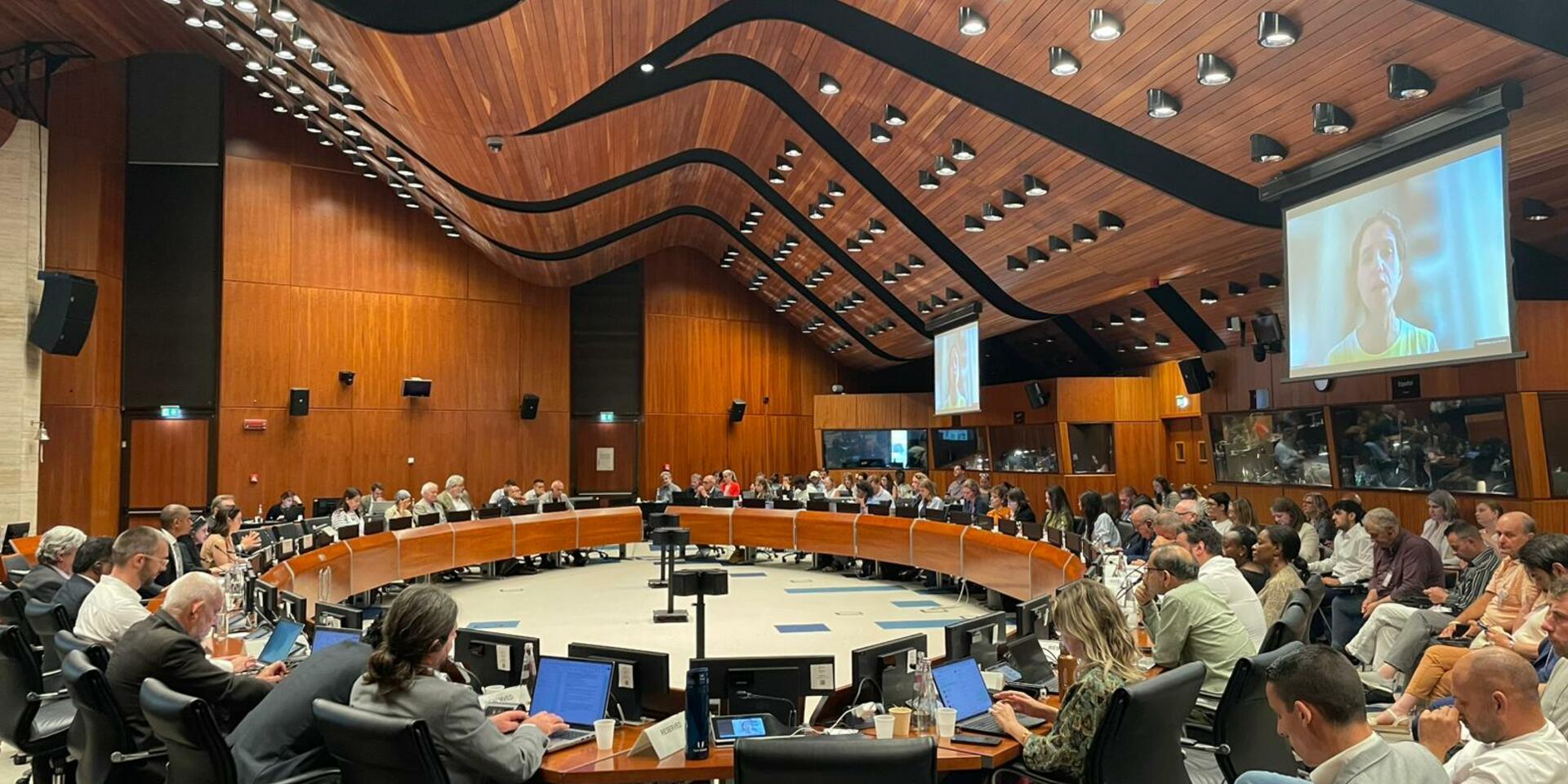

At the CFS High-Level Forum on 30 June, the Alliance argued that inclusive AI governance must be designed with farmers, not for them. Jacob van Etten, Digital Inclusion director for the Alliance, outlined how data, participation and shared governance can make digital food systems fairer.
Who benefits when food systems go digital, and who gets left out? This question was central to the Committee on World Food Security's High-Level Forum on AI, Digitalization and Data Governance.
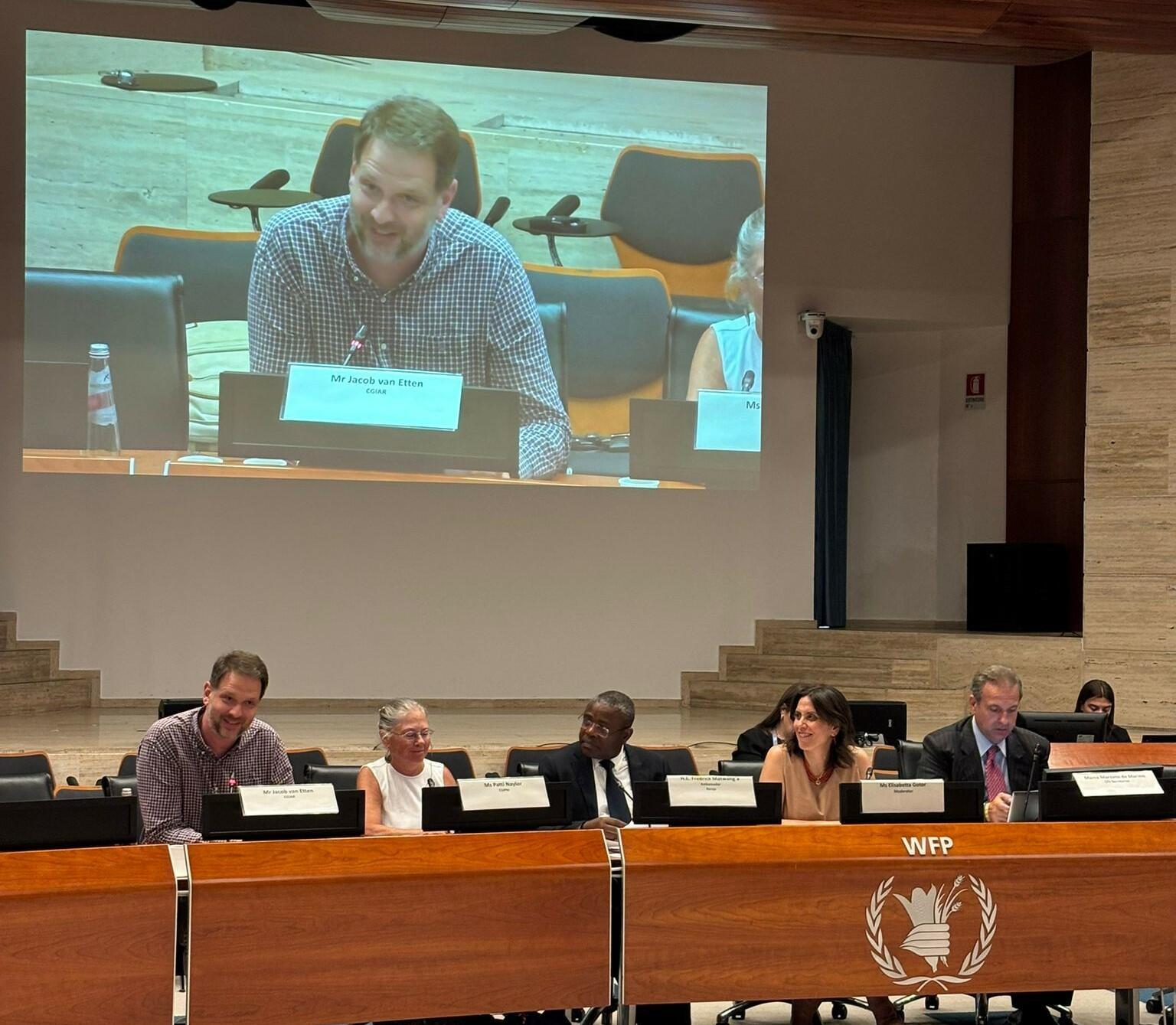
The Alliance of Bioversity International and CIAT had two seats in the room: Elisabetta Gotor, Leader of the Policy, Inclusion and Socio-economic Analysis for Impact and Learning Programme, moderating the Forum, and Jacob van Etten, Director of the Digital Inclusion Research Programme, speaking on Exploring the frontiers of data and innovative AI governance needs in food security. What follows is the shape of their argument.
Three logics, none of them sufficient alone
Data and AI are now infrastructure for food systems. They decide what's seen, what's measured, what gets acted on. And infrastructure is never neutral as it carries the priorities of whoever builds it, finances it, controls it. Three logics compete for control:
1) Markets, which extract value from data wherever it pays;
2) States, oriented toward security and control and
3) Communities oriented towards rights, livelihoods, trust.
Each is legitimate but none is sufficient alone. Leave it to markets and the smallest farmers become invisible, because nobody profits from counting them. Leave it to states and you get surveillance. Leave it to communities and the trust is real but the scale isn't there.
The reference was unexpected for a food security forum: the social scientists Mary Douglas, Marco Verweij and Michael Thompson, and their idea of "clumsy solutions" arrangements that don't resolve the tension between competing logics, so much as hold them in the same room. As Van Etten put it:
“[Fair governance of AI in food systems] will not look elegant. It will look like a negotiated mess that nonetheless works."
Digital inclusion for farming communities: two examples
Two examples illustrate this concept. The first came from the EU Deforestation Regulation, which requires proof that a given crop didn't come from recently cleared land. That proof is increasingly produced through AI, satellite imagery cross-checked against ground data. The smallholder farmer who can't verify compliance is not punished by the regulation directly; the buyer simply stops sourcing from them. A rule built to protect forests therefore runs the risk of filtering out the smallest farmers, not the largest plantations.
The Alliance's own response to this hurdle is Sample Earth, a tool that draws on open, GPS-located reference data so that crop and land-cover maps are accurate everywhere, not just in places that are commercially worth mapping. With better public data, this keeps farmers in the supply chain.
The second example is architectural. Satellite connectivity, such as Starlink, is reaching remote communities, including indigenous communities in the Amazon, in ways that change what's possible. But the same link that connects them to the world also ties them to a single private provider. The solution isn't to reject connectivity, but to pair it with something running underneath it: small language models, light enough to run on a phone, working offline, keeping data and value where the data was generated. This enables local capability to keep a measure of power. This form of “federated learning” is what reconciliation looks like in practice; the model travels to the data and comes back improved, but raw data never has to leave home.
Participation comes first
The harder problem isn't just how data is governed, but who gets to develop the tools from the outset. Most of a building's energy efficiency is locked in at the first sketch, long before anyone moves in. The same is true of AI systems. By the time a tool is finished, the consequential choices have already been made.
What doesn't count as participation? The cookie banner with the click "accept all," protects almost nothing; it is consent theatre, not consent. A real alternative is the data trust: an intermediary holding data under a duty of loyalty to the people it came from, closed by default, but usable by researchers on request. It's most developed in health data, but the logic of privacy and usefulness stop being a trade-off carries directly into food security, where mobility data, for instance, could yield real insight without ever leaving the hands of the people it describes.
The example of this is FUMA Gaskiya, a farmer-led federation in Niger's Maradi region with tens of thousands of members, running its own research with well over a thousand farmers at a time. The data stays with the organization; researchers are invited in selectively, on FUMA Gaskiya's terms. The sequencing makes this work: the organization existed first, with its own leadership and its own capacity to analyze its own data. Researchers came afterward. Power followed local ownership and from that position of strength, the organization could engage national and international researchers with real confidence.
The best solutions are participatory
Both halves are tied together by a refusal of false choices. Openness versus control. Connectivity versus autonomy. Consultation versus delay. The binary is usually the design failure, not the constraint. The best arrangements, such as Sample Earth, federated learning, data trusts, and FUMA Gaskiya, don't split the difference between two goods. They find a way to have both, the version that didn't seem possible until someone built it.
To get to these solutions, participation is crucial. But participation is not tokenism, asking for assent when the design work has been done. Participation is also not about dividing a pie, a zero-sum game. It is not primarily one side handing control to the other. It is about enabling dialogue and collaboration, running all the way down into the details. It is about enabling creativity that overcomes trade-offs. The best solutions are the ones no single party could have designed alone.
The Committee on World Food Security's High-Level Forum on AI, Digitalization and Data Governance was held at the World Food Program’s Rome headquarters on June 30th, 2026.
The Team
Elisabetta Gotor
Director, Land Resource Economics Unit, and Program Leader, Performance, Innovation and Strategic Analysis for Impact
Jacob van Etten
Director, Digital Inclusion