Research Articles Reading the Weather that Never Falls from the Sky

A coffee-farming family in the mountains of Honduras has probably never heard of the Chicago exchange. Even so, what their harvest is worth and what their fertilizer costs are decided, to a considerable extent, over there, somewhere between the grain benchmark, the dollar and the oil curve. Those forces arrive at the farm gate unannounced.
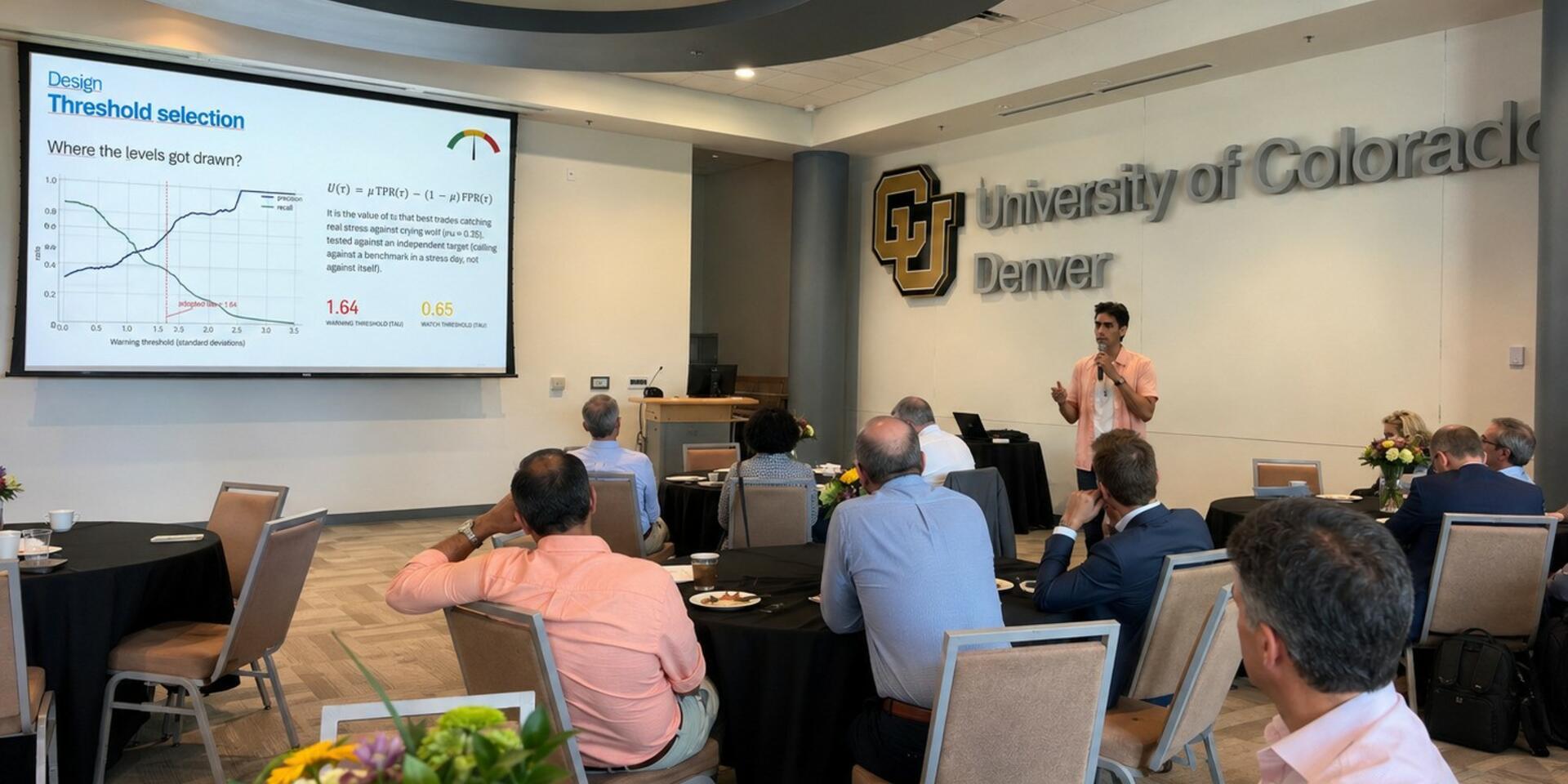
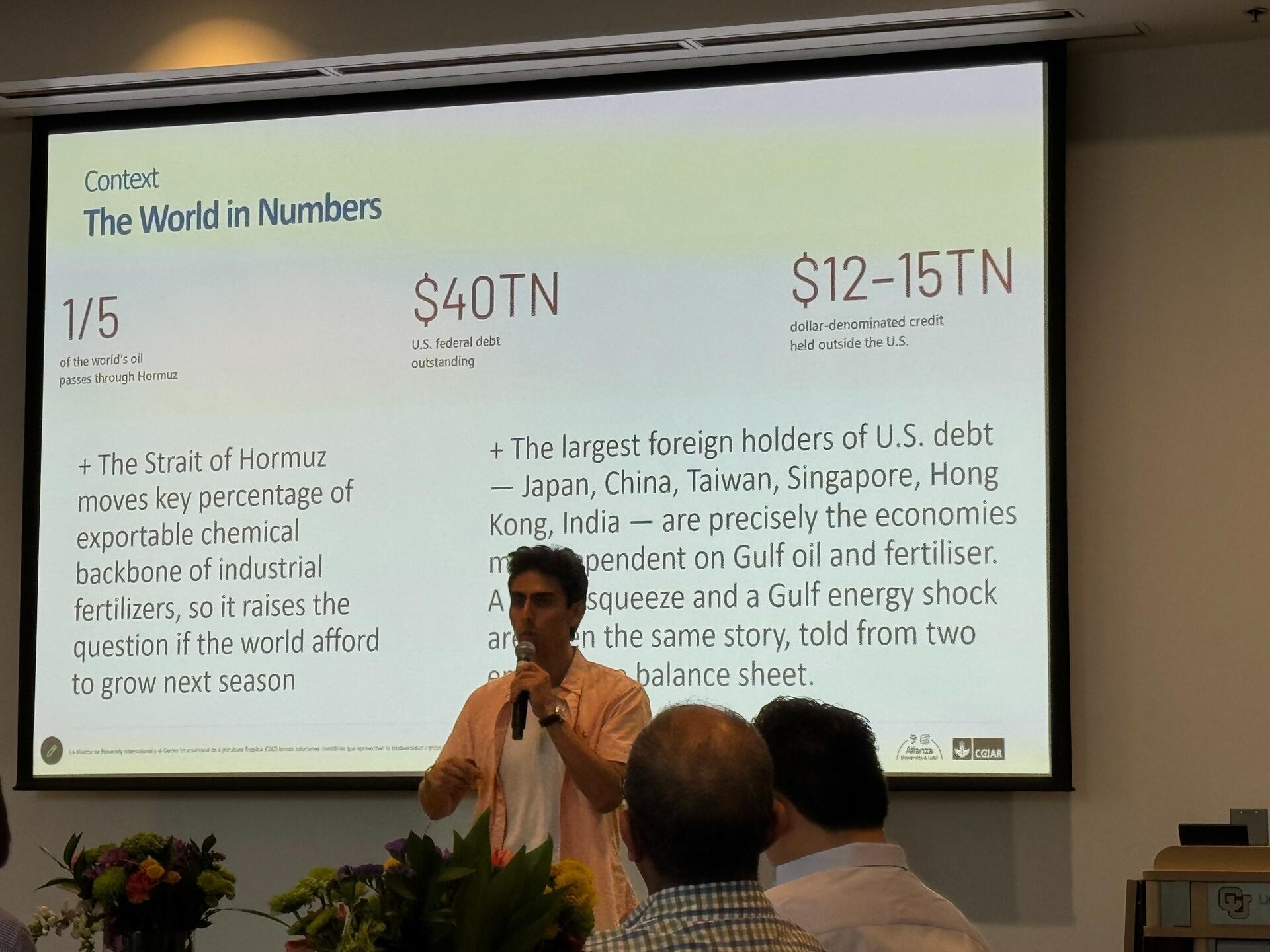
With that idea turning over in my mind, I spent two days this August in Denver at the annual research symposium of the J.P. Morgan Center for Commodities at the University of Colorado Denver, which brought together economists, materials scientists, exchange officials and traders of wheat and oil. I went to present an early-warning barometer for agricultural markets, expecting to hear about matters far removed from our day-to-day questions, and I returned convinced of the opposite, for that room spoke of agriculture the whole time, even though hardly anyone called it by its name.
Markets only look at what is directly in front of them
Several studies presented at the symposium converged on something uncomfortable. Researchers from Hunan University showed that a drought in China only moves rice prices sharply if it strikes during grain filling, those few weeks in which the plant shifts its reserves into the ear and settles the final weight of the harvest; if the drought arrives earlier or later, the market barely registers it. In the American maize belt, traders ignore two-week rainfall forecasts and react strongly only to what the next few days will bring. “Markets weigh information exactly as much as the news deserves”, argued the economist Nicolás Merener. And in the European carbon market, investors pay dearly to protect themselves against a collapse in prices, yet happily sell protection against a rise.
The rule running through these stories is simple and unsettling: the near and specific get priced, while the distant and general find nobody willing to look at them. And anyone working on climate knows that the gravest risks are precisely the distant and general ones.
Prices no longer call the shots on their own
The second lesson is that prices no longer govern production the way the textbooks say they do. Using data from individual wells, a Georgetown University study showed that publicly listed American oil companies have stopped drilling more when prices rise, because their investors now reward restraint and punish expansion, even when expanding would be profitable. If investor sentiment can halt profitable oil wells, it is worth asking what it is quietly doing to decisions about land, water and crops.
Institutions are running behind as well. Fred Seamon of CME Group, the company that operates the Chicago exchanges where the world’s grain prices are set, recounted that his exchange twice created new contracts to reflect the new map of agricultural trade – Brazil has already displaced the United States as the decisive supplier of soya and beef – and twice watched the traders drift back to the old Chicago benchmark within eighteen months. The moral of the symposium fits in a single line, specifically that trust is the scarcest commodity in any market, so new tools only survive when they lean on something people already know and respect.
An early warning for agriculture
This is where the Alliance’s work comes in. The barometer I presented is built from the financial signals traders watch every day and, applied retrospectively, it detected the strain building across currency, energy, and grain markets months before Russia’s invasion of Ukraine sent food prices soaring. Its natural users are not banks but cooperatives, rural lenders, and ministries that stand alongside farming families. The hardest part of building it is not the mathematics but the translation, that craft of turning a market signal into a sentence a farming family can act upon while there is still time to change a decision.
That is precisely the wager of the Alliance’s 2026–2030 strategy, which sets out to conserve the greatest possible diversity of crops, to bring climate and market intelligence to farmers in good time, to build markets that work for the people who grow the food, and to place credible evidence in the hands of those who finance them. Volatility is no longer an interruption of normal times but the medium in which we shall be working. Preparing before the next blow, rather than after it, makes all the difference.
What comes next?
We shall keep refining the barometer with partners across Latin America and searching for the format – a bulletin, a local radio station, a cooperative – that carries the signal all the way to the people who need it. If you would like the full picture, read the Alliance’s new strategy; if you work with producer organizations and would like to pilot the tool, you will find the methodology here, and do get in touch.