Blog Prioritizing the data that matters for food security and nutrition

What information do policymakers need most to tackle food insecurity? The challenge is no longer simply identifying data gaps, but determining which gaps should be prioritized to enable better decision-making.
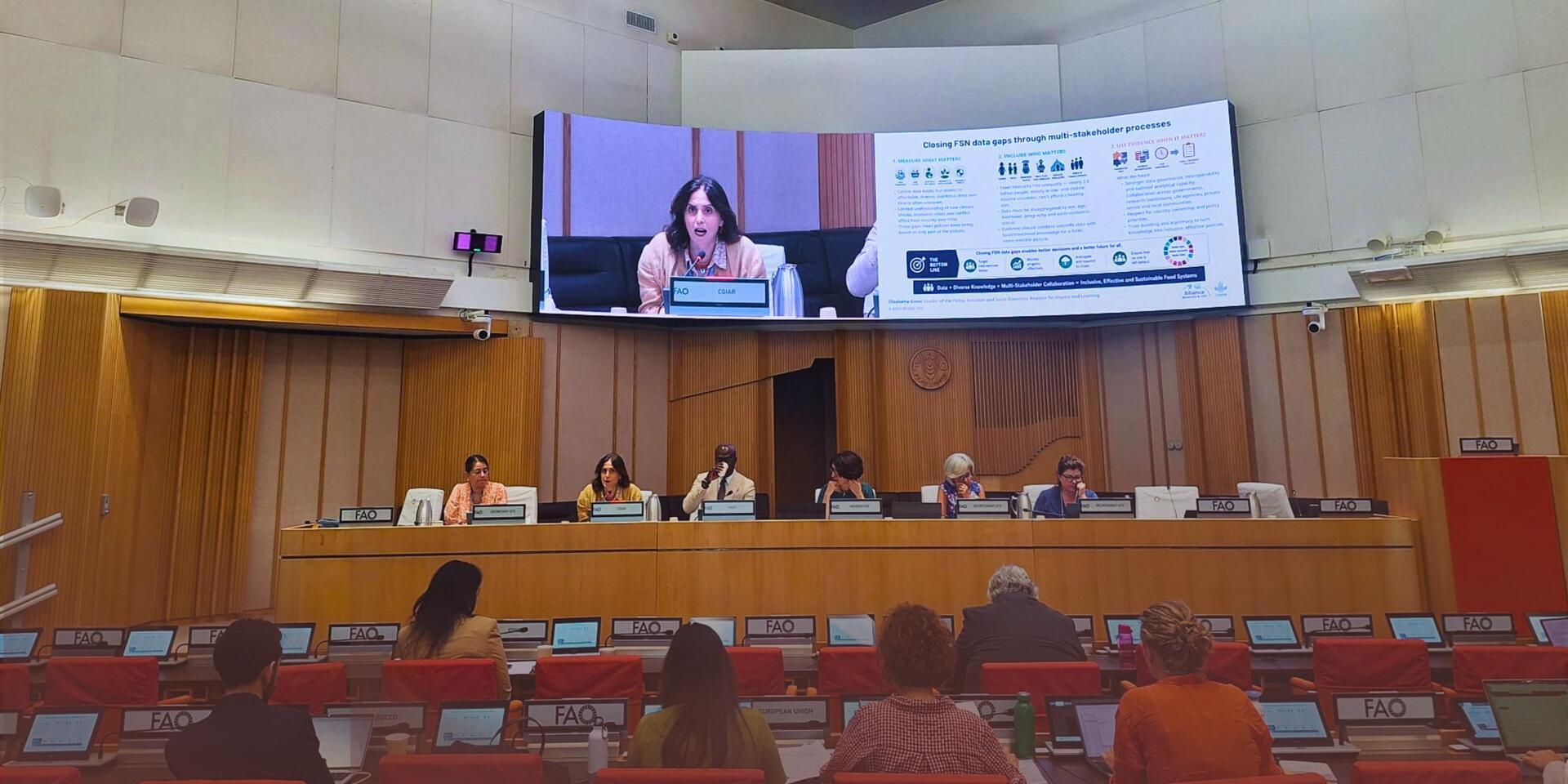
This was the central message of the Collaborative Governance Dialogue hosted by the Committee on World Food Security (CFS) at FAO headquarters in Rome on 16 July 2026. Bringing together governments, UN agencies, civil society, research organizations and the private sector, the event explored how multi-stakeholder processes can strengthen information and data systems for food security and nutrition (FSN).
Elisabetta Gotor, Principal Scientist and Leader of the Alliance of Bioversity International and CIAT's Policy, Inclusion and Socio-Economic Analysis for Impact and Learning (PISA) programme, spoke on the panel "Mapping Priority Data Gaps Across Key FSN Dimensions." Her intervention focused on a critical shift in perspective: rather than trying to fill every data gap, countries and institutions should prioritize the information that has the greatest potential to improve policies and food security outcomes.
She highlighted three priorities for identifying the data gaps that matter most.
Measure what matters
Significant progress has been made in measuring food production and, to a certain extent, food access. However, important dimensions of food security remain underrepresented, including diet quality, nutrition, biodiversity, resilience, and the long-term impacts of climate change, conflict, and economic shocks.
Prioritizing these dimensions provides a more complete understanding of food systems and enables policymakers to move beyond measuring calories towards assessing whether people have access to healthy, diverse, and resilient diets.
Include who matters
National averages often conceal the experiences of those most vulnerable to food insecurity. Women, youth, Indigenous Peoples, small-scale food producers and populations living in fragile contexts frequently face overlapping challenges that remain invisible without disaggregated data.
Prioritizing inclusive data means ensuring that evidence reflects differences across sex, age, geography, livelihoods and socio-economic conditions. It also requires bringing together scientific evidence with local and traditional knowledge through multi-stakeholder collaboration. This creates a richer understanding of why food insecurity persists and how policies can respond more effectively.
Use evidence where it matters
In many countries, the challenge is not a lack of data but making existing information usable. Data is often fragmented across institutions, collected using incompatible methodologies, and unavailable when decisions need to be made.
Addressing these gaps requires stronger data governance, greater interoperability, and enhanced national analytical capacity so that available evidence can inform policy in a timely way. Achieving this depends on sustained collaboration among governments, research institutions, UN agencies, civil society, the private sector and local communities—partnerships that build trust, strengthen country ownership and translate evidence into more inclusive and effective policies.
From data gaps to better decisions
Closing data gaps is not simply a technical exercise. It is about identifying the information that matters most for decision-making and ensuring it is available, inclusive, and actionable.
By prioritizing what to measure, whose realities to capture and how evidence is used, countries can better target interventions, anticipate emerging challenges, monitor progress and accelerate action towards more resilient, equitable and sustainable food systems.

Elisabetta Gotor
Director, Land Resource Economics Unit, and Program Leader, Performance, Innovation and Strategic Analysis for ImpactElisabetta Gotor represented the Alliance of Bioversity International and CIAT on the panel “Mapping Priority Data Gaps Across Key FSN Dimensions” during the CFS Collaborative Governance Dialogue on “Addressing Gaps in Information and Data Availability Through Multi-Stakeholder Processes in Food Security and Nutrition,” held at FAO HQ in Rome on 16 July 2026.
Keep exploring