Press and News Spatial targeting and expansion prevention offer effective pathways to protect African maize from parasitic weeds

A new study in Nature Communications maps, for the first time, where parasitic Striga weeds hit hardest and shows that protecting newly cultivated land is the cheapest way to stop losses from growing.
DAKAR, Senegal, 07 November 2026 - Parasitic weeds known as witchweed (Striga spp.) cost maize farmers in sub-Saharan Africa an estimated US$1.04 billion every year, according to a study published on 15 October in Nature Communications. Half of those losses come from less than 6% of infested land, giving governments and development partners a clear map of where action pays off most.
The research was led by the Alliance Bioversity International and International Center for Tropical Agriculture (CIAT), in collaboration with other CGIAR centers - the International Maize and Wheat Improvement Center (CIMMYT) and the International Institute of Tropical Agriculture (IITA) – and the African Union Inter-African Phytosanitary Council (AU-IAPSC), and the International Centre of Insect Physiology and Ecology (icipe).
“For thirty years, nobody could say with confidence how much Striga really costs Africa. We now have a number, a margin of error and even a map. The conversation can now focus on the question: ‘where do we act first?’”
Alcade C. Segnon, Scientist at the Alliance and corresponding author of the study

Alcade C. Segnon
ScientistA hidden threat to 300 million people
More than 300 million Africans depend on maize for food. Striga is a parasitic weed that attaches to maize roots and takes water and nutrients from the plant. It can reduce yields by 20% or destroy entire harvests. One plant can release over 200,000 seeds, which can survive in the soil for more than 15 years.
Most of the damage happens underground, before Striga becomes visible. Farmers may mistake the damage for drought or poor soil. This has made it difficult to measure its true economic cost. Previous estimates ranged from US$383 million to over US$1 billion, making it hard to plan effective investments.
How the team improved the estimates
The team developed a novel integrated spatially-explicit framework combining agroecological similarity mapping, machine learning, and stochastic modeling to quantify Striga economic impacts across African maize production systems. The researchers combined 2,171 verified Striga records from 1990 to 2020 with data on climate, soil, roads and maize production to generate striga agroecological suitability maps using a Fourier-based algorithm capturing environmental gradients relevant to striga establishment. They used machine learning to systematically extract from published literature c how widely farmers use control methods and how effective these methods are.
They then developed a stochastic model and ran 100,000 simulations quantifying uncertainty at each stage, yielding confidence intervals. This helped them narrow the estimated annual cost of Striga to US$940 million–US$1.15 billion.
Where the losses fall
Ten countries account for 84% of maize losses across Africa, with East and West Africa responsible for 92%. Kenya records the highest annual losses (US$217 million), followed by Nigeria (US$173 million), Mali (US$103 million) and Benin (US$85 million).
However, the financial losses do not tell the whole story. Some countries lose a much larger share of their maize production. Kenya loses 17.5%, compared with 6.5% in Nigeria. The impact is even greater in smaller producing countries: Senegal loses 19.5% of its maize, Benin 17.3% and Niger 13%, although Niger's financial losses are only US$1.4 million.
The study also identifies priority areas where maize losses are high, better control is possible and farming households are particularly vulnerable. These include the Lake Victoria basin (Kenya, Uganda and Tanzania), Sikasso region in Mali, Nahouri in Burkina Faso, northern Nigeria and northern Cameroon.
The 2050 outlook: prevention is the biggest lever
Projections for nine countries that account for two-thirds of current losses show annual losses rising from US$0.71 billion to US$1.33 billion by 2050 if current trends continue (+88%). Under a scenario of weak institutions, they could reach US$2.21 billion, roughly three times today’s level. With the best integrated management, they would be held to US$0.80 billion.
The main driver is agricultural expansion. Newly cleared fields start free of Striga, but contaminated seeds and spread from nearby fields typically establish the weed within 4 to 7 years. Once its seed bank builds up, it persists for over a decade. In East Africa, 76% of projected loss increases come from expansion into Striga-prone land. In West Africa, 67% come from rising infestation on fields already farmed. Mali faces the steepest rise (+220% by 2050), while Uganda’s losses stay essentially stable.
“New farmland gives us a window of a few years before Striga takes hold. Clean seed and early detection in those areas cost far less than decades of fighting an established seed bank.”
Robert Zougmore, Principal Scientist at the Alliance, AICCRA Director and lead author of the study

Robert B. Zougmoré
Director, AICCRAWhat the authors recommend
The authors call for a dual strategy rather than spreading the same effort everywhere:
- Target hotspots on existing farmland, where a small share of the area produces most of the losses.
- Prevent establishment in areas being opened up for cultivation, through clean seed systems and early surveillance.
- Bring parasitic weeds into monitoring and early-warning systems, which today track insect pests and diseases but largely overlook Striga.
- Tailor interventions to local conditions: under identical management assumptions, only five of the nine countries studied return to their 2020 loss levels by 2050.
“Our surveillance systems are good at spotting insects and diseases, but parasitic weeds slip through because their damage looks like drought or tired soil. Adding Striga to national and regional phytosanitary monitoring is a practical, low-cost step African countries can take now.” - Dr Saliou Niassy, Coordinator of the Inter-African Phytosanitary Council (AU-IAPSC) and co-author of the study
Media contact
- Dr Alcade C. Segnon, Alliance Bioversity International and CIAT - ([email protected])
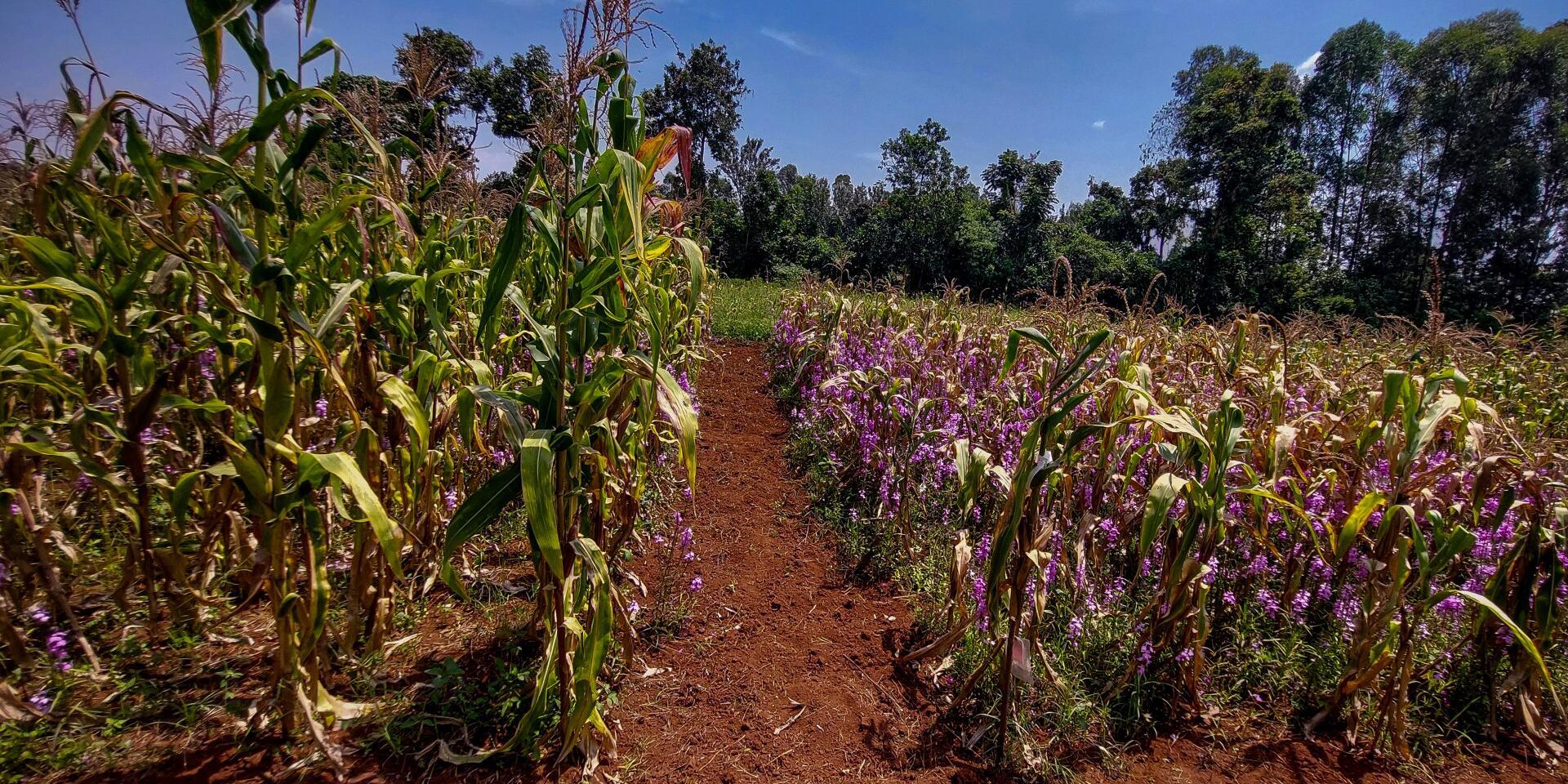
Cover image: Striga tolerant hybrid developed by CIMMYT Right – Commercial hybrid succumbing highly to Striga infestation © Dan Makumbi, 2022.