From the Field Host communities and refugees in Northern Uganda in need of better adapted varieties
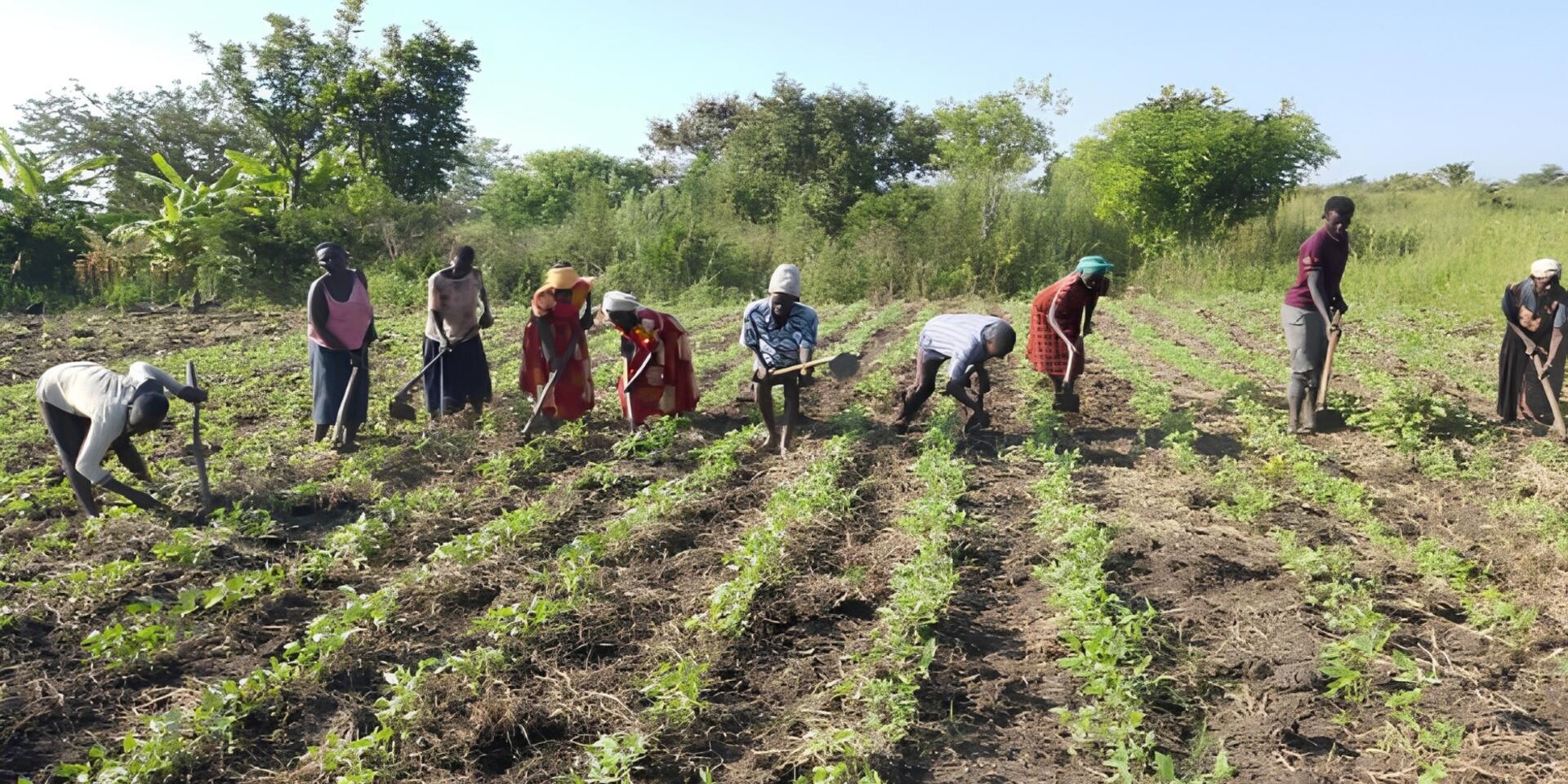

The Palabek and Palorinya Refugee Settlement camps are located in Lamwo and Obongi districts in Northern Uganda, hosting populations of 75,000 and 122,000 refugees respectively, the large majority from South Sudan. Here, a research team is working with local communities to harness crop diversity that can support sustainable farming, improve household nutrition, create income-generating opportunities, and enable timely responses to the adverse effects of climate change. This brief reports on a baseline survey carried out to better understand the livelihood conditions in both districts.
Background
Northern Uganda and South Sudan are home to large numbers of internally displaced persons and refugees. In Northern Uganda, there are over 1.5 million South Sudanese refugees. They live in communities in dire living conditions: limited access to healthcare, persistent food and nutritional insecurity, and degradation of natural resources. The erosion of biodiversity, particularly of staple crops such as cereals, legumes, and vegetables, contributes to their vulnerability. Without diverse and resilient seed systems, farming households cannot access timely, affordable, and high-quality seed and planting material. Crop production and livestock raising remain fragile activities. Women farmers face even greater obstacles due to entrenched socio-cultural and religious norms that limit their participation in community meetings, training opportunities, and decision-making processes. Their exclusion weakens collective resilience, as women are central to household food production and seed management.
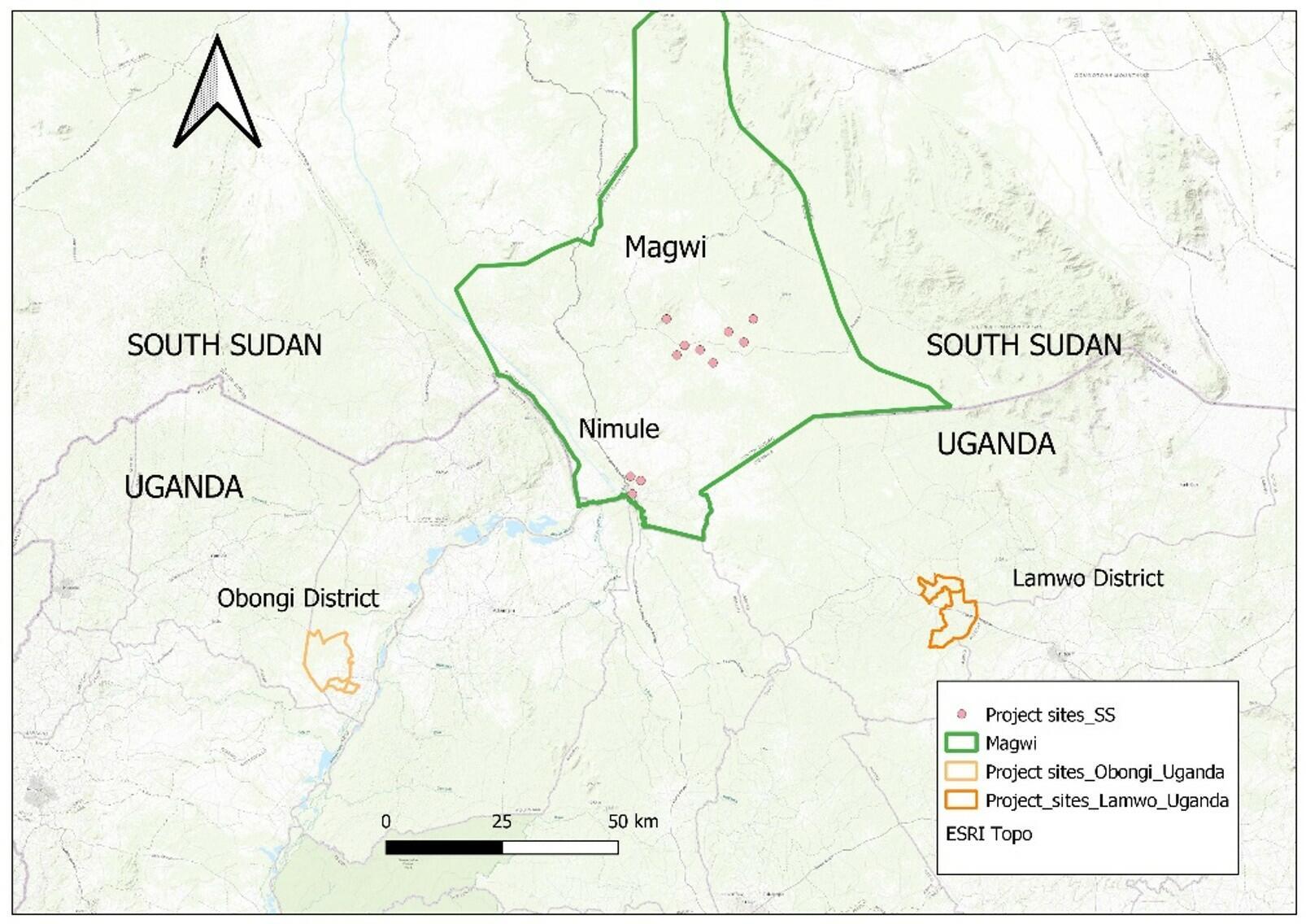
Map. Project sites in South Sudan and Uganda. Sources: UNHCR, National Bureau of Statistics South Sudan, and Uganda National Bureau of Statistics
The project
Despite these challenges, there are opportunities to strengthen resilience and improve livelihoods through more effective use of plant genetic resources. Harnessing crop diversity can support sustainable farming, improve household nutrition, create income-generating opportunities, and enable timely responses to the adverse effects of climate change. Our project, supported by the Benefit Sharing Fund of the International Treaty on Plant Genetic Resources for Food and Agriculture, emphasizes South-South learning and includes livelihood diversification and value addition, sustainable use of crop diversity, seed system assessment, and seed system resilience building.
The project is implemented in Lamwo and Obongi districts in Northern Uganda, where the Palabek and Palorinya Refugee Settlement camps are located hosting populations of 75,000 and 122,000 refugees respectively, the large majority from South Sudan. In South Sudan, two Uganda bordering counties in Eastern Equatoria State, are included: Magwi and Nimule. These sites were selected based on agricultural potential, population densities, accessibility, security conditions, and connections with Uganda. The map depicts the sites.
To obtain a better understanding of livelihood conditions, a qualitative agricultural baseline survey was designed to capture local perspectives of women and men. Survey data were collected through a series of Focus Group Discussions. In South Sudan, 20 people participated in the survey from the two districts and in northern Uganda about 320 from host communities and refugee settlements. Questions asked concerned crop and variety cultivation choices, food consumption, production constraints including climate change, seed access and management, access to information and training, and government and NGO support. Given the project focus, in-depth data were collected for bean, cowpea and sorghum. This brief summarizes the Uganda survey results. A companion brief focuses on South Sudan.
In Uganda, refugee communities opt for cultivating low-input, quick-maturing crops for household subsistence; host communities are more commercially oriented. Although both groups make use of crop- and varietal diversity, farmers could benefit from better-adapted and more resilient varieties. The survey findings point to the need for integrated interventions that address soil health, climate resilience, seed systems, and access to extension services, inputs and markets.
Lamwo and Obongi districts
Crop and variety diversity
In Obongi, households in host communities cultivate a diverse range of crops on relatively large portions of land: in order of importance, sesame, ground nut, cassava, sorghum, maize, cowpea, soya bean and rice. The key factors influencing crop selection were food, income, and market opportunities, combined with ease of cultivation. In the refugee settlements key crops are maize, sorghum, sesame, cowpea, sunflower, coconut and ground nut. Crop selection is motivated by food, income, and staple value, adaptability of crops to the local environment and ease of cultivation. Host community and refugee settlement households cultivate in small plots a number of legumes and vegetables for own consumption in the form of staple food accompaniments (e.g. to make sauces).
In refugee settlements, households opt for fast-growing, resilient crops that require minimal labor and inputs—aligned with the constraints they face. In terms of consumption volumes, among the project priority crops, sorghum is the main staple, with cowpea eaten once a week and bean hardly consumed. Refugee settlement farmers reported limited access to resources, occurrence of diseases and pests, and droughts, as the most critical constraints. Beans are primarily affected by poor soils, while sorghum and cowpea face a broader array of challenges including biotic threats, environmental stress, and limited access to inputs.
In the host communities the cowpea varieties cultivated on larger plots are Goli, Opiruku, Pujiru, big seeded, small seeded; on small plots, Lapotu, brown medium seeded, big black seeded, small whitish seeded. Bean varieties are Kurukuruwa, white, and yellow. Sorghum varieties grown on large plots are Dura, Godo, red, tall and white seeded; on small plots, Godo, Dura, Gayani, short, and white seeded.
In the refugee communities, the cowpea varieties are Lapotu, big seeded, small seeded, and white seeded. Sorghum varieties cultivated on large plots are Godo, Maturu, Mayo, Silina, Sulugumu, and tall; on small plots, Godo, Dula, Gaya, Serena, and short. Bean is hardly cultivated due to poor soils.
Overall, in Obongi, variety choices of the three crops are well-reasoned and influenced by yield performance, resistance to pests and diseases, taste, maturity time, and market demand.
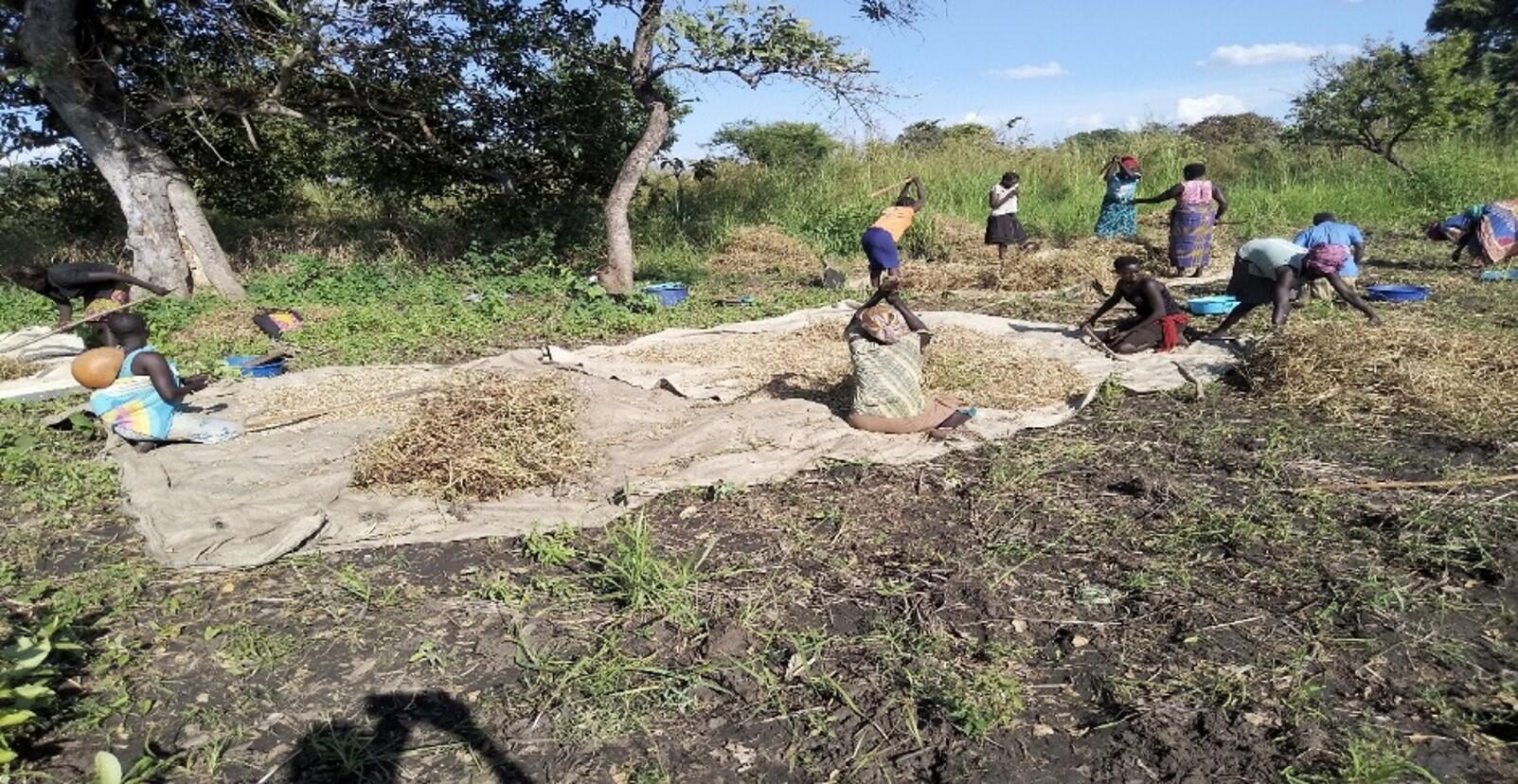
Group members jointly threshing their cowpeas in the group garden. The project promotes use of tarpaulins to reduce post-harvest losses. Credit: VEDCO
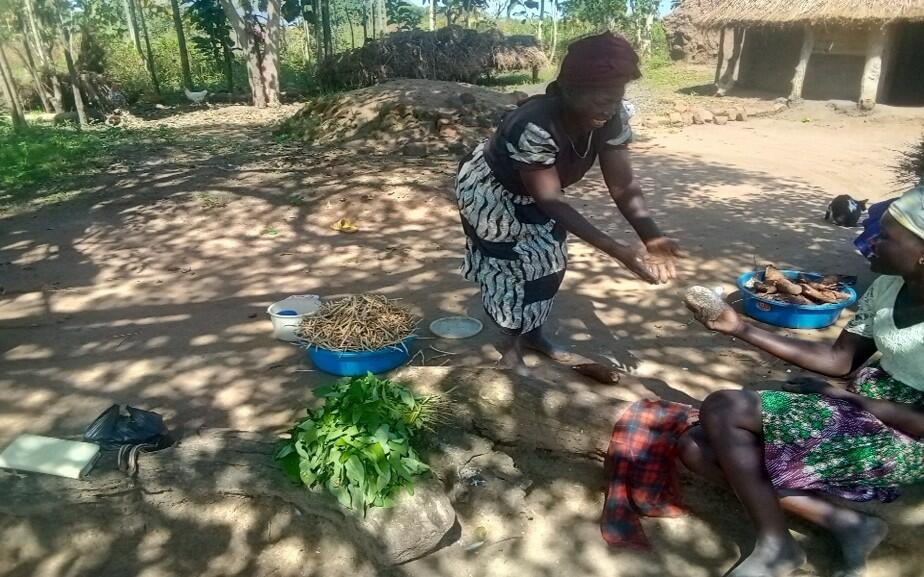
Seed support: farmers are encouraged to multiply the seed they receive in the community through ‘seed transfers:’ giving seed to other people within the community. Credit: VEDCO
In Lamwo, where only host communities participated in the survey, crops grown on large plots include maize, sorghum, cassava, and tobacco (cash crop), bean and soya beans, motivated by satisfying food and income, combined with suitability to local agroecological conditions. Crops grown on small plots are protein-rich legumes (bean, cowpea, groundnut, soya bean) and drought-tolerant grains (sorghum, millet). All crops that are suitable for small-scale production and vital for ensuring nutritional balance, early harvests, and climate resilience. In terms of consumption volumes, bean and sorghum are the most consumed of the project priority crops, while cowpea consumption is low. Farmers reported production challenges caused by climate variability, poor access to quality inputs, and biological constraints (pests, diseases, weeds).
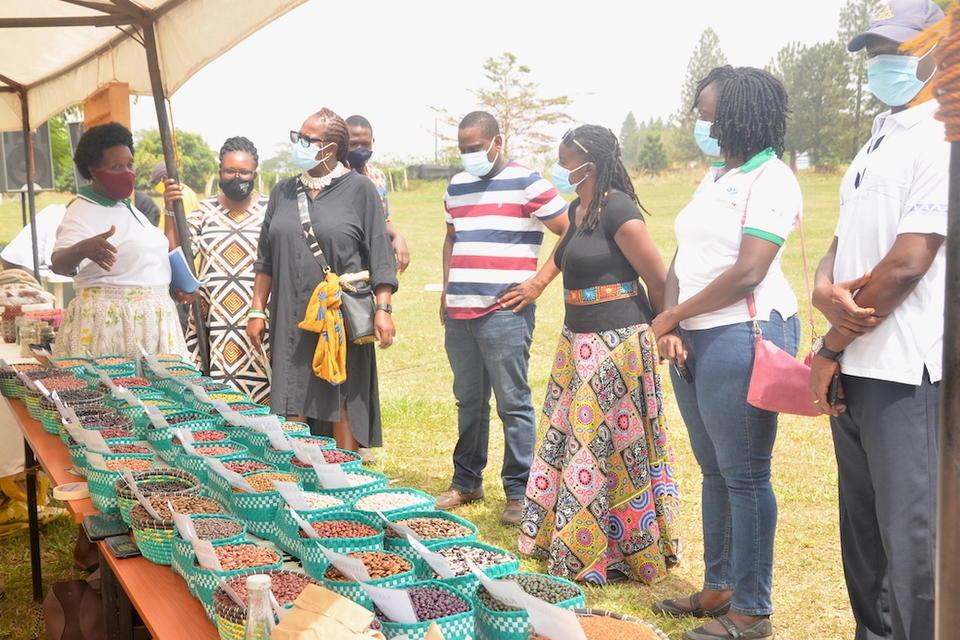
The main cowpea variety categories cultivated among host community households are: name unknown (more than half of the respondents); improved; NARO-SEEDCO variety; white-red-eyed; small brown. The knowledge gap regarding varietal identification suggests that farmers do have limited contact with agrodealers, extension and research and obtain seeds mostly from local sources. Concerning bean grown on larger plots mostly for sale, the varieties are: improved varieties, mixes, black, small black, yellow, Agwede, Kanyebwa, NARO-bean, K21 and K31, indicating a moderate level of varietal diversity with improved and traditional types coexisting, and a significant proportion already adopting improved lines. Small plot varieties largely used for own consumption are yellow, black, white, Kanyebwa, Agwede, and unknown. This choice suggests a stronger leaning towards familiar, traditional bean varieties. Kawera sorghum variety is most widely used on large plots, followed by brown, white, Dura yellow, white Serena, Bel Makwar, Kabir and NAROSOG, indicating a strong preference for improved or widely adapted varieties. On small plots the varieties are: brown; white; white Serena; Dura; Kabir; Kewera red and white, motivated by subsistence needs, culinary qualities, and household consumption.
Seed management
In both districts, seeds are obtained from various sources including self-saved seeds (for local varieties mostly), fellow farmers, local markets, agro-input shops (for improved varieties), and in Obongi, also from NGOs. Seeds are not always available in sufficient amounts and prices are often high. Seed management is hampered by poor storage facilities, the difficulty of identifying quality seed, limited varietal diversity, high rates of poor-quality seed, unreliable sources, and lack of selection knowledge and techniques. When asked about interest in taking part in community-based seed multiplication initiatives, respondents in both districts responded very positively.
In Obongi, the most prominent channels to obtain information about seeds include farmers, community, informal meetings, and family exchange, indicating that interpersonal and community-based interactions are dominant. Other noted but less emphasized channels are radios and knowledge transfer.
In Lamwo, the dominant channels are the same, but with additional sources of NGOs, exhibitions, agricultural fairs, and government to farmer knowledge transfer. In all focus group discussions, participants expressed strong willingness to adopt newly introduced varieties, particularly if traits such as higher yield, pest and disease resistance, and adaptability to local conditions were included. Participants also mentioned that they would like to receive technical know-how about the management of the new varieties.
Support services
In Obongi, agricultural support from the government hardly exists while NGOs offer some. The government’s main activity is seed distribution. In Lamwo, support is much better organized by government and NGOs encompassing extension, seed distribution and training. Regarding agricultural training support, the two districts differ greatly, with Lamwo benefitting from good service and Obongi experiencing serious gaps. In both districts though, more and better support is needed. Farmers asked for improved access to quality seeds, market access, and linkages to buyers and input suppliers. And they requested training on improved farming techniques and value addition.
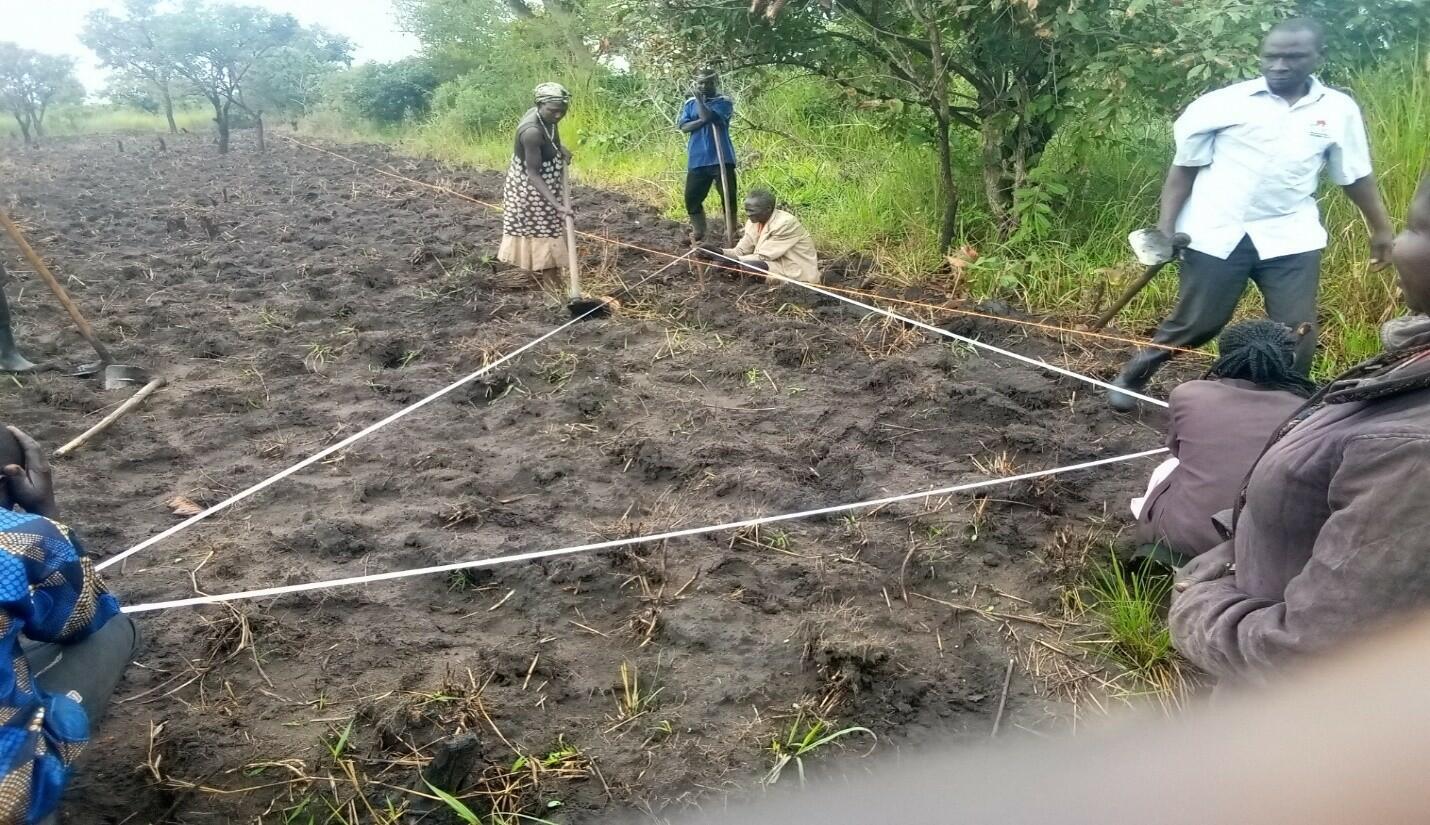
Good agronomic practices: Vegetable line planting being practiced by Lapit pe kun group as guided by the Project Officer (Holding a hoe). Credit: VEDCO
Acknowledgement
We thank the 320 key informants from the two districts for sharing their knowledge with us. We acknowledge the technical guidance and financial support from our implementing partners and the funding agency, the Food and Agricultural Organization of the United Nations (FAO), through the Benefit Sharing Fund of the International Treaty on Plant Genetic Resources for Food and Agriculture.