Blog Gender and intersectionality research in dialogue at IAFFE 2026

At the 34th conference of the International Association for Feminist Economics, held in Cali, Alliance researchers put their work on gender and intersectionality in dialogue with academics and activists from around the world
In July 2026, researchers from the Alliance of Bioversity International and CIAT took part in the 34th Annual Conference of the International Association for Feminist Economics (IAFFE), a leading international gathering for researchers, activists and policymakers working on feminist economics. This year's edition was held at Universidad Icesi in Cali, Colombia, under the theme "Feminist Economics and Transformative Change: Ideas, Policies and Movements."
There, the Alliance presented two studies that look at gender from very different angles. The first reviews global research on postharvest loss, the food loss between harvest and consumption, and asks how gender and other inequalities shape it. The second examines how women in Colombia experienced the land restitution process for victims of the armed conflict, based on interviews in Valle del Cauca.
Presenting this work at IAFFE put the Alliance's research in conversation with feminist economists from around the world who are asking similar questions in very different contexts.
Women and postharvest loss: more than a technology problem
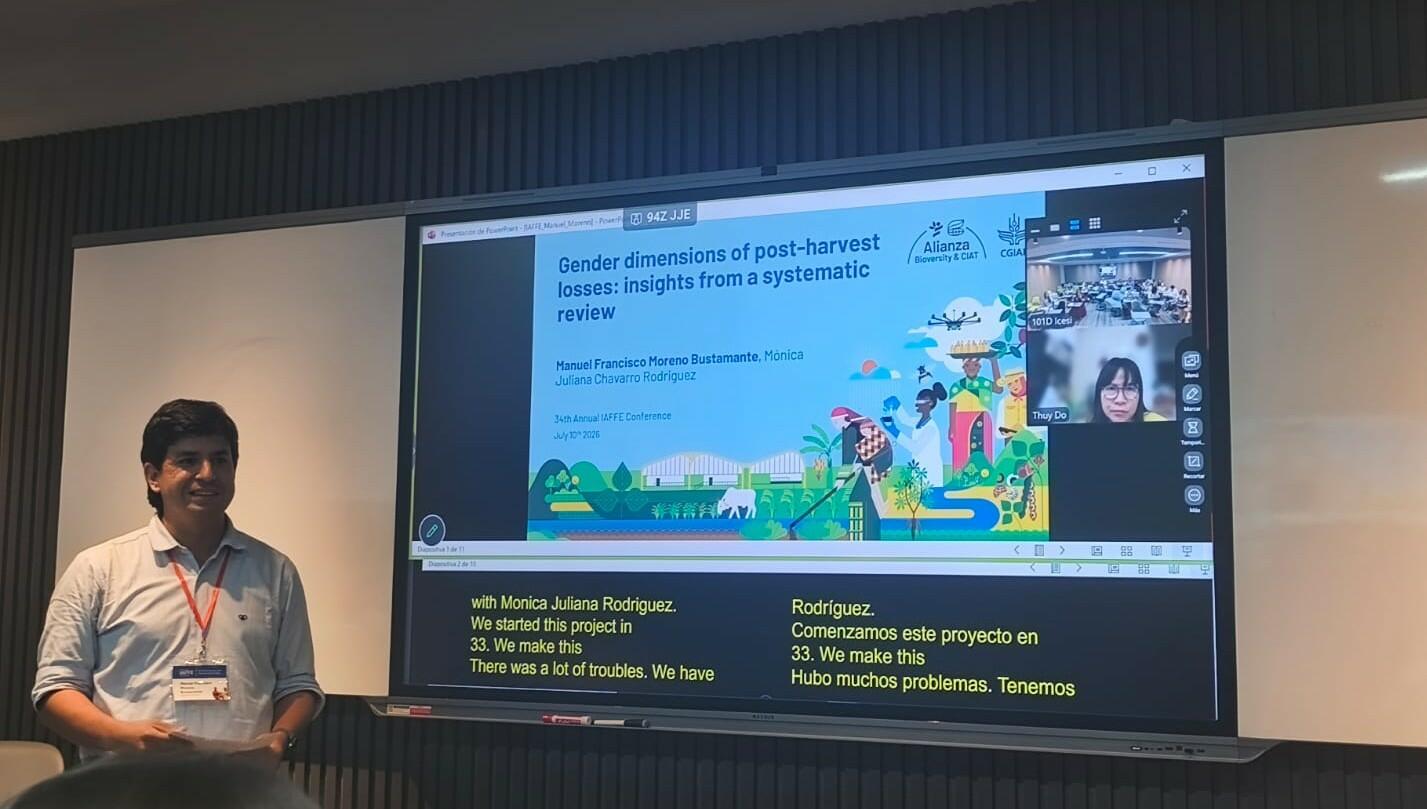
In the session Women's Land Rights, Agriculture, and Rural Development, Manuel Moreno presented research co-authored with Mónica Chavarro: a global literature review on the relationship between post-harvest losses and gender. Although advances in technologies to reduce losses have been widely presented, loss levels remain high. The authors argue that, to understand post-harvest loss levels, it is important to recognize that intersectionality plays a key role in them. Intersectionality enables us to recognize the multidimensional complexity experienced as subjects and to inquire into power relations and their respective repercussions on PHL. For example, the division of labor is determined not only by gender but also by other socio-demographic characteristics.
Gender and land restitution: from law to implementation
During the session titled "Gender, Racial, and Other Inequalities," Luisa María Claros presented the results of a study co-authored with Fanny Howland and conducted in Valle del Cauca. The study is based on interviews with women and men who were beneficiaries of the land restitution program, as well as with institutional stakeholders.
Although Law 1448 of 2011, known as the Victims and Land Restitution Law, formally incorporated a gender perspective, the study shows that in practice many women experienced new forms of victimization during its implementation. In addition to violence and displacement, they faced barriers within the judicial process, such as a lack of information, caregiving burdens, and prolonged delays. Other harms emerged within the program itself: appraisals that failed to recognize the cultural and emotional value of the land, new threats, and adverse effects on physical and mental health.
Nevertheless, the research also highlights the agency and leadership that many women developed on their own initiative. It therefore recommends institutionalizing gender sensitivity in implementation processes, offering reparations alternatives adapted to urban realities, and providing sustained psychosocial support.
The presentation was part of a panel that also featured studies on gender gaps in STEM (Science, Technology, Engineering, and Mathematics) careers, ethnic and racial inequalities in subsistence enterprises, bargaining power within households, and the statistical invisibility of Black women in the public sector.
Beyond the sessions: a shared agenda on rural women
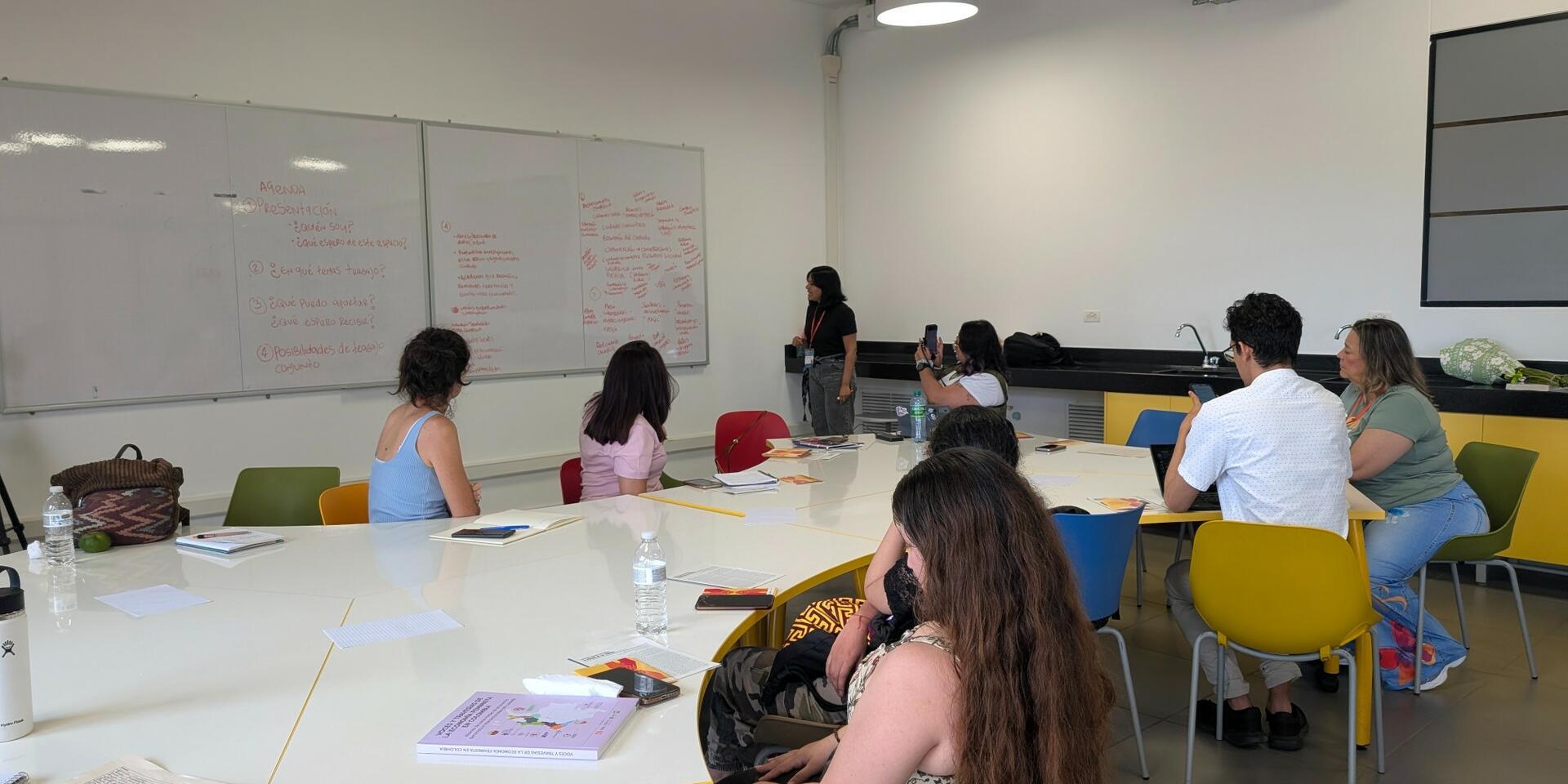
The conversation continued beyond the sessions. The Alliance of Bioversity International and CIAT and the Observatorio para la Equidad de las Mujeres (OEM) at Universidad Icesi convened academics, activists and regional policymakers at the meeting "Research on Rural Colombia: Progress and Perspectives" to share progress and explore opportunities for collaboration. This event brought together women and men from various institutions and universities, who highlighted the following critical points for shared progress:
- Care work in rural areas, which falls mostly on older women and faces the challenge of generational renewal.
- Transformations in rural life: closer urban–rural links, food sovereignty, agroecological transitions and environmental challenges.
- Rural women's economic autonomy and rights, from their place in labor markets and value chains to rural reform and gender-based violence.
- The role of knowledge and communication in shaping policy, both in institutions and at home.
What's next
The meeting led to concrete commitments: jointly mapping the projects and communities each institution works with, sharing data, and opening sessions of the qualitative studies group to discuss methods and case studies. Besides, the OEM's podcast Diálogo de ciudad ("City Dialogue") was proposed as a channel to bring these discussions to wider audiences.
The goal is for conversations started at IAFFE to reach decision-makers and rural communities, not just academic audiences.
View the presentation slides: https://hdl.handle.net/10568/185735 and listen to Diálogo de ciudad: La economía de la vida: Cuidados, igualdad y mirada feminista, check the oficial web of IAFFE.
Partners: Observatorio para la Equidad de las Mujeres, Policy Innovations Science program
Credits header picture
Participants at the meeting on research in rural Colombia. Photo: Fanny Howland / Alliance of Bioversity International and CIAT