From the Field From Knowledge to Action: How AKIS and Scaling Science Strengthen the Transformation of Agrifood Systems

There are technologies, practices, and solutions with the potential to improve agriculture. However, for that potential to translate into real impact, technological and social innovations must respond to the needs of territories, adapt to different contexts, and be sustained over time. This raises a key question: how can we advance innovations to respond to the needs of people and territories?
This question becomes even more relevant in the face of challenges such as climate change, environmental degradation, and biodiversity loss, which make it increasingly urgent to move toward more resilient, sustainable, and inclusive agrifood systems. In this context, developing new technologies is essential, but so is ensuring that innovations reach their users more quickly and respond to their needs, so that they can generate real impacts in the short term. To move in this direction, it is crucial to strengthen the way we generate, share, and use knowledge.
It is precisely at this point that Agricultural Knowledge and Innovation Systems (AKIS) take on strategic relevance.
Toward More Collaborative Innovation
For many years, agricultural innovation relied primarily on a model in which research developed new technologies and extension services facilitated their dissemination to farmers. This approach drove important scientific and productive advances that contributed to the development of the agricultural sector.
Today, current challenges and diverse territorial realities highlight the importance of continuously adapting solutions to the needs of those who implement them. While this model enabled important advances, this context also underscores the need to more actively incorporate the knowledge, experience, and capacities of farmers, as well as those of other AKIS actors, into co-innovation processes, recognizing them as strategic participants in building solutions.
This represents a change in the way innovation is understood: knowledge no longer flows in only one direction but is instead generated and shared among different actors, turning innovation into a more collaborative process based on mutual learning and the joint development of solutions.
AKIS: A Network Where Knowledge Generates Innovation
This new model builds on the AKIS approach (Agricultural Knowledge and Innovation Systems), which proposes precisely this transformation. More than an institutional structure or a specific program, an AKIS is a non-hierarchical network of actors in which farmers, researchers, extension agents, universities, businesses, civil society organizations, and public institutions collaborate to generate, exchange, and apply knowledge, building solutions adapted to the needs and particularities of each territory.
Within an AKIS, innovation is no longer understood exclusively as the result of scientific research; instead, it becomes a continuous process of learning and co-creation, in which scientific knowledge and local knowledge complement each other to address shared challenges. Thus, the best solutions do not emerge from a single actor, but from the interaction among many.
The strength of an AKIS lies not only in connecting actors; its true value lies in transforming the way demands are identified and solutions are developed.
In a strengthened AKIS:
- Users’ needs guide innovation processes.
- Scientific knowledge engages with local knowledge.
- Solutions are adapted to the characteristics of each territory.
- Women, young people, and other traditionally underrepresented groups actively participate in developing innovations.
- Learning takes place continuously among all actors.
- Collaboration replaces isolated efforts and strengthens collective capacity to address shared challenges.
This way of innovating enables the development of more relevant and sustainable solutions, adapted to the needs and characteristics of each territory.
From Knowledge to Impact: The Complementarity Between AKIS and Scaling Science
Generating a good innovation is the first step. The real challenge is ensuring that it responds to the needs of people and territories, that it is useful and used in different contexts, and that its use is sustained over time. Added to this is the challenge of ensuring that it reaches an increasing number of users, in order to generate significant and lasting impacts.
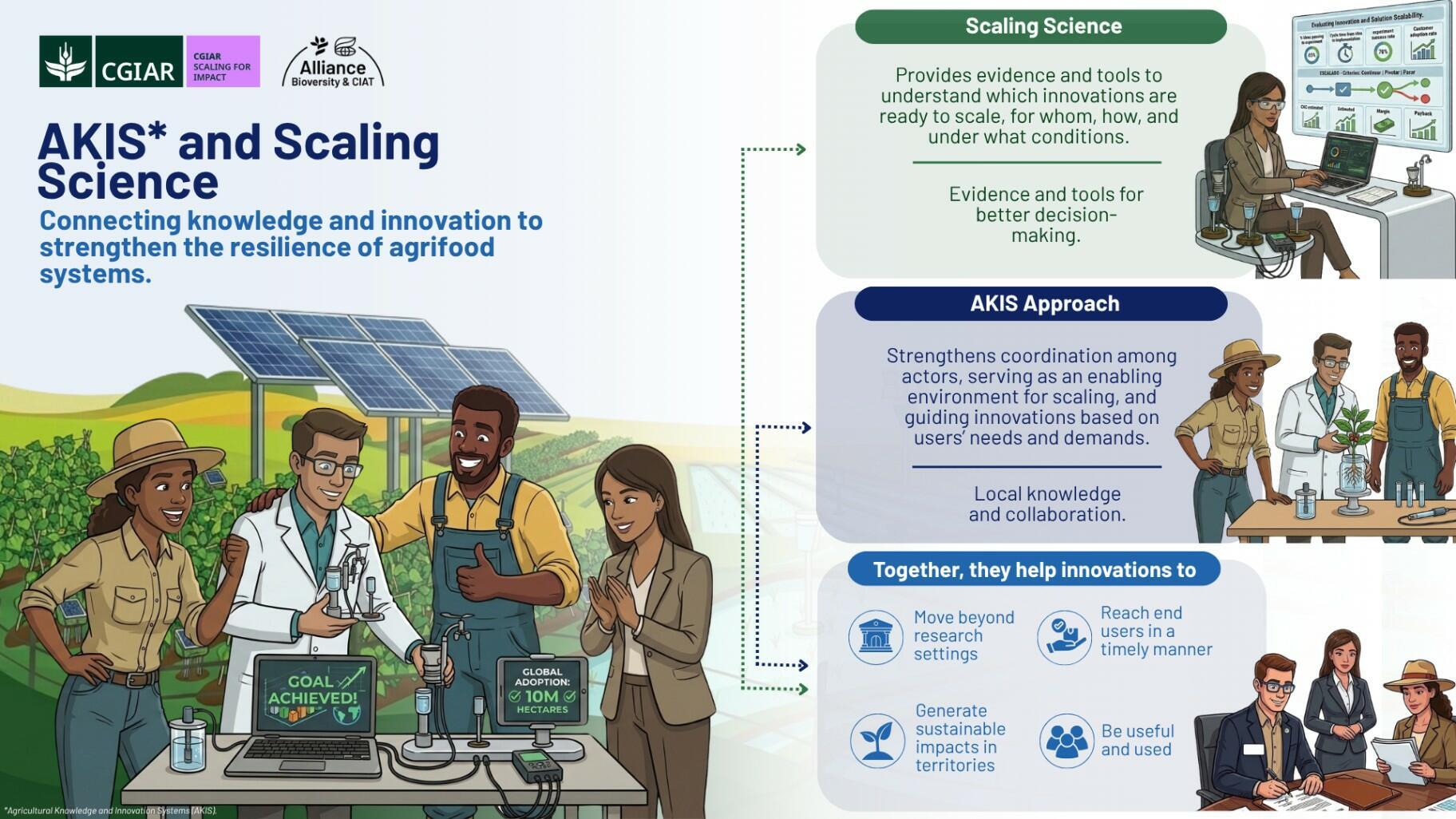
This is where the AKIS approach and scaling science complement each other. While AKIS strengthen coordination among actors and help orient innovations around users’ needs and demands, scaling science provides evidence and tools to understand which innovations make sense to scale, for whom, how, and under what conditions. This complementarity helps innovations move beyond research settings, reach end users in a timely manner, be useful and used, and generate sustainable impacts in territories.
This articulation represents a shift from approaches focused solely on technology dissemination. Beyond expanding the reach of an innovation or solution, responsible scaling requires considering and strengthening the conditions that support its adoption, adaptation, and sustained use, recognizing that each territory has different capacities, institutions, and contexts. This involves promoting continuous learning, coordination among actors, and evidence-based decision-making.
From Concept to Action: Strengthening AKIS in Latin America and the Caribbean
In Latin America and the Caribbean, the AKIS approach has begun to be used as a starting point for strengthening agricultural innovation and promoting systems that are better coordinated, more inclusive, and more responsive to territorial needs.
In this context, the Inter-American Development Bank (IDB), together with the Alliance of Bioversity International and CIAT, has promoted the application of methodologies to diagnose and strengthen Agricultural Knowledge and Innovation Systems, helping countries identify actors’ needs, coordination challenges, and key institutional bottlenecks to inform research, public policy, and investment priorities and, in this way, transition toward the AKIS approach.
CGIAR’s Scaling for Impact Program is also using this approach to inform and identify demand for innovation and scaling. Initially, the approach is being implemented in Bangladesh, Nigeria, and Colombia, strengthening agrifood innovation systems through harmonized diagnostics, inclusive evidence, and participatory tools to inform research, policy, and responsible scaling strategies within the AKIS approach.
In Colombia, the AKIS approach in the context of responsible scaling uses these diagnostics to co-develop demand-driven roadmaps with system actors. These roadmaps strengthen coordination, align national priorities with the CGIAR Scaling for Impact portfolio, and support adaptive planning, resource mobilization, and the scaling of inclusive innovations adapted to each context.
AKIS for Transforming Agrifood Systems
Strengthening an AKIS means creating the conditions for innovation to respond to the needs of people and territories while, at the same time, helping strengthen the capacity of agrifood systems to address present and future challenges.
In this process, the way knowledge is generated and shared is fundamental. When this happens collaboratively, innovations can respond more effectively to each context and contribute to more resilient, sustainable, and inclusive agrifood systems. This is where AKIS and scaling science complement each other, strengthening the way innovations are generated, adapted, overcome barriers, and expand their impact.
Transforming agrifood systems does not depend solely on developing more and better innovations or solutions; it also requires strengthening the systems that enable knowledge to be transformed into solutions capable of responding to territorial needs and contributing to a more resilient, sustainable, and inclusive future.
Further reading