Research Articles Can cattle farming help deliver the SDGs? Rethinking cattle through a systems lens

Cattle farming sits at the heart of one of the most difficult sustainability debates of our time. On the one hand, livestock supports the livelihoods of more than a billion people, contributes significantly to rural economies, and provides nutrient-dense food that is essential for human health. On the other, cattle production is often associated with deforestation, water pollution, biodiversity loss, and greenhouse gas emissions.
So where does the cattle sector stand in relation to the United Nations’ 2030 Agenda and its 17 Sustainable Development Goals (SDGs)? Is cattle part of the problem – or part of the solution?
As demonstrated in a recent global review on cattle farming and the SDGs, the answer is: both. The challenge lies not in whether cattle farming should exist, but in how it is managed and how its trade-offs are governed.
The double role of cattle in sustainable development
Cattle farming strongly supports several SDGs linked to people and prosperity, contributing to:
- SDG 1 (No Poverty) by generating income and assets for rural households
- SDG 2 (Zero Hunger) by producing meat and milk rich in protein and micronutrients
- SDG 8 (Decent Work and Economic Growth) through employment across value chains
In many low- and middle-income countries, cattle are more than a food source. They function as savings accounts, draft power, fertilizer suppliers and social safety nets. Income from cattle can improve access to education and healthcare, creating positive contributions to SDGs 3 (Good Health and Well-being) and 4 (Quality Education).
Yet, these gains often come with costs that are borne elsewhere.
When progress creates trade-offs
The same cattle systems that advance poverty reduction and food security frequently undermine environmental goals. Expanding grazing land is a major driver of deforestation, particularly in tropical regions. Manure and agrochemicals pollute rivers and groundwater. Methane emissions contribute significantly to climate change.
As a result, progress on SDGs 1, 2 and 8 often clashes with:
- SDG 6 (Clean Water and Sanitation)
- SDG 12 (Responsible Consumption and Production)
- SDG 13 (Climate Action)
- SDG 15 (Life on Land)
From a systems perspective, these are not isolated problems. They reflect sub-optimization: maximizing short-term economic outputs while externalizing environmental and social costs. The outcome is a development trajectory that looks successful in one dimension but weakens the overall sustainability of the system.
Why systems thinking matters
The SDGs were designed as an integrated agenda, not a checklist. Systems theory helps explain why progress in one goal can either reinforce – or undermine – progress in others.
In cattle systems, three SDGs stand out as “multipliers”:
- SDG 1 (No Poverty)
- SDG 2 (Zero Hunger)
- SDG 8 (Decent Work and Economic Growth)
These goals tend to drive both synergies and trade-offs across the system. When pursued without safeguards, they amplify environmental degradation. When aligned with sustainability principles, they can also accelerate positive change.
The key question, then, is how to redesign cattle systems so that economic gains no longer come at the expense of the planet.
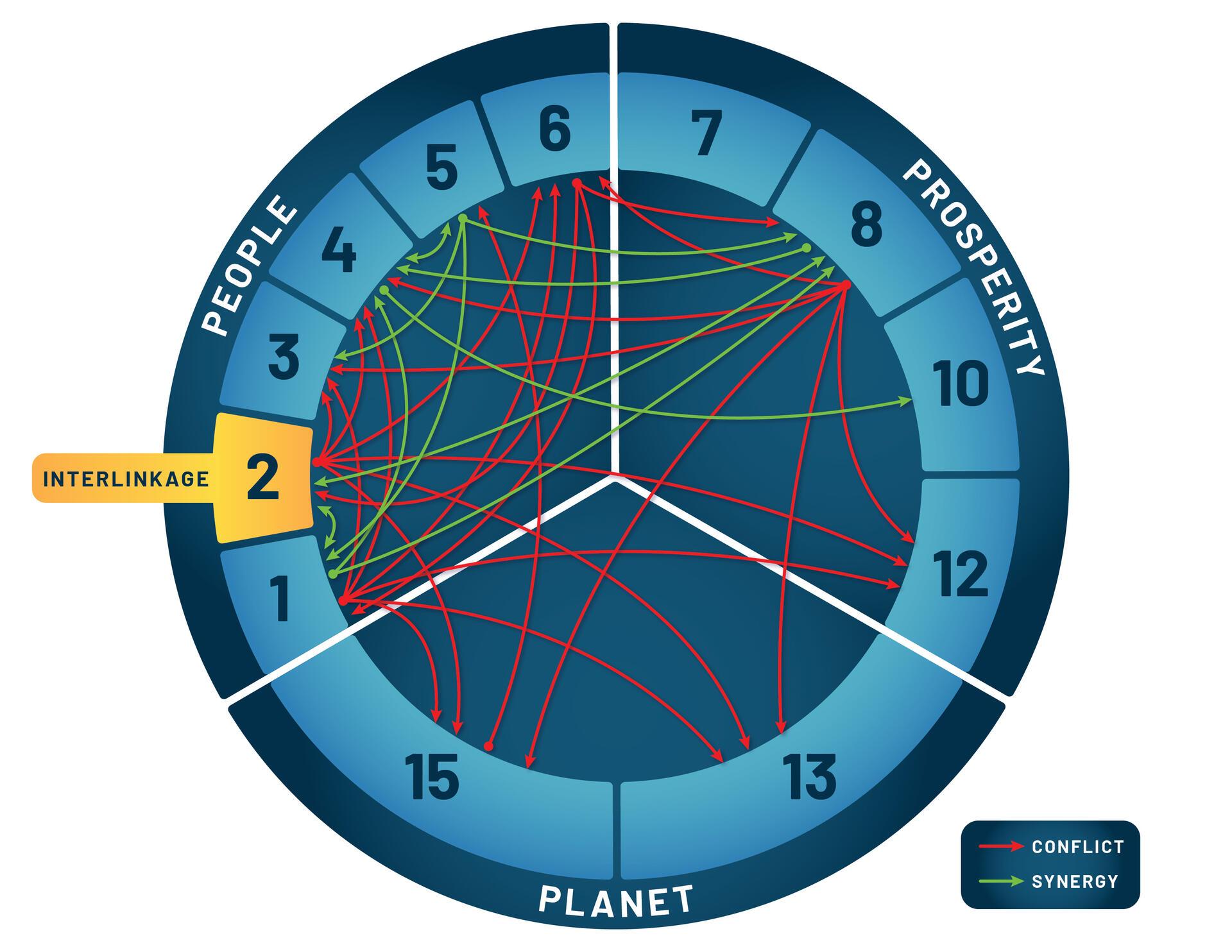
Evidence-based synergies and trade-offs among SDGs in the cattle sector. This figure synthesizes the synergies (green lines) and trade-offs (red lines) among SDGs as reported in studies reviewed for the cattle sector.
Sustainable intensification: A way forward
Sustainable intensification offers a promising pathway. Rather than expanding production into new land, it focuses on increasing productivity while improving environmental performance and social outcomes.
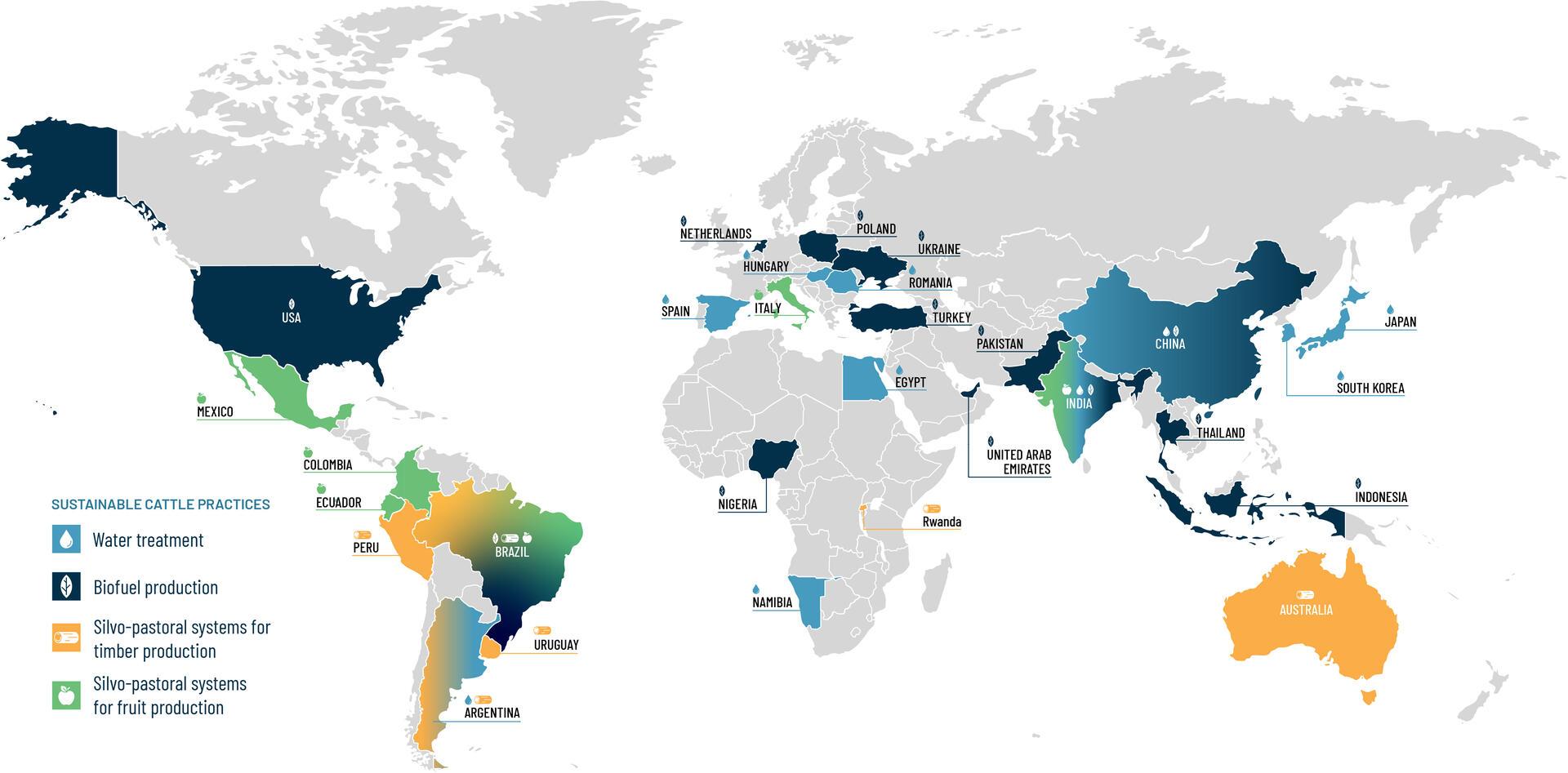
Across diverse regions, three practices stand out for their ability to rebalance SDG interactions:
1. Treating wastewater as a resource
Untreated cattle wastewater is a major source of water pollution and health risk. But when properly managed, it becomes an opportunity.
Technologies such as constructed wetlands, filtration systems, and nutrient recovery processes can:
- Reduce contamination of rivers and groundwater (SDG 6)
- Lower disease risks for communities (SDG 3)
- Enable circular use of water and nutrients (SDG 12)
In some cases, treated wastewater can even support energy or fertilizer production, creating new income streams. The main barriers remain high upfront costs and limited access to technology, especially for smallholders.
2. Turning manure into renewable energy
Cattle manure is one of the largest untapped renewable energy resources in agriculture. Through anaerobic digestion, manure can be converted into biogas for electricity, heating, or cooking.
The benefits are multiple:
- Climate mitigation through methane capture (SDG 13)
- Clean energy generation (SDG 7)
- Income diversification and job creation (SDGs 1 and 8)
- Reduced waste and pollution (SDG 12)
In regions with supportive policies and infrastructure, biogas plants have proven economically viable. However, scaling remains challenging where capital, technical expertise, or stable energy markets are lacking.
3. Silvopastoral systems: Integrating trees and cattle
Perhaps the most transformative option is the adoption of silvopastoral systems – integrating trees, forage, and cattle on the same land.
Silvopastoral systems can:
- Increase farm income through timber and fruit production (SDGs 1 and 8)
- Improve animal welfare and productivity (SDG 2)
- Sequester carbon and reduce emissions (SDG 13)
- Restore biodiversity and soil health (SDG 15)
In tropical regions, silvopastoral systems have demonstrated the ability to turn cattle landscapes from deforestation hotspots into carbon sinks. Yet adoption is slowed by long investment horizons, land tenure issues, and limited technical support.
This figure synthesizes three practices identified as having the strongest potential to act as trade-off buffers (water treatment, biofuel production, and SPS) helping reconcile trade-offs between productivity-oriented SDGs (1, 2, 8) and environmental SDGs (6, 12, 13, 15). Each practice contributes to strengthening synergies while reducing pressures on water, soil, and climate. Source: own elaboration.
Why policy and governance are crucial
Technology alone is not enough. Across all three practices, success depends on institutions, incentives, and coordination.
Key policy priorities include:
- Redirecting subsidies toward long-term sustainability outcomes
- Expanding access to credit and risk-sharing mechanisms
- Strengthening extension services and farmer organizations
- Integrating livestock, climate, and land-use planning
Importantly, solutions must be adapted to local contexts. What works in Latin America’s forest frontiers may differ from what is feasible in South Asia or Sub-Saharan Africa.
From trade-offs to transformation
The evidence is clear: Cattle farming does not have to be locked into a lose-lose relationship with the SDGs. When water, energy, and biomass flows are redesigned, new feedback loops emerge – ones that make environmental impacts visible, reward sustainable behavior, and align economic incentives with long-term resilience.
The real challenge is political rather than technical. Moving from isolated pilot projects to systemic change requires coordinated action among governments, producers, researchers, and consumers.
If done right, the cattle sector can evolve from being a major source of SDG trade-offs into a powerful contributor to integrated, inclusive, and resilient development.
The future of sustainable cattle farming is not about choosing between people and planet but about finally designing systems that work for both.
Acknowledgements: This work was carried out as part of the CGIAR Initiative Livestock & Climate (L&C) and the CGIAR Science Program on Sustainable Animal & Aquatic Foods (SAAF). We thank all donors who globally support our work through their contributions to the CGIAR System. The views expressed in this document may not be taken as the official views of these organizations.