From the Field Building Malawi’s forage innovation system

Improved forages are gaining momentum in Malawi. A recent visit by the Alliance of Bioversity International and CIAT’s Tropical Forages team brought together research, private-sector collaboration and national coordination efforts that could help move forage innovations from promising technologies towards wider use by farmers.
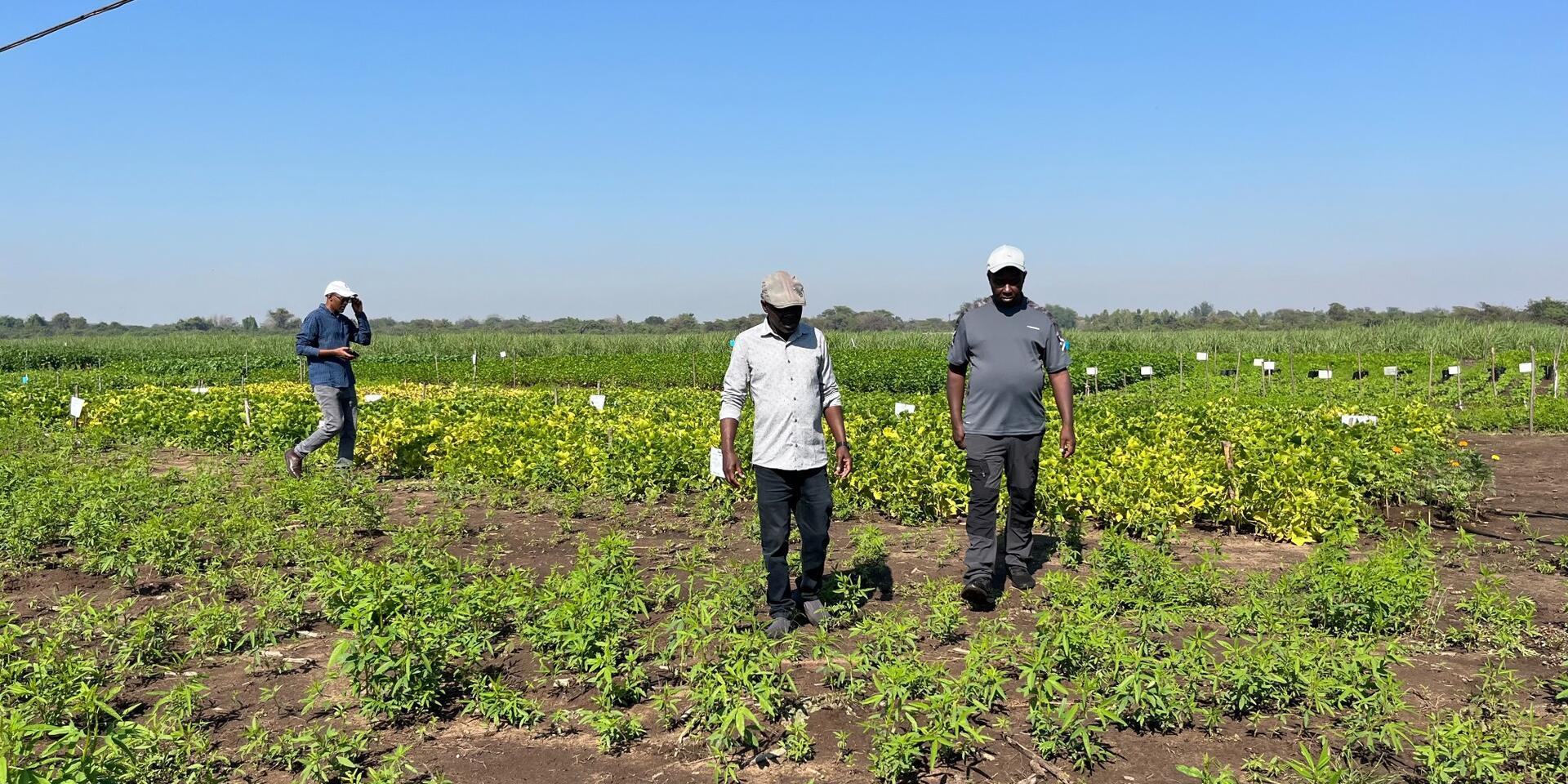
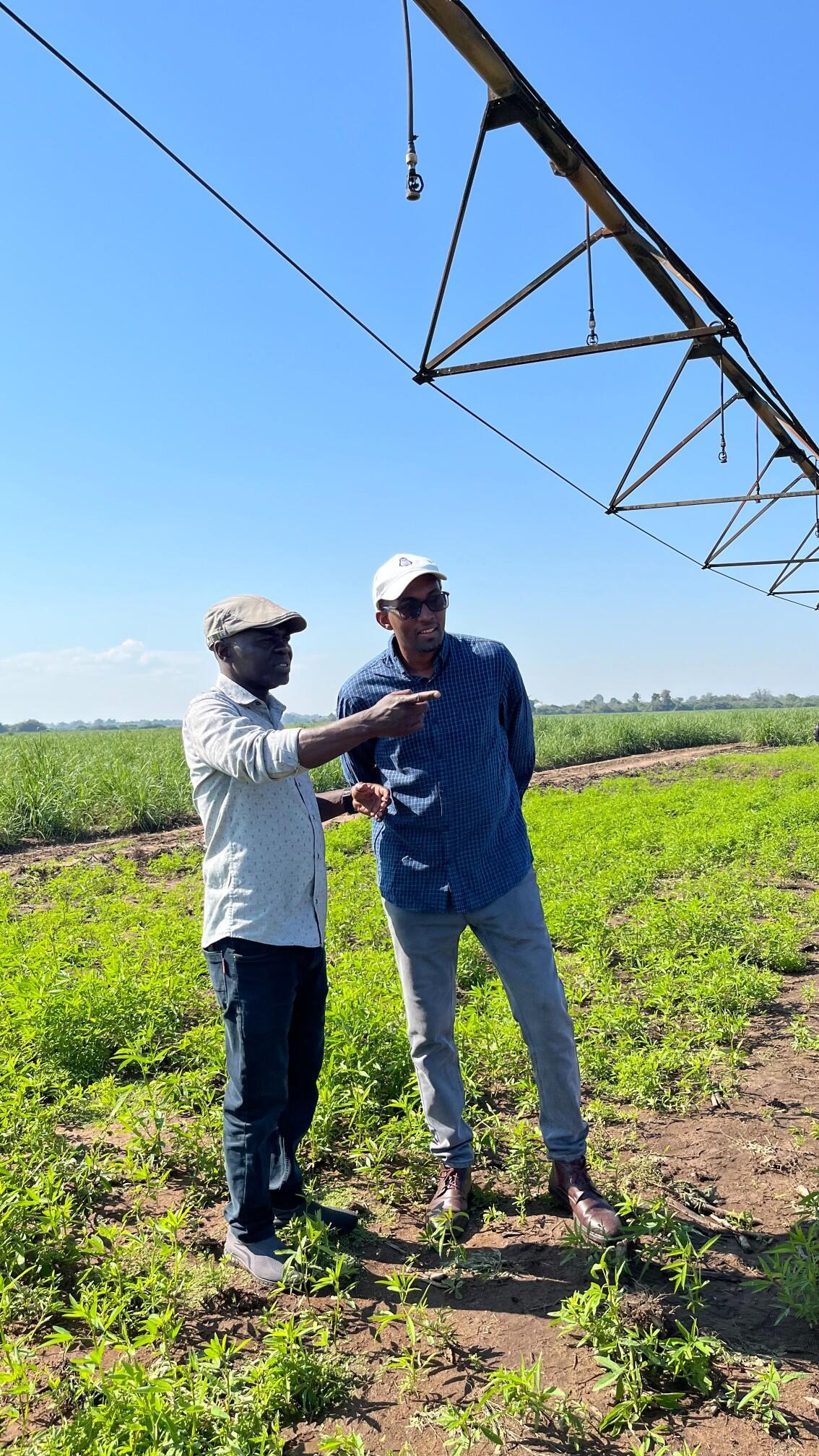
A major focus of the visit was the Shire Valley, where the team met with Agricane to review ongoing forage trials established in connection with the Shire Valley Transformation Program (SVTP). The irrigated trials, established at Agricane's Sangawa Farm in collaboration with Malawi's Department of Agricultural Research Services (DARS), are evaluating four improved tropical forage cultivars—Camello, Cayman, Mulato II and Cobra—to understand their adaptation and performance under Lower Shire conditions. The trials are exploring forage options that could support livestock production as agricultural production expands and intensifies in the valley. With irrigation and commercialization transforming the Lower Shire Valley, producing more nutritious livestock feed from increasingly limited land will become critical for maintaining productive, profitable and climate-smart crop–livestock systems.
The visit was deliberately about more than inspecting plots. The Alliance and Agricane teams jointly reviewed the trials and agreed on a data collection protocol and Standard Operating Procedure (SOP) to ensure that forage performance is assessed systematically. This will provide stronger evidence for identifying promising options and informing future recommendations.
The teams also prepared for a field day on 25 August, where farmers and other stakeholders had an opportunity to see the forage materials directly in the field and discuss their establishment, management and potential uses.
The demonstration formed part of the LEGUME TOUR 2026 Malawi Field Day Experience, organized by Agricane and the Soybean Innovation Lab, with support from Ireland and Palladium through the Make It Possible initiative. Around 270 participants—including smallholder farmers, government agencies, NGOs, research organizations and private-sector representatives—visited the forage demonstration in three groups. Alliance scientist Dr. Feyera Liben and Dr. McLoyd Banda (DARS) jointly presented the trials in both English and Chichewa, explaining the characteristics of the four cultivars, their potential feeding value and their possible roles in intensified crop–livestock systems.
Building a longer-term partnership
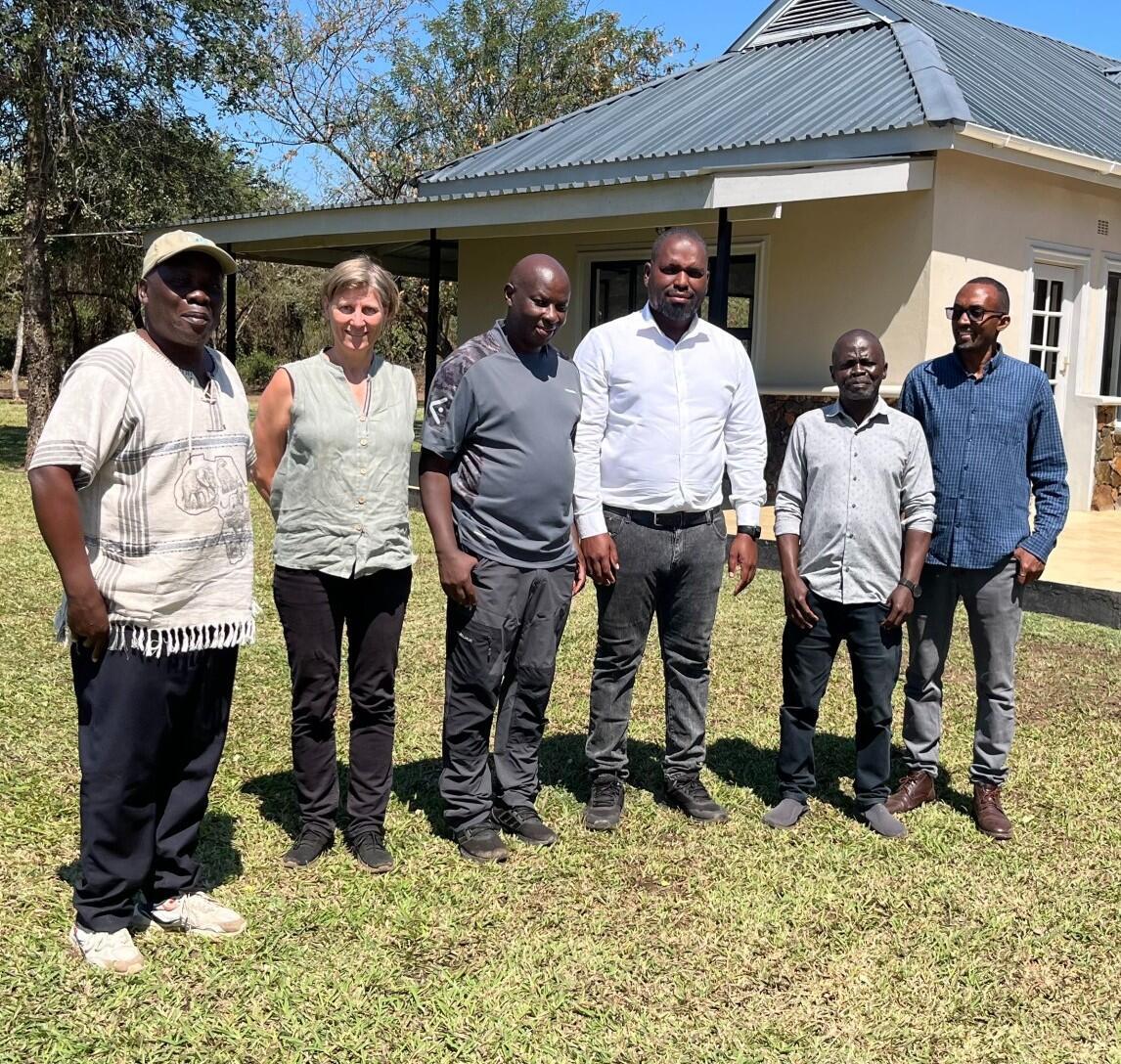
Just as important as the technical discussions was strengthening the partnership between Agricane and the Alliance. The visit provided an opportunity for the teams to get to know each other better, discuss their respective expertise and ambitions, and agree to work towards establishing a formal Memorandum of Understanding.
The discussions also reinforced a shared conviction that forages deserve greater attention within the Shire Valley Transformation Program. Irrigation and increased crop production create opportunities not only for food crops but also for integrating productive forage resources into farming systems. Developing that, forage component will require appropriate technologies, good agronomic management, access to planting material and seed, and viable pathways through which farmers can adopt and benefit from them. The field day further demonstrated that improved forages can play multiple roles within irrigated landscapes—not only in dedicated forage plots, but also along irrigation canals, drainage channels and field boundaries, where they can simultaneously produce livestock feed while helping stabilize canal banks, reduce erosion and trap sediment.
Strong national expertise to build on
The team also visited the Department of Agricultural Research Services (DARS) Bvumbwe Research Station, where researchers are undertaking extensive work on improved forages. Seeing the range of forage materials and the expertise already available within DARS reinforced an important message from the visit: Malawi does not need to build a forage innovation system from scratch.
That national capacity is increasingly being connected. Malawi's emerging Forages Technical Working Group brings together DARS, government, universities, producer organizations and other actors around a common agenda for forage development. During the visit, the Alliance team also caught up with David Slane, the Alliance's Malawi country representative, to discuss how these partnerships and activities can be further strengthened.
The Working Group could eventually provide the foundations for a Malawi platform linked to the proposed Pan-African Feed and Forage Innovation Network (PAFFIN), connecting national forage research and market development with experience, technologies and partners elsewhere in Africa.
From promising forages to functioning markets
The next challenge is therefore not simply to demonstrate that improved forages can grow in Malawi. It is to understand how they can reach farmers sustainably and at scale.
Several pieces are beginning to come together: DARS has forage research and technical expertise; promising commercial forage varieties are moving through registration processes; forage seed business models are being explored; Agricane provides an important private-sector and implementation partnership in the Shire Valley; and the Technical Working Group offers a mechanism for coordination among actors.
This creates an opportunity to connect research, seed systems, business models, farmer demand, extension and investment rather than addressing each separately.
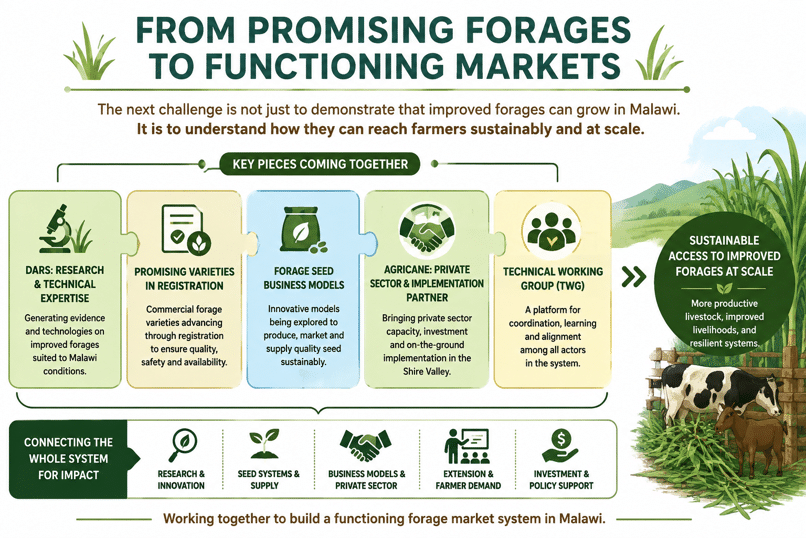
The work in the Shire Valley under the CarboPastures Package of Deliverables provides one practical entry point. By combining rigorous evaluation of forage options with field demonstrations, partnerships and attention to pathways for wider adoption, the collaboration can help generate evidence not only on which forages work, but increasingly on what is needed to make them work at scale.
The discussions during the field day also highlighted what scaling will require. Participants raised practical questions about forage productivity, seed availability in Malawi, establishment and management practices, and cultivar tolerance to pests and diseases. These discussions reinforced an important lesson: good-performing forage varieties alone are not sufficient. Farmers also need reliable access to quality seed or planting material, practical knowledge on establishment, harvesting and utilization, and effective extension support. Strengthening Malawi's forage seed systems and farmer capacity will therefore be just as important as identifying the best-performing cultivars.
The field day represented another important step in that process. By bringing together researchers, government, the private sector, development partners and farmers around the forage demonstrations, it showed that scaling improved forages is not simply about identifying superior varieties. It is about building the partnerships, evidence, seed systems and institutional coordination needed to integrate livestock successfully into Malawi's rapidly evolving irrigated agricultural landscapes.
Further reading