Rumen Digital Twin
We are building a foundation model of ruminants to support discovery, development, and deployment of methane mitigation technologies. Using AI to bring together global data on ruminant productivity, methane emissions, diet, genetics and the rumen microbiome, the model will support applications ranging from microbiology and physiology research to forecasting the impact of mitigation interventions across specific production environments.
Project Name (full): Rumen Digital Twin for sustainable livestock production
Start and end year: 2025-2027
Region and Countries: Americas
Funder: Bezos Earth Fund’s AI for Climate and Nature Grand Challenge
Partners: Yale University and Biomedit
Project impact
Studies from different species
Ruminant species
Samples
Countries
- Over 5 continents
Harmonized variables
- That are classified in 11 categories
Brief description
The development of methane mitigation solutions for ruminants is constrained by an incomplete understanding of the complex interactions among the rumen microbiome, diet, and host genetics. At the same time, relevant data remain fragmented across studies and biased among global regions, making it difficult to integrate knowledge and generalize it to new animals, diets, and production systems.
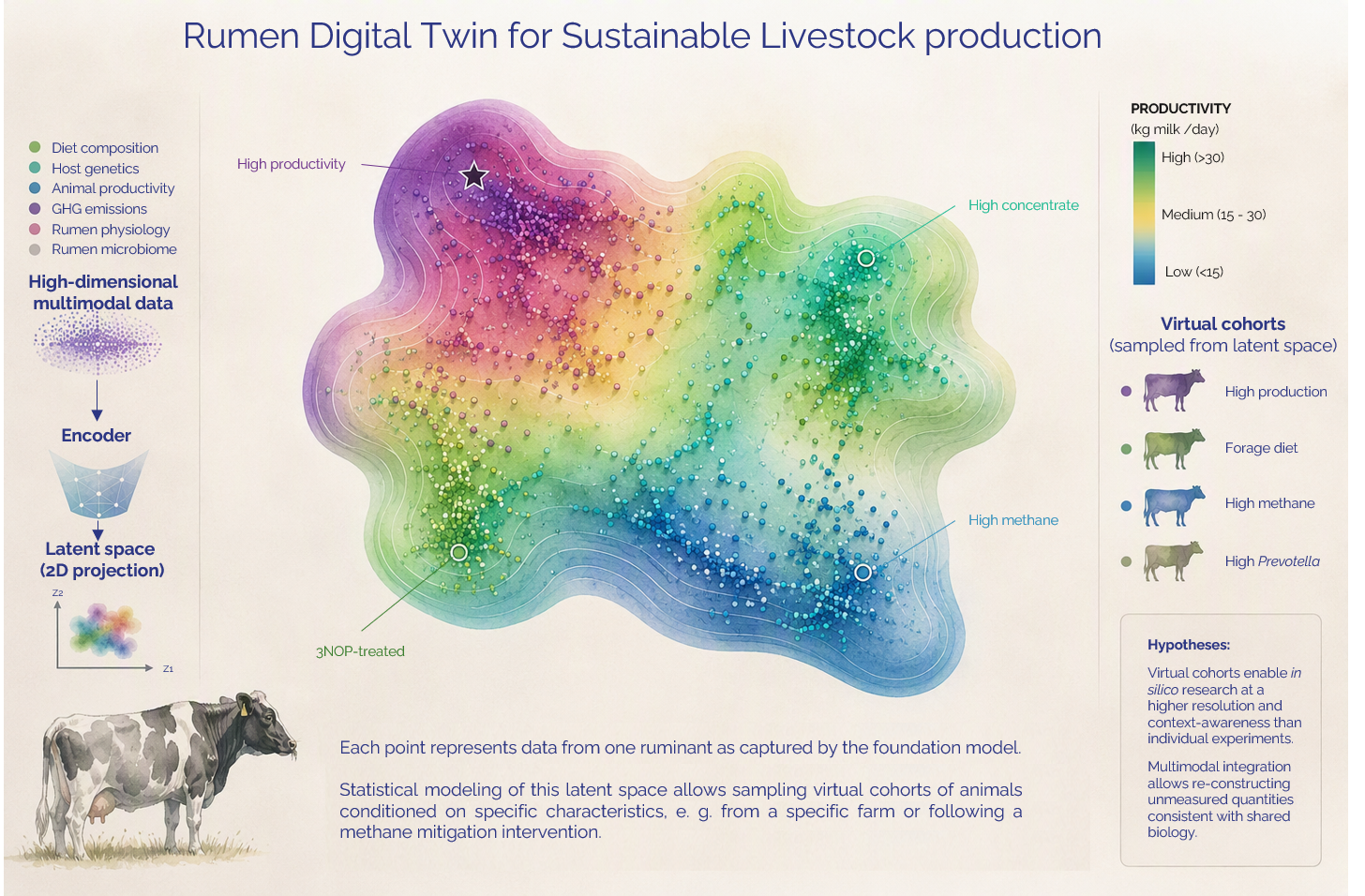
AI excels at finding patterns in complex systems, and multimodal AI can integrate diverse data types to uncover hidden biological relationships. We envision a world model of ruminants that simulates their responses to interventions. Such a model would support in silico experimentation to predict biological outcomes, helping reduce the cost, duration, and scale of animal trials. The first step toward this vision is a generalizable multimodal state representation, or foundation model.
Supported by the AI for Climate and Nature Grand Challenge of the Bezos Earth Fund, we are building a generative foundation model of ruminants that directly supports or may be fine-tuned to support enteric methane mitigation research and world model construction. By enabling virtual experimentation, integrating fragmented global datasets, and predicting outcomes from limited data, the foundation model can improve the speed, scale, and confidence with which climate-smart interventions are developed and deployed across diverse ruminant production systems.
How we are doing it
A harmonized compendium of ruminant data
Research on ruminant productivity, the rumen microbiome, methane emissions and mitigation interventions is extensive, but the resulting data are fragmented across publications and repositories and often lack standardization. We are collecting publicly available individual-animal datasets across studies, species, breeds, and geographic regions and processing them with standardized workflows. Combined with data contributed through project partnerships, this effort will generate a harmonized resource containing more than 10,000 rumen microbiome profiles linked to diet composition, methane emissions, host genetics, or performance traits. The integrated database will provide a unique resource for model development that will be made available to the broader research community.
Building a ruminant foundation model
Data collected across biological contexts is often sparse, but multimodal learning can bridge data gaps by leveraging biological signals shared across data types and studies. We will use ecology-informed models to enable integration, even when data are limited, resulting in a generalizable representation of the ruminant-microbiome system that can support the generation of realistic virtual cohorts for research. Rather than specializing in a single prediction task, a generative foundation model aims to learn the underlying relationships among host, microbiome, diet, and environmental factors, providing a holistic view of the system. The model will be evaluated on its ability to learn transferable representations of biological data, predict relevant traits across data modalities, adapt efficiently to new applications with limited data, and support prediction of intervention responses and other biologically meaningful outcomes.
- Model fine-tuning for predicting intervention efficacy: The trained foundation model will be fine-tuned on intervention data to demonstrate its ability to transfer insights across biological contexts. Specifically, longitudinal and case-control studies will be leveraged to learn the system’s responses in the model representation, including anti-methanogenic tropical forages from the Low-Methane Forages project. This will enable prediction of intervention-specific trajectories for methane emissions, productivity, and microbiome composition, providing a critical step from a descriptive foundation model to a predictive world model, creating a platform for future digital twin applications.
- Engaging future users: Throughout the project, we will engage with research communities, industry partners, and other organizations that can both contribute to and benefit from the foundation model. We will actively share project progress, identify opportunities for data sharing and collaborative research, and explore co-development of applications supported by the model. Key project deliverables will include the harmonized datasets and open-source code developed during the project, as well as a web platform providing researchers with access to the foundation model and its capabilities.
Relevant blogs, stories, news coverage
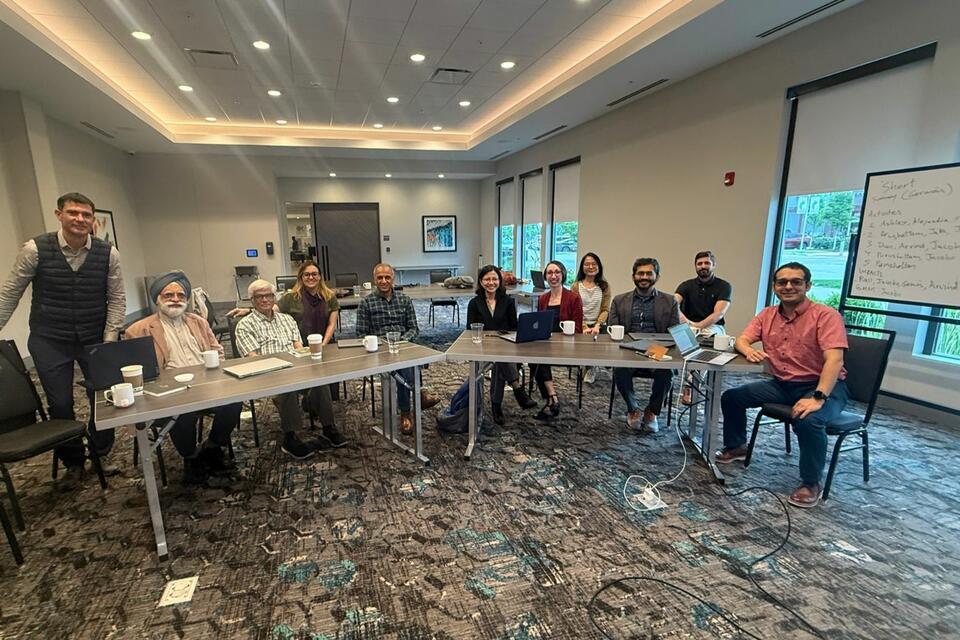
Other Project Members: Mauricio Peñuela, Jacob Shields, Dwi Susanti, Ashley Hall, Sandra Calderon, Arvind Kumar
Project leaders
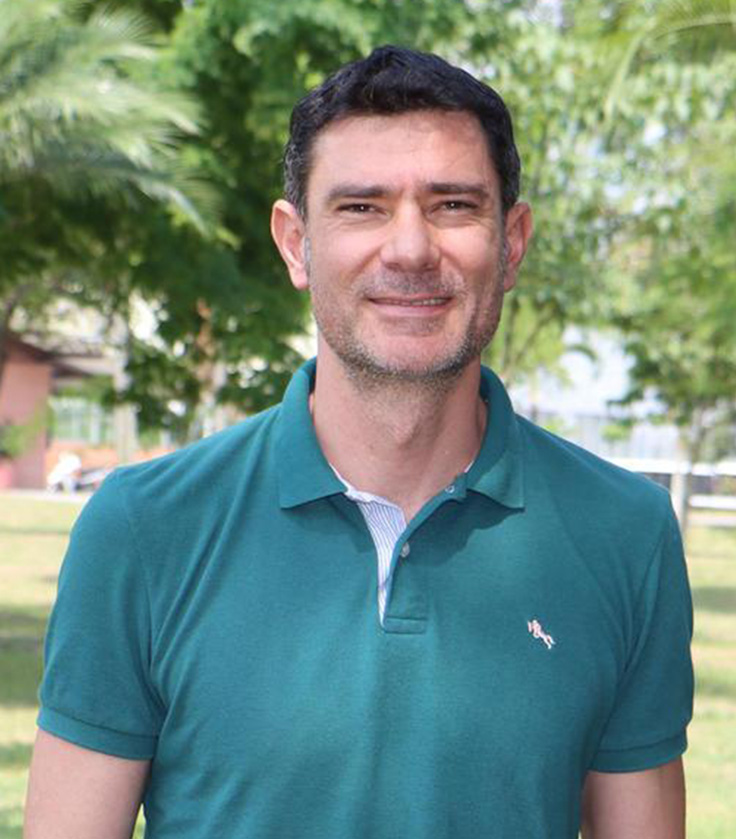
Jacobo Arango
Program Leader, Tropical Forages
Germán Plata
Senior Director & Lead Scientist at BiomEdit
Purushottam Dixit
Rector of Sapienza University of RomeProject leaders

Jacobo Arango
Program Leader, Tropical ForagesProject members