Blog Training Tomorrow’s Leaders for Integrated and Sustainable Resource Management

New courses on water-energy-food-ecosystems (WEFE) nexus approaches aim to train natural resource managers to adopt integrated solutions to achieve sustainable, inclusive and resilient agri-food systems.
The struggle to balance human and environmental wellbeing is becoming increasingly complex in an era of compounding global crises. Greater pressure on our shared resources in this changing context is creating new and wicked problems that will require new ways of problem-solving. To meet this challenge, the United Nations’ 17 interrelated Sustainable Development Goals (SDGs) serve as a call to action for countries to work in global partnership to solve these complex issues.
Working toward the SDGs requires unprecedented coordination and cooperation across borders and sectors. Although governments and practitioners typically manage food, water, and energy separately, these sectors are deeply interconnected and interdependent. As such, solutions and strategies for their sustainable development must also be interconnected to maximize synergies and mitigate trade-offs across sectors and stakeholders.
To achieve this massive system shift, wide-scale capacity development is urgently needed. The next generation of water, energy, food, and ecosystem professionals must become water-energy-food-ecosystem (WEFE) nexus professionals, who think and work together in an integrated way to tackle wicked problems through nexus approaches.
Cultivating the skills of tomorrow’s nexus leaders
To this end, the CGIAR Initiative on NEXUS Gains has supported the Center for Water Resources Studies (CWRS) from the Nepal Institute of Engineering at Tribhuvan University to create a new course series on WEFE nexus issues aimed at developing professional capacities for integrated, equitable, and sustainable resource management. These courses, which differ in format, target three distinct groups of current and future nexus professionals and policy/decision-makers:
- Sensitization course on the WEFE nexus for policy/decision-makers
- Professional course on the WEFE nexus for early to mid-career professionals
- Academic course on the WEFE nexus for graduate students
“Training tomorrow’s leaders to employ nexus thinking and approaches is vital to enable these leaders to make informed decisions to optimize outputs from the available, limited resources. WEFE nexus training enables them to visualize interlinkages and interactions among WEFE resources while deciding on an intervention in a single sector,” says Professor Vishnu Prasad Pandey, who led the development of the courses.
In the spirit of a nexus approach, this course series was co-developed with professors and researchers from several different departments, fields of expertise, and research institutes, including CGIAR’s Alliance of Bioversity International and CIAT and International Water Management Institute (IWMI). This participatory and iterative process involved a series of multi-disciplinary workshops as well as piloting and revising the contents over three years in Nepal. Tribhuvan University will now be rolling out the resultant academic WEFE nexus course in two institutes central to resource management: Engineering and Forestry.
Building momentum for nexus approaches worldwide
Nepal is a forerunner in promoting WEFE nexus approaches for integrated resource management. The government is attempting to bring nexus thinking into some of its own resource ministries and policies, and the country’s largest and most prominent university is taking a critical step to bring interdisciplinary nexus contents into its institutes.
The CGIAR Initiative on NEXUS Gains is supporting global knowledge-sharing of the Nepal experience on nexus approaches. The course materials developed in Nepal are available with open access in the CGIAR NEXUS Gains resource repository to allow educators around the world to draw on this resource in their own teaching.
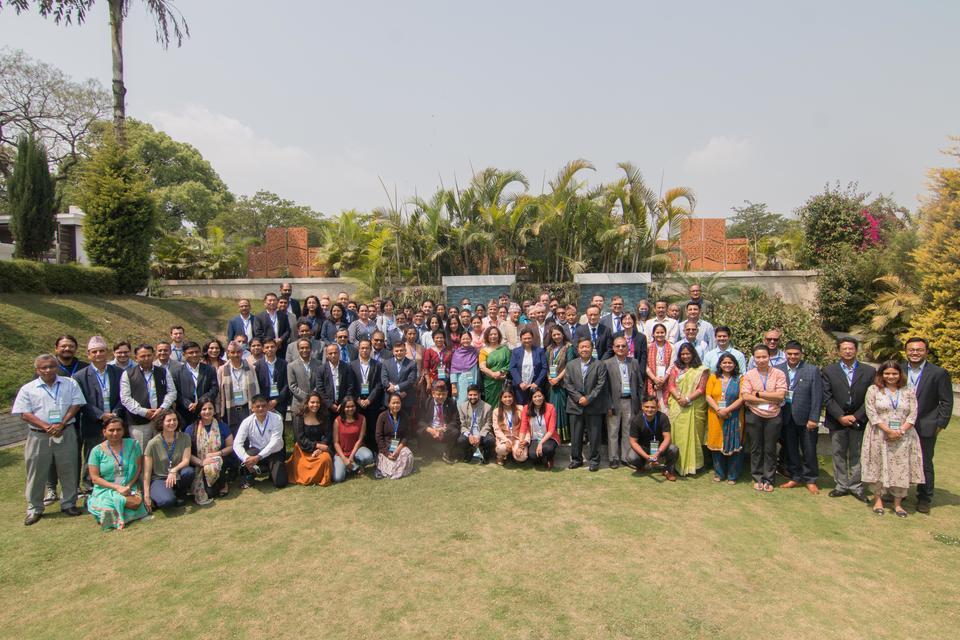
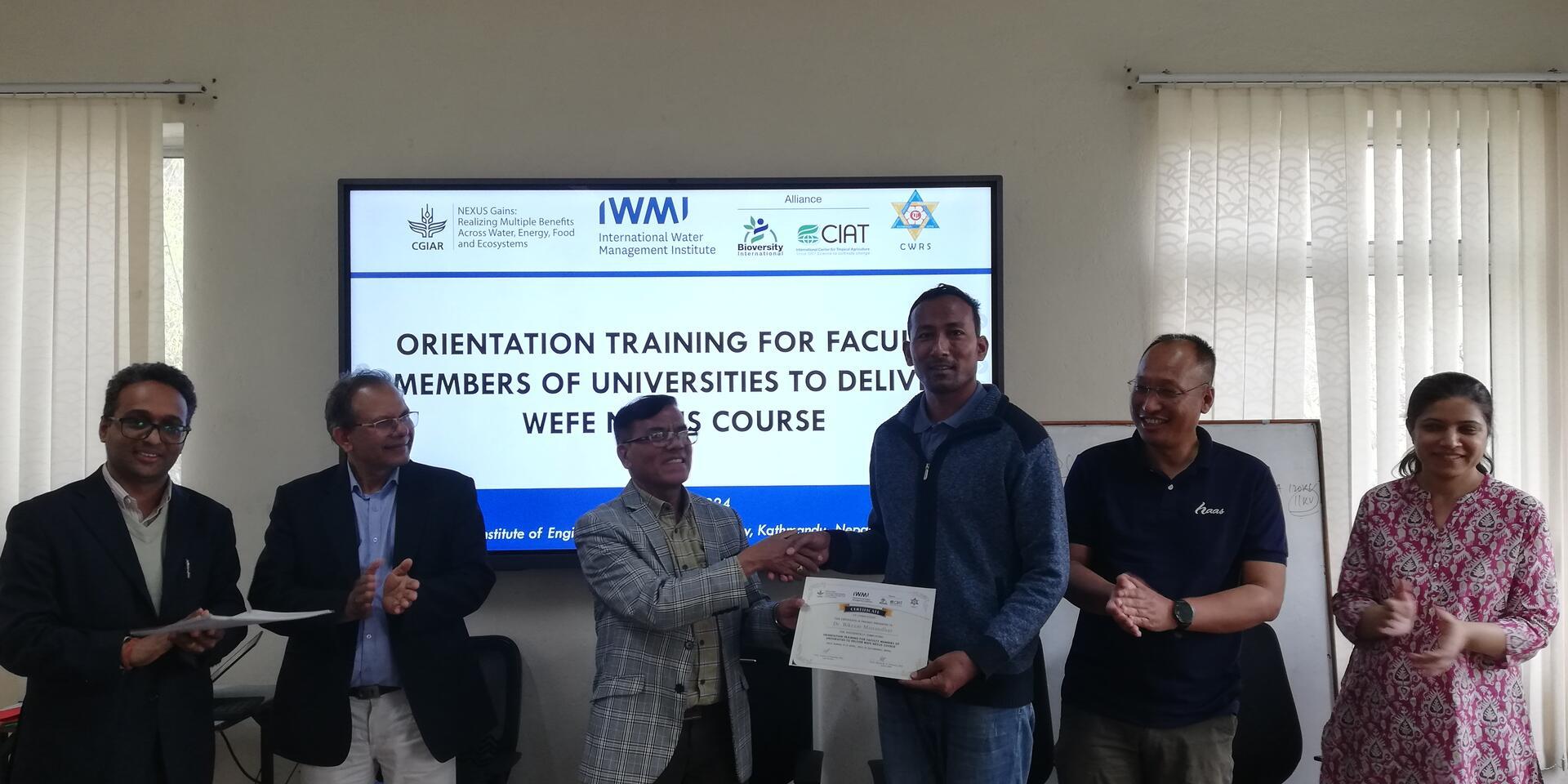
Moreover, NEXUS Gains supported a Training of Trainers (ToT) in Kathmandu, held in April 2024, that brought together professors from Uzbekistan, Pakistan, and different regions of Nepal to discuss course materials and their effective delivery to aspiring nexus professionals. Led by Professor Pandey, the ToT, focused on nexus concepts, principles, and teaching strategies across the professional and educational contexts represented. The goal is that participants will bring nexus perspectives and ideas shared into their own courses and curricula.
According to Professor Gulomjon Umirzakov, who participated in the ToT, “The training provided invaluable insights into the interconnectedness of water, land, energy, forests, and biodiversity, and their crucial role in various aspects of life, including nutrition, health, food security, poverty reduction, and environmental sustainability. I am eager to share the insights gained from the training with my colleagues and faculty staff at the National University of Uzbekistan and to explore potential avenues for collaboration in advancing research and education in the field of the WEFE Nexus.”
Importantly, the ToT and the participatory process of developing the courses have contributed to building a network of knowledgeable nexus leaders and has helped to strengthen the foundation of a growing WEF(E) nexus Community of Practice.
Future directions
In the future, Professor Pandey calls for delivering professional nexus courses across the globe to create a critical mass of nexus practitioners in a global Community of Practice. Moving the needle to achieve more integrated approaches to WEFE management at scale will also require further engagement in policy spaces. “We need to implement multiple iterations of the sensitization course for policy/decision makers in different countries to have the agenda of nexus-thinking internalized in policy/decision-making platforms at global level,” says Pandey.
The WEFE nexus course series is freely available here
The course series and the associated Training of Trainers modules are supported by the CGIAR Initiative on NEXUS Gains and the Alliance of Bioversity International and CIAT.
Header Photo: Course developer Professor Vishnu Pandey (Deputy Director at the Center for Water Resources Studies, Institute of Engineering, Tribhuvan University, Nepal) with a global group of educators at the Training of Trainers (ToT) in Kathmandu, April 2024