Blog Kenya’s frontier in nature-based solutions monitoring and evaluation


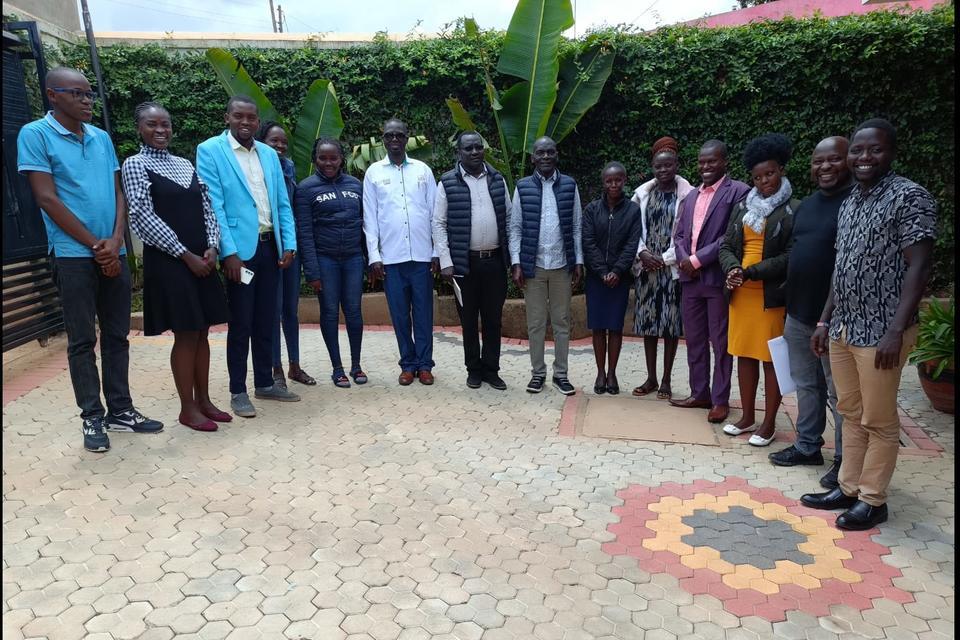
From February 24th to 26th, the Ministry of Agriculture and Livestock Development in Kenya, in collaboration with the Alliance of Bioversity International and CIAT, hosted a workshop at the KALRO Headquarters, Kiboko, to validate and refine a Nature-Based Solutions Monitoring and Evaluation Framework tool, developed under the Initiative for Climate Action Transparency project.
Nature is foundational to human survival, economic stability, and long-term well-being. When its value is overlooked, economic systems tend to evolve in ways that degrade ecosystems, undermine biodiversity, and exacerbate climate-related risks. At the same time, ignoring nature means losing powerful opportunities to address major societal challenges such as climate change, food insecurity, and disaster vulnerability. This is why mainstreaming Nature-based Solutions (NbS) into national climate strategies is more than an environmental priority; it is an economic and social imperative.
NbS enables countries to ground their climate efforts in robust science, context-specific actions, and strategies that deliver outcomes that are not only sustainable but also socially inclusive. For Kenya, a country that has positioned itself as a climate policy leader, strengthening the ability to measure and report the impact of NbS has become increasingly important.
Kenya’s commitment to climate action is reflected in an extensive policy architecture. The ten-year Kenya Climate Smart Agriculture Strategy, the National Climate Change Response Strategy, the Climate Change Act, and the updated Nationally Determined Contributions (NDCs) for 2031–2035 together signal a strong national vision. At the global level, Kenya continues to demonstrate ambition through its obligations under the Paris Agreement, including the development of the Biennial Transparency Report (BTR) for 2026. Yet, strong policies alone are not enough. A gap remains in the country’s ability to systematically track, measure, and report climate adaptation, particularly NbS, across counties and landscapes. Much of the data generated at the community or county level remains scattered in spreadsheets, paper reports, and project-specific information systems. As a result, critical adaptation actions remain largely invisible in national datasets, and Kenya’s progress is not always fully reflected in global reporting.
The digitized NbS M&E framework
This data gap is one of the central challenges that the NbS Monitoring and Evaluation (M&E) framework, including its digitization efforts, seeks to address. To validate and refine this tool, the Ministry of Agriculture and Livestock Development (MoALD), through its Climate Change Unit (CCU), collaborated with the Alliance of Bioversity International and CIAT under the CGIAR Climate Action Program, with support from the Initiative for Climate Action Transparency (ICAT) and the UNEP Copenhagen Climate Centre. Together, they convened a multi-stakeholder workshop in Kiboko, Makueni County.
Held at the KALRO Headquarters from 24th to 26th February, the workshop brought together technical officers and stakeholders from Makueni, Kajiado, and Taita Taveta counties, alongside private sector actors. The purpose of the three-day engagement was to review the usability, functionality, and relevance of the digitized NbS M&E tool, ensuring that it is not only scientifically sound but also practical and accessible for county officers who are central to Kenya’s climate reporting process.
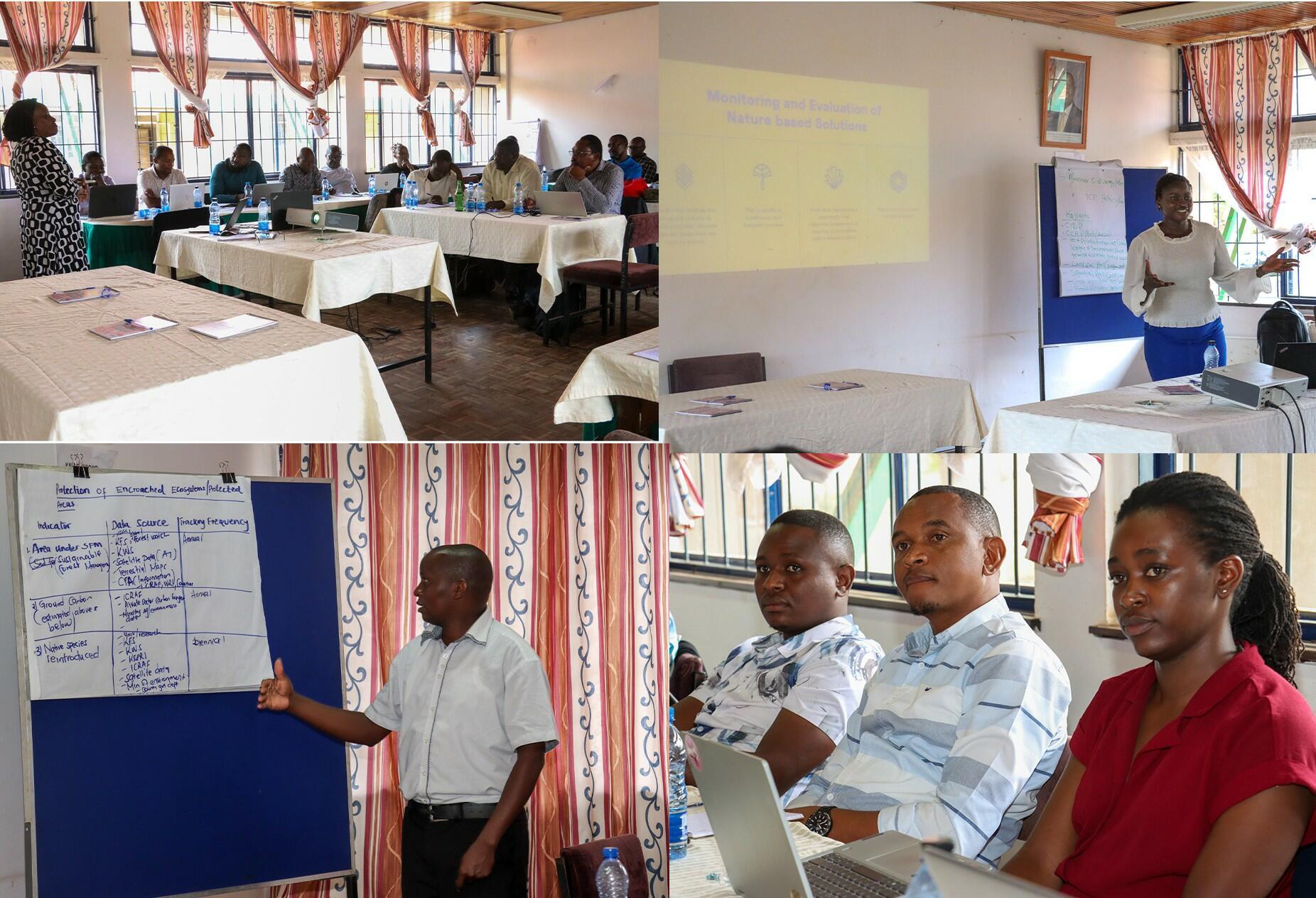
Capacity building of both the public and private stakeholders on the use of the digitized NbS M&E tool. Photo: Alliance Bioversity International and CIAT/Esther Nzuki
Learning from the Chyulu Hills pilot
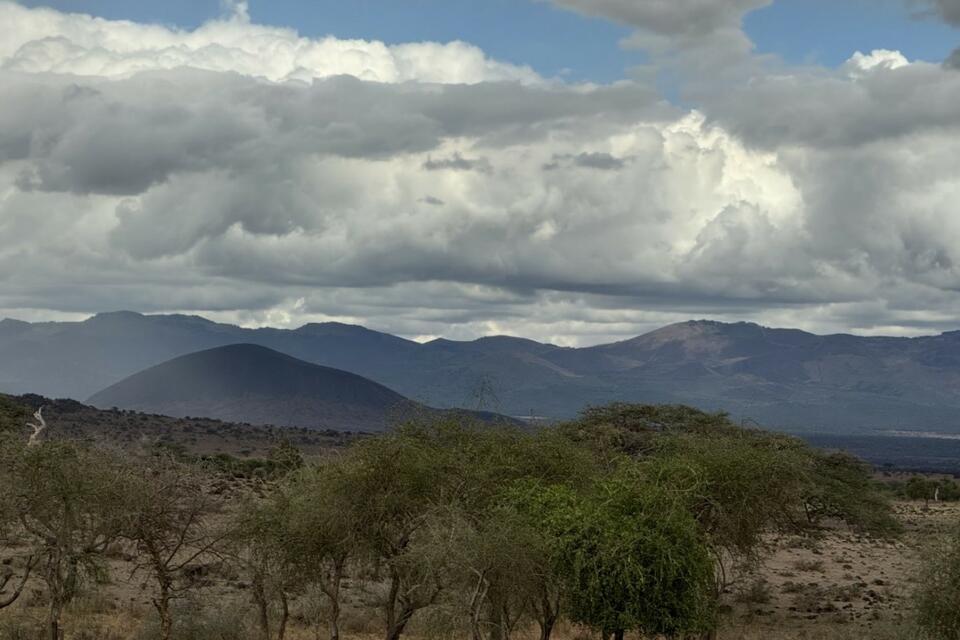
The workshop was built on experience from a pilot carried out in the Chyulu Hills landscape. This area was intentionally selected because it hosts diverse and active NbS initiatives, such as the Chyulu Hills REDD+ Project and the TWENDE climate adaptation project. With its rich ecological diversity and ongoing conservation work, the Chyulu Hills provided an ideal real-world setting for testing how effectively the M&E framework captures different types of interventions and their impacts across a multi-use landscape.
Making adaptation visible in national reporting
Insights emerging from the workshop highlighted the persistent challenge of capturing adaptation. Kenya was among the first countries to formalize adaptation reporting, yet adaptation remains under-documented relative to mitigation. This is not unique to Kenya. Globally, adaptation tends to be localized, incremental, and deeply embedded in day-to-day practices, making it difficult to quantify. Activities like farmer-managed natural regeneration, improved rangeland management, and climate-resilient agricultural practices are happening across the country, yet they rarely appear in national reports. Without systematic documentation, these efforts remain invisible in Kenya’s NDCs and on international platforms. The digitized NbS M&E Framework begins to correct this imbalance. It allows counties to capture adaptation activities in structured, consistent, and transparent ways, providing national agencies with a clearer picture of what is happening on the ground.
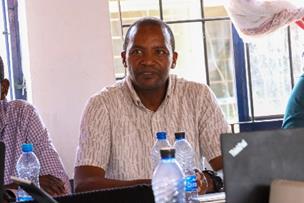
“Transparent data is critical not only for international reporting but also for strengthening coordination between national ministries, county governments, and community institutions,”_Bernard Kimoro (MoALD -State Department livestock Development (CCU)
Stakeholders emphasized repeatedly that no NbS intervention can be meaningfully measured or evaluated without understanding the land on which it operates. Knowing where an activity is implemented, which ecosystem it affects, and how it intersects with agriculture, settlements, or conservation zones is essential for avoiding conflicts and maximizing co-benefits. They suggested that the framework and its digitized tool should respond to this need by integrating geospatial capabilities such as GPS coordinates, remote sensing data, and field observations to produce a more holistic picture of landscape change over time.
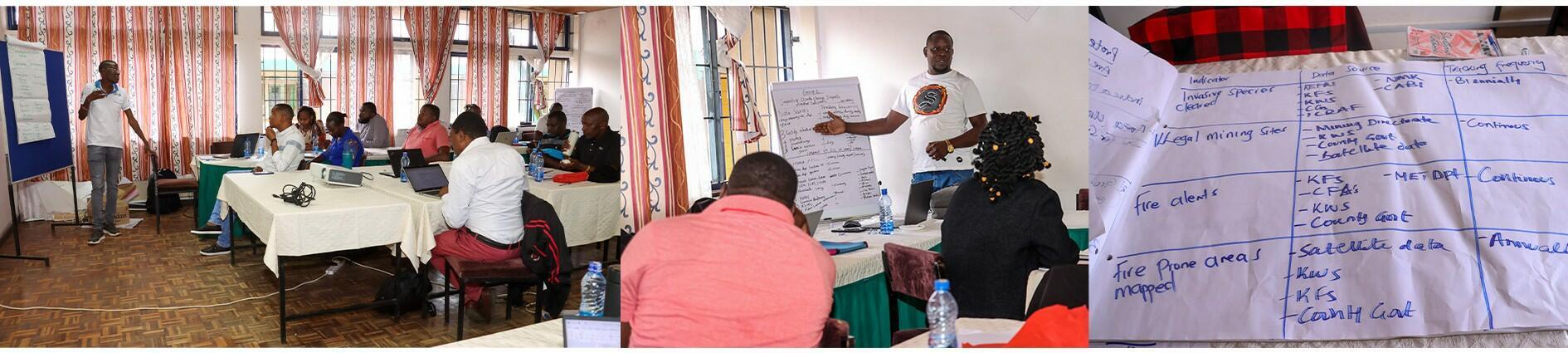
Interpreting Indicators and Applying the Framework to Sample NbS Interventions Photo: Alliance Bioversity International and CIAT/Esther Nzuki
Data governance
Another important theme that emerged from the discussions was the need for stronger data governance. While participants expressed enthusiasm for the tool, they also raised concerns about ownership, access, and privacy. Without clear and mutually agreed protocols, data systems risk eroding trust among communities and local governments. Participants emphasized that data governance frameworks must be co-developed with counties and respect local priorities, privacy considerations, and community rights. This is essential if the NbS M&E system is to serve as a trusted, long-term backbone for Kenya’s climate reporting and planning.
The NbS monitoring and evaluation framework
The digitized tool does more than organize data; it creates a clear, streamlined reporting chain. Locally collected information flows to the CCU, which curates and validates the data before transmitting it to the national Climate Change Directorate (CCD). This ensures that reporting reflects actual implementation, reducing duplication and minimizing misattribution in Kenya. The system provides mutual visibility: counties can see how their work contributes to national and global goals, national agencies can identify strong local innovations, and communities can demonstrate the value of their stewardship. When attribution is clear, stakeholders are also more likely to remain engaged, which is increasingly important as climate finance shifts toward results-based models.
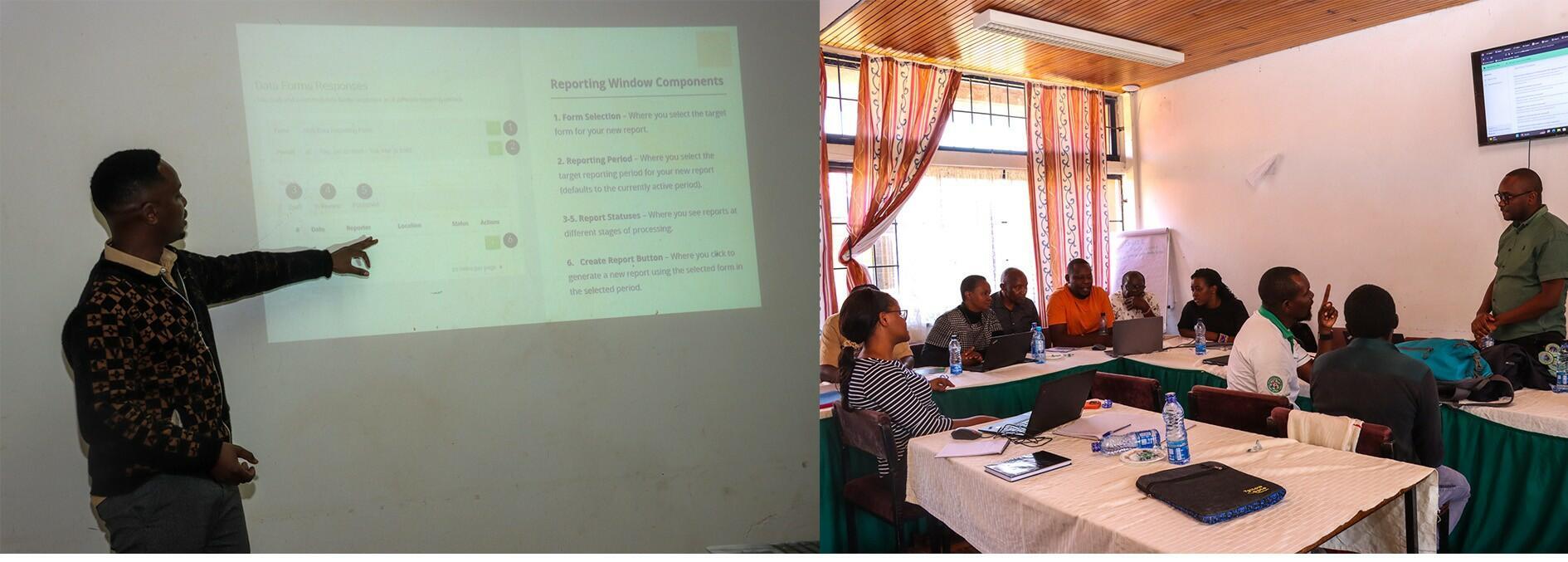
Anthony Kwaje showcases the innovative NbS M&E tool (left) as stakeholders put the technology to the test (right), evaluating its usability.
A Turning point for Kenya’s climate action
In her opening remarks, Makueni County Executive Committee Member for Agriculture, Hon. Elizabeth Muli, emphasized the urgency of moving beyond theoretical discussions to practical tools and actionable strategies. She noted that Chyulu Hills, one of Kenya’s vital water towers, plays an essential role in supporting agriculture, livestock, climate regulation, and biodiversity conservation. A strong M&E framework will help counties measure ecosystem services, carbon sequestration, biodiversity outcomes, and community benefits, information that will ultimately attract more climate finance and guide better resource allocation.

“NbS aligns with Kenya's commitment under the Paris Agreement, our national climate policy framework, and our county climate change action plans. By investing in nature-based solutions, we are investing in water security, food security, economic empowerment, and intergenerational equity. However, good intentions alone are not enough. We must measure impact. We must track progress.
We must demonstrate value for money. We must attract climate finance and green investments. A strong M&E framework will enable us to quantify ecosystem services, track carbon sequestration, monitor biodiversity indicators, and assess social and economic benefits at the community level. Evidence-based decision-making strengthens policy formulation, improves resource allocation, and enhances accountability to our citizens and partners"_Hon. Elizabeth Muli, CECM Agriculture, Livestock, Fisheries & Cooperative Development- Makueni County
Ultimately, the workshop underscored that Kenya’s digitized NbS M&E Framework is more than a just a technical improvement. It represents a turning point in how the country measures and values nature. By enabling counties to generate reliable, transparent, and scientifically grounded data, the tool strengthens Kenya’s ability to contribute to NDC and BTR commitments, enhances coordination across government levels, improves county planning, and elevates the visibility of community-level adaptation. Most importantly, it ensures that the essential role of nature in building climate resilience is recognized, measured, and supported.