Press and News ICA confirms that genetically edited rice is a conventional cultivar
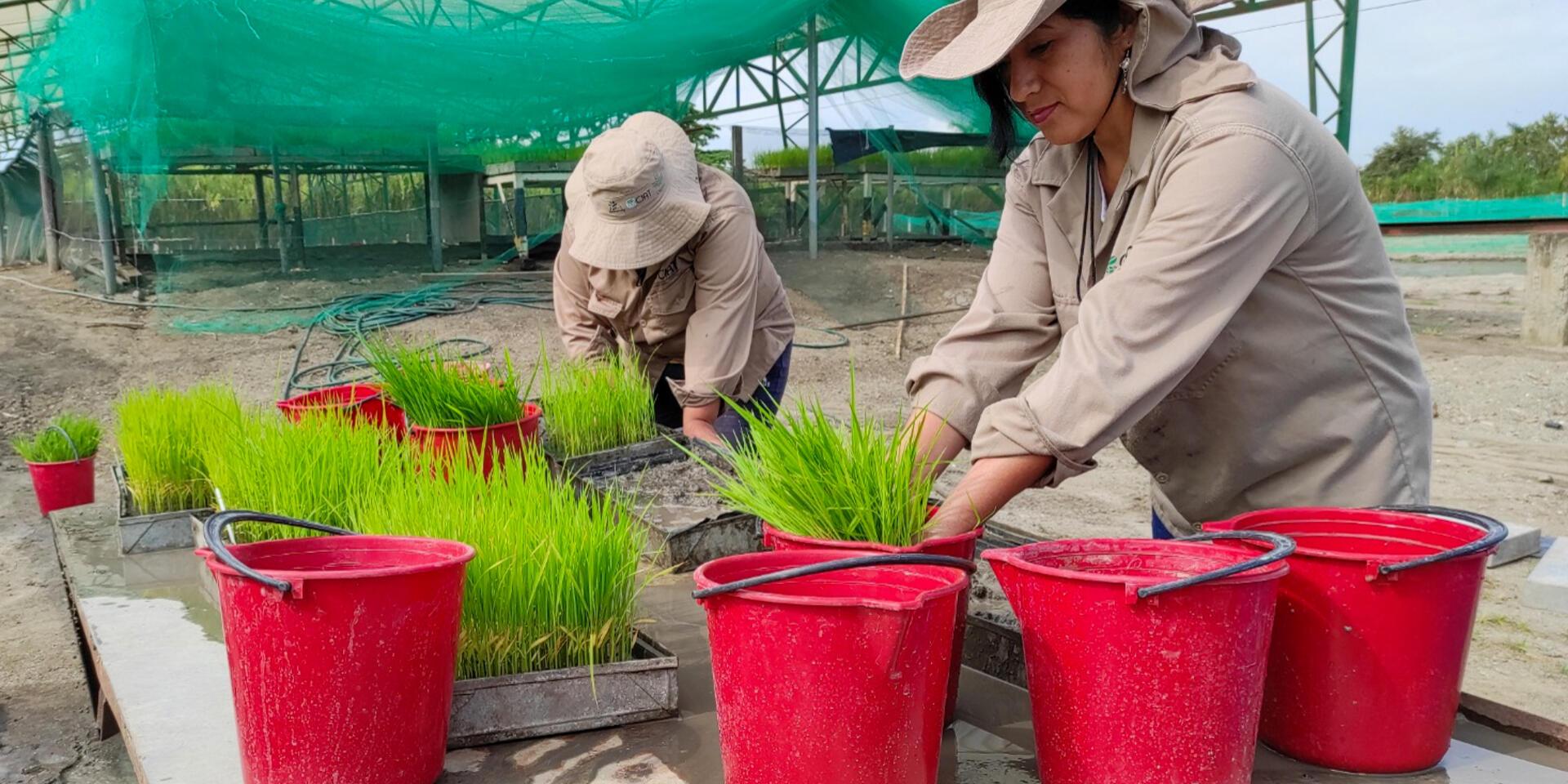

The entity, in compliance with the 2022 Resolution 22991, concluded that a rice line, developed by the Alliance of Bioversity International and CIAT, is a conventional cultivar and, therefore, can be evaluated in open fields. This concept accelerates the development of a new variety adapted to the Colombian highlands.
Palmira, Valle, December 11, 2025. The Alliance of Bioversity International and CIAT announces a milestone for agriculture in Colombia: the Colombian Agricultural Institute (ICA) determined that a new line of rice developed in the country with CRISPR/Cas9 gene editing is considered a conventional cultivar rather than a 'living modified organism'. The decision is based on the fact that the CRISPR/Cas9 editing did not add DNA from another species, but rather produced a change equivalent to a natural mutation that exists in rice.
This line was developed in Colombia by the Alliance, from the commercial variety CORPOICA Llanura 11, a rainfed japonica type rice released by CIAT (now part of the Alliance), CORPOICA (now Agrosavia) and CIRAD, recognized for its adaptation to acidic soils and its tolerance to the fungus that causes rice blast (Pyricularia spp.), a disease that severely affects rice cultivation in the world.
What was edited and why is it important?
The development was achieved by precise editing of the GN1a gene, which regulates the production of cytokinins, plant growth factors that directly influence the number of panicles and grains in each plant.
In simple terms, GN1a helps regulate grain production. By adjusting its function through gene editing, it is possible to increase the number of grains per plant without altering the variety identity; thus, gene editing is a high-precision tool for increasing rice yield.
"The gene editing obtained was classified as SDN-1 type. That is, editing that produces a small and precise change in DNA without introducing genetic material from other species. In this case, it is the punctual elimination of two DNA bases, equivalent to a mutation that occurs naturally in rice, but obtained with high precision in a commercial variety," says Paul Chavarriaga, leader of the Biotechnology program of the Alliance of Bioversity International and CIAT.
.

Paul Chavarriaga
Biotechnology Program Leader and Gene Editing Platform LeaderField results
In initial evaluations in confined fields, the edited material showed significant yield increases over the parental version of CORPOICA Llanura 11, a commercial variety registered for production in the Colombian Altillanura region, including: higher number of tillers, more panicles per plant, more grains per panicle and per plant, and no undesirable modifications in key characteristics such as days to flowering and height.
These results confirm the potential of genetic editing to strengthen productivity in a material already adapted to difficult conditions, such as those of the Altillanura.
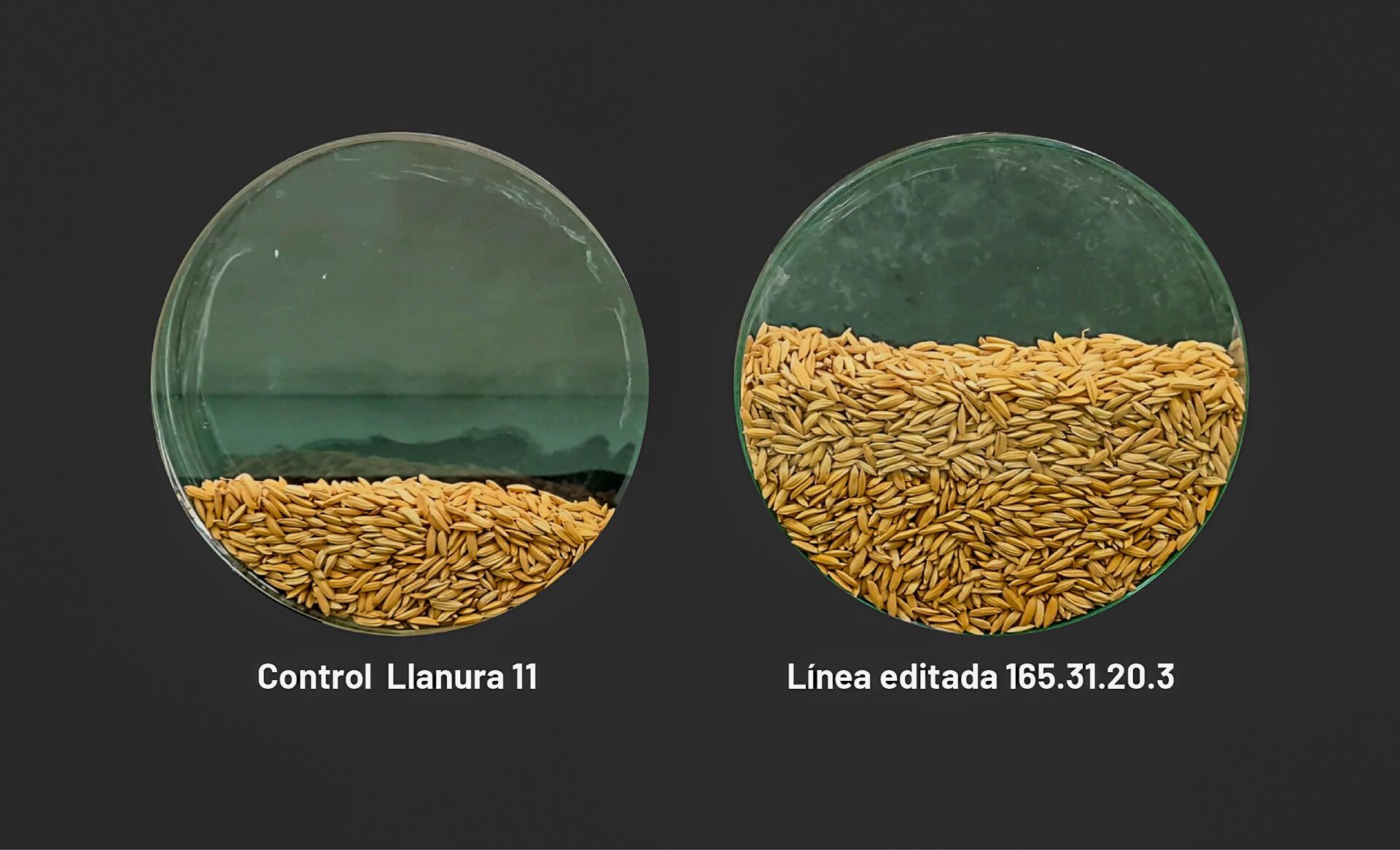
Comparison of grain yield in rice between the Plains 11 control line (left) and the edited line (right), showing a remarkable increase in grain yield after gene editing.
A concept that drives innovation
After analyzing the requested technical information, the ICA concluded that the line does not present DNA insertions from another species and does not retain traces of the genetic tools used during the editing process. The only change is the point deletion in the GN1a gene; therefore, the final product is classified as a conventional cultivar.
Also, the ICA's decision reaffirms that SDN-1 type editions are distinct from LMOs, aligning the country with international standards; this accelerates agricultural innovation by allowing developments made in Colombia to reach producers faster; and demonstrates the national scientific capacity to generate more efficient and resilient varieties.
"This ICA concept allows us to advance in the evaluation of representative zones of the Colombian Altillanura. There we will be able to validate its performance in different environments and define its potential as a future commercial variety. In addition, we will be able to use it as a progenitor plant to transfer this high-yielding characteristic to other materials adapted to dry land and acid soils. All this translates into concrete benefits for the country's rice producers," says scientist Sandra Patricia Valdés from the Alliance.

Sandra Patricia Valdés Gutiérrez
Senior Research AssociateAbout the Alliance
The Alliance of Bioversity International and the International Center for Tropical Agriculture (CIAT), provides scientific solutions that harness agricultural biodiversity and sustainably transform food systems to improve people's lives.