Research Articles Beyond silos: The essential shift to holistic climate accounting


Food’s climate cost is bigger than we think. Mary Ngaiwi, scientist of the Alliance call for integrated GHG accounting to fix fragmented data and boost progress toward Paris climate goals.
Picture any fresh item in the supermarket, a head of lettuce or a bunch of grapes, sitting on a supermarket shelf. Before arriving there, they traveled through a web of processes: cooled in storage rooms, transported across long distances in fuel-powered trucks and wrapped in packaging designed to make them last longer and look attractive to buyers. Yet when we measure its impact, official reports usually spotlight one piece of the puzzle, say farming or transport, and present it as the whole story. This narrow lens hides the complexity of the system and misrepresents the true environmental cost.
It is a well-stablished fact that the global food system is responsible for roughly one-third of total greenhouse gas (GHG) emissions. However, most reporting frameworks treat each stage of the system separately. This fragmented accounting obscures the true magnitude of emissions and hides the most effective opportunities for reduction, making the Paris Agreement’s 1.5°C target far more difficult to reach.
The myth of complete data
For decades, climate policy has rested on a flawed assumption: that our current methods for measuring GHG emissions provide a complete picture. They do not. The prevailing approach divides the food system into disconnected segments: production, transport, consumption and waste, each treated as an isolated source.
Myth: Our emissions data are comprehensive
Many assume that if we measure emissions from farms and landfills, we have captured the whole problem. But this compartmentalization prevents effective climate action. Counting emissions in silos hides how different parts of the food chain interact.
Reality: Fragmented data hides real solutions.
Traditional reporting creates isolated datasets under labels like energy, farming and waste. As a result, policy makers cannot see the full climate impact of a single intervention.
Consider food waste reduction: cutting waste lowers emission from fuel used in transport, fertilizer in crop production and methane from landfills. Yet because these saving appear in separate ledgers, the overall benefit remains hidden.
This very fragmentation in accounting is the central issue tackled by a new paper entitled “Methodologies for quantifying greenhouse gas emissions in food systems: a comprehensive review” published in Environmental Research: Food Systems, that highlights this challenge and points toward a more complete way to understand emissions across food systems.
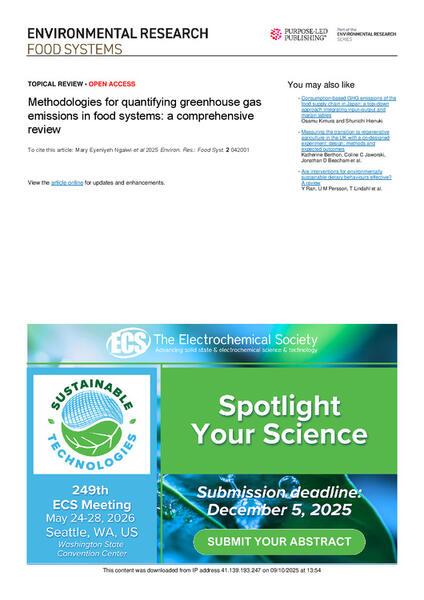
The study, led by Mary Ngaiwi, a scientist within the Low Emissions Landscapes team at the Alliance Bioversity & CIAT, reveals a critical flaw: reported emissions for similar food systems can differ by up to twofold, meaning one study’s estimate can be double that of another. These inconsistencies are not due to scientific error, but differences in system boundaries (what is included), methodological choices (how emissions are measured) and data sources (where the information comes from). This variability severely limits the reliability of current climate planning.

Mary Ngaiwi
Research SpecialistThe breakthrough: a holistic approach
The review offers a clear solution: adopt a holistic food system accounting framework that connects emissions across the entire value chain.
The paper identifies five stages that together represent the full climate footprint of a food system:
1. Pre-production (such as fertilizer manufacturing)
2. Farm activities (including crop and livestock production)
3. Processing (industrial transformation and packaging)
4. Consumption (distribution, retail and household use)
5. Waste (food loss, disposal and recycling)
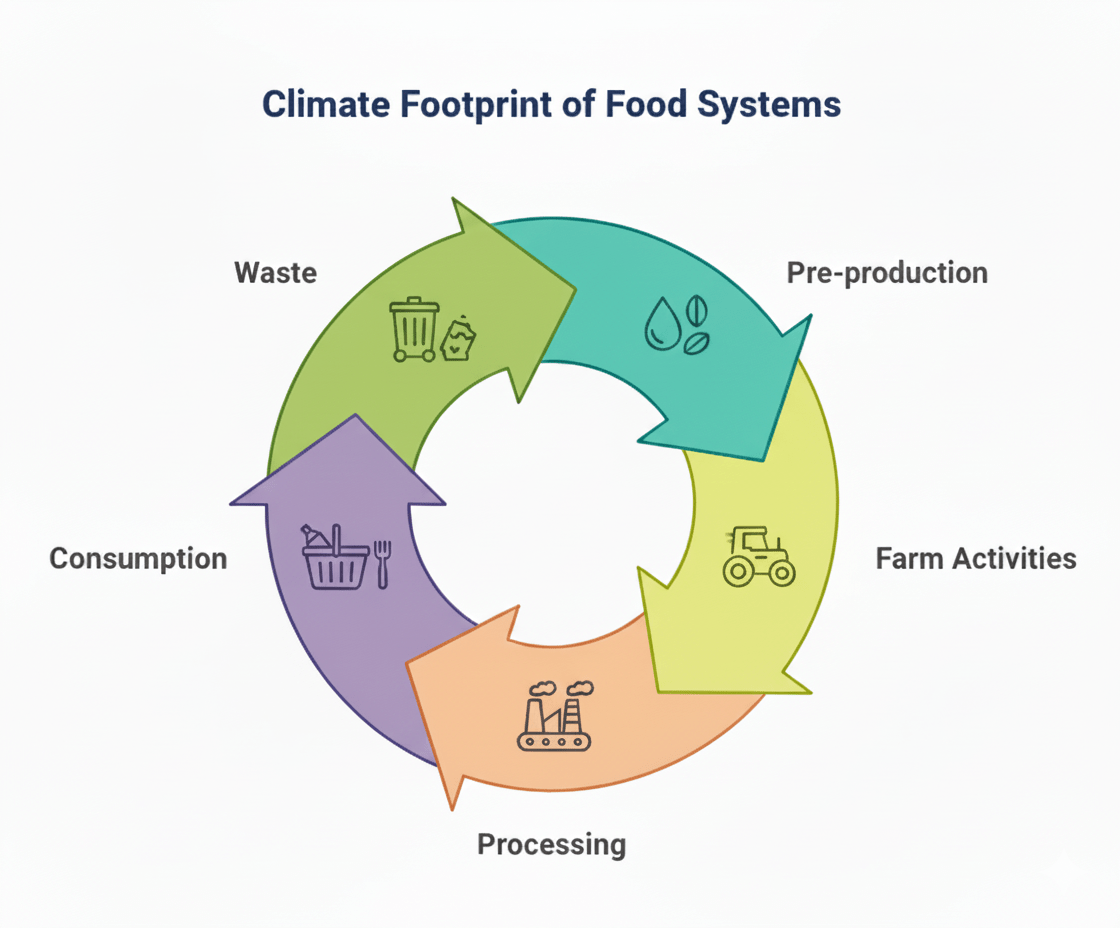
By linking these stages, the paper identifies what it calls “high-leverage points”: interventions that deliver multiple benefits across sectors. Integrating accounting in this way, allows decision-makers to:
1. Find hidden wins: integrated approaches reveal actions, like reducing food loss, that cut emissions simultaneously in farming, transport and waste management. As the authors note: “Integrating sectors across production, consumption and waste through food systems approaches may help identify high-leverage, cost-effective mitigation opportunities that are often obscured in sector-based reporting”
2. Maximize investment: governments and investors can direct resources toward solutions that generate the greatest and most reliable emissions reductions across the full system.
Lead author Mary Ngaiwi summarizes the paper’s purpose:
“If we’re serious about climate goals, we can’t afford a twofold difference in emissions data depending on which study you read. Our work is about bringing clarity and consistency to the climate conversation so every investment in mitigation counts”
Mary’s words highlight that climate action begins with alignment. When the world measures emissions by the same standard, every effort gain weight, every result counts and progress become tangible.
The new mandate: Integration as imperative
This shift toward integrated accounting is more than technical refinement; it is a new mandate for coordinated climate action. It addresses two key goals:
I. Verifiable progress: Integrated accounting enables accurate tracking of efforts toward the Paris Agreements’ 1.5°C target. It also strengthens Nationally Determined Contributions (NDCs), ensuring they are both ambitious and evidence based.
II. Sustainable development: By revealing inefficiencies and hotspots such as food loss and waste, holistic accounting supports progress toward Sustainable Development Goals (SDG) on hunger, responsible production and climate action, while improving food security.
Fragmented accounting has long distorted the climate response. To meet global goals, we must end the myth of separation and embrace the reality of interconnection. A unified accounting framework supports effective, coordinated, and lasting climate action.