Research Articles Advancing banana pest and disease solutions in Uganda through science–policy collaboration

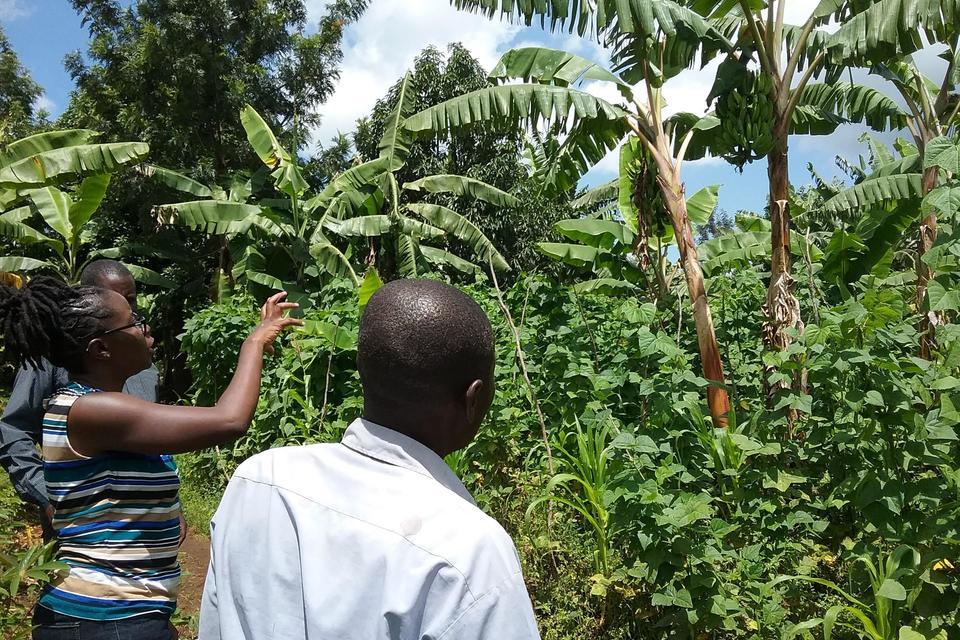
Alliance scientists and partners in Uganda are collaborating to improve banana health by distributing pest- and disease-resistant varieties, improving farming approaches, and mapping risk areas.
In Uganda, where bananas are both a staple food and a key income source, pests and diseases are more than a technical challenge: they pose a growing threat to food security and rural livelihoods.
Against this backdrop, scientists from the CGIAR Science Program for Policy innovation met with two key national policy partners: the National Crops Resources Research Institute (NACRRI) of the National Agricultural Research Organization (NARO) and the newly launched Agricultural Policy Research Centre (APRC), hosted by the College of Agricultural and Environmental Sciences (CAES).
The visit brought researchers and policymakers together around an urgent question: How can science and policy work closely to better protect Uganda’s agricultural sector, particularly essential crops like banana?
Connecting science, academia and policy: APRC
At the Agricultural Policy Research Centre in Uganda - one of the 16 member institutes of the Africa Network of Agricultural Policy Research Institutes (ANAPRI) - the discussion highlighted the country’s growing investment in evidence-based agricultural policy. Operating within Makerere University’s Department of Agribusiness and Natural Resource Economics (DANRE), APRC was launched in February 2025 to strengthen the link between scientific research and national policy. APRC Director Prof. Bernard Bashaasha introduced the Centre’s mission to close the gap between research and policy through rigorous data and high-quality analytical work. The goal is to ensure that Uganda’s agricultural policies are grounded in strong evidence and aligned with national food system priorities.
Shared priorities are:
- the need for science and evidence-based policy recommendations,
- more timely and interdisciplinary inputs,
- clearer ways to translate research findings into actionable insights for policymakers.
These are also opportunities for deeper collaboration between national institutions and CGIAR to ensure that scientific evidence informs agricultural decision-making.
On the frontline: NACRRI’s work on banana pest and disease threats
At the National Crops Resources Research Institute (NACRRI), conversations focused on the challenges farmers face as pests and diseases continue to threaten Uganda’s banana sector. NACRRI researchers shared ongoing efforts to promote improved varieties, strengthen on-farm demonstrations and support communities with practical management strategies. A major concern is the spread of transboundary banana diseases, including Fusarium Wilt, BXW and BBTD, which can move quickly across districts and borders. Responding effectively requires coordinated, multi-institutional action. Both NACRRI and the Alliance emphasized the importance of raising national awareness and bringing together government agencies, researchers, development partners and farmer representatives to mobilize a stronger collective response. The shared goal is clear: protecting one of Uganda’s most important food and income crops through evidence-based, field-tested solutions.
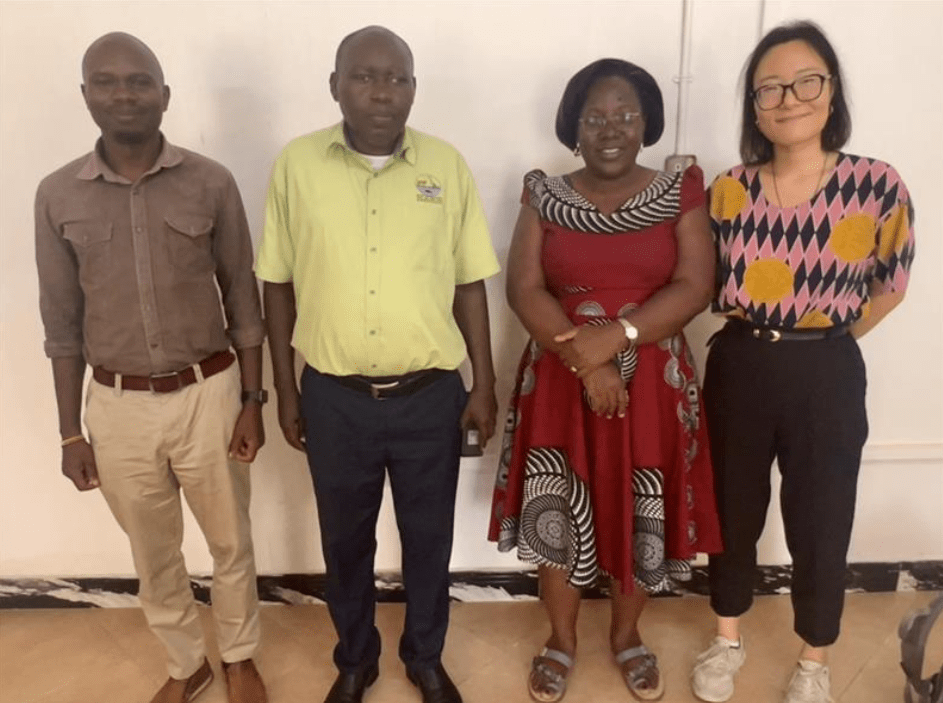
Left to right Mr. Patrick Odongo, Dr. Alex Barekye, Dr. Esther Gloria Mbabazi, Dr. Chun Song

Chun Song
Spatial EconometricianHow CGIAR innovations can support Uganda’s response
Across discussions with both APRC and NACRRI, several concrete opportunities emerged where CGIAR innovations can strengthen Uganda’s banana sector:
- New resistant banana varieties: The Alliance has contributed to developing pest- and disease-resistant varieties that can reduce losses and lower reliance on chemical control. Working closely with NACRRI can help accelerate testing, release, and adoption.
- Improved management practices: Clean planting material, integrated pest management, field sanitation and crop rotation remain essential for reducing disease pressure. Joint demonstrations and farmers training can help scale these practices.
- Economic modelling to inform policy action: Quantifying the cost of inaction, such as lost yields, reduced incomes, and long-term food security risks can help policymakers prioritize investments and interventions.
- Spatial analyses for targeted action: Geospatial tools can identify high-risk areas and guide surveillance, control measures and deployment of improved varieties, strengthening national and local planning.
A shared vision going forward
Moving ahead, each partner will contribute to a stronger banana sector:
- APRC will strengthen the role of evidence and economic analysis in shaping national agricultural policies.
- NACRRI will continue developing and validating technologies and field-level solutions to manage banana pests and diseases.
- The Alliance will work with both institutions to co-develop innovations, translate scientific evidence into actionable policy messages, and support the capacity building of emerging analysts and Ministry officers.
Together, these partnerships set the foundation for an action-oriented agenda: joint events, integrated research–policy collaboration, and targeted, data-driven responses to protect Uganda’s banana production.