Research Articles How inclusive design is shifting power to farmers and closing the seed adoption gap

Researchers from the Alliance’s Artemis project developed mobile AI tools and farmer feedback systems in Tanzania and Colombia to transform how crop breeding responds to real-world smallholder needs.
Across the Global South, crop breeding programs face a recurring challenge: the gap between improved varieties developed in research stations and the realities of smallholder farms. This mismatch is a byproduct of breeding systems that have historically been centralized, top-down, and data-poor, thus limiting their ability to reflect local growing conditions or farmer preferences.
But researchers are working to change that. Artificial intelligence (AI), when connected with participatory, human-centered design methods, has opened the field to exciting new opportunities. A set of mobile phenotyping tools, developed by the Alliance of Bioversity and CIAT’s Artemis project has harnessed AI to develop an inclusive, technology-enabled breeding system that generates more accurate data, amplifies farmer voices, and strengthens seed systems where they’re most needed.
Why does breeding need to speed up?
Breeding decisions rely heavily on phenotyping (the measurement of plant traits that inform which varieties are selected and advanced). In low-resource breeding programs, this is typically done through manual visual scoring by trained technicians. But this method is slow, subjective, and difficult to scale across the many environments where smallholder farmers operate.
Moreover, farmer feedback is rarely incorporated in a systematic way, especially during early stages of variety development. As a result, improved seeds often fail to meet the production or consumption needs of farmers. This leads to low adoption and slow varietal turnover, which is an urgent concern in the face of climate change and food insecurity.
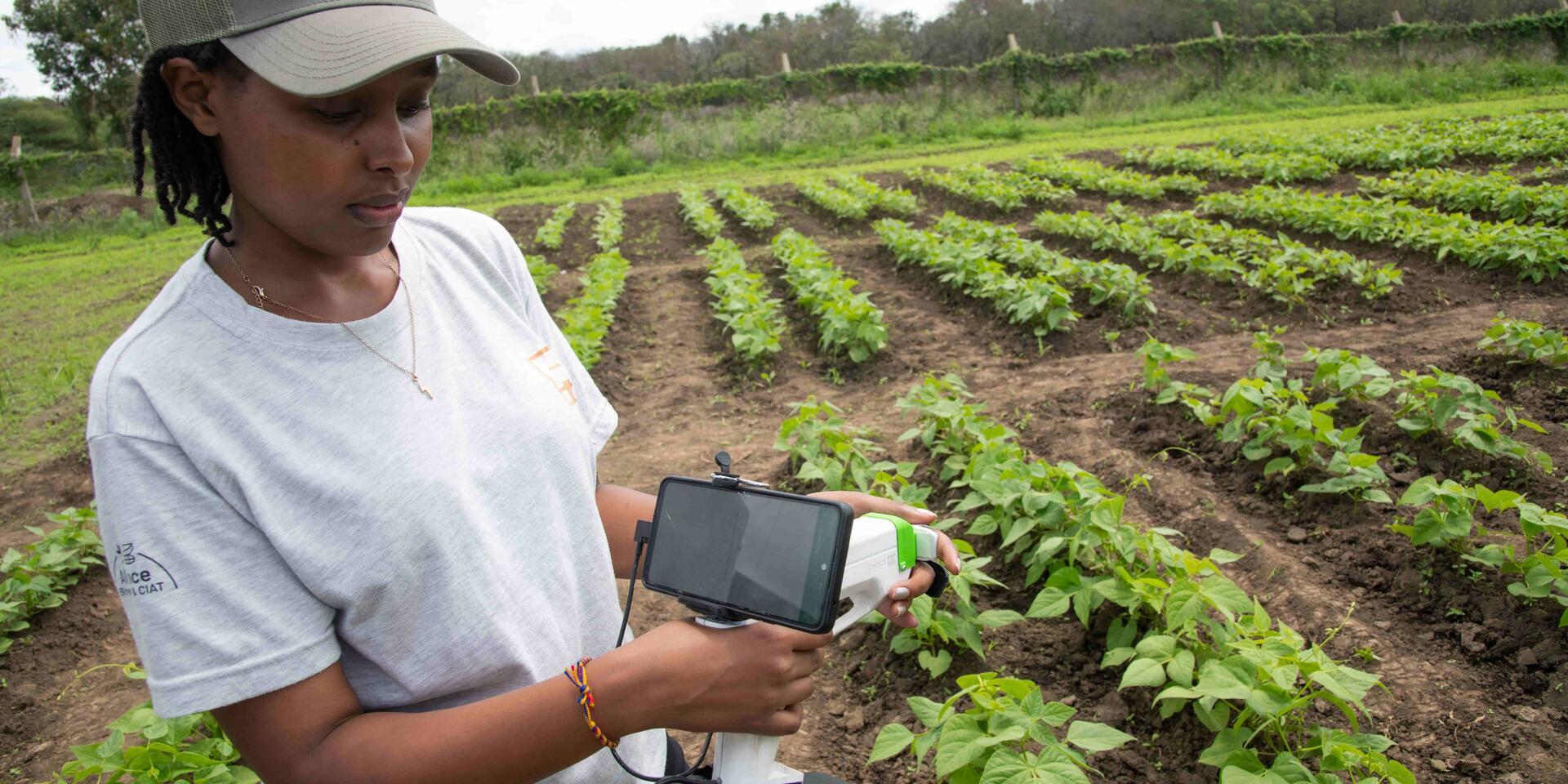
To address this bottleneck, the Artemis team developed mobile phone-based digital phenotyping tools that apply computer vision (CV) models to rapidly assess traits such as plant stand count, pod count, and disease severity. These tools have been tested in breeder stations in Colombia and in on-farm trials across five districts in Tanzania.
The results are in:
-
CV-based tools achieved trait accuracy correlations of 0.88 to 0.95 compared to ground-truth data, often surpassing traditional visual scoring precision.
-
Phenotyping a standard 4m × 3m plot now takes under one minute, compared to several hours using manual methods.
-
In on-station trials, daily image capture enabled ten times more data per genotype than analogue techniques.
-
On-farm trials captured quantitative data from 480 sites, a scale previously impossible for resource-limited programs.
This means that high-quality phenotyping data can now be collected directly in farmer fields, using tools accessible to anyone with a smartphone.
Co-designing tools that fit real-world breeding workflows
Accuracy alone isn’t enough for tools to be adopted at a scale, they need to fit into the existing workflows of breeding teams, technicians, and community enumerators. That’s why the researchers applied human-centered design (HCD) to guide development.
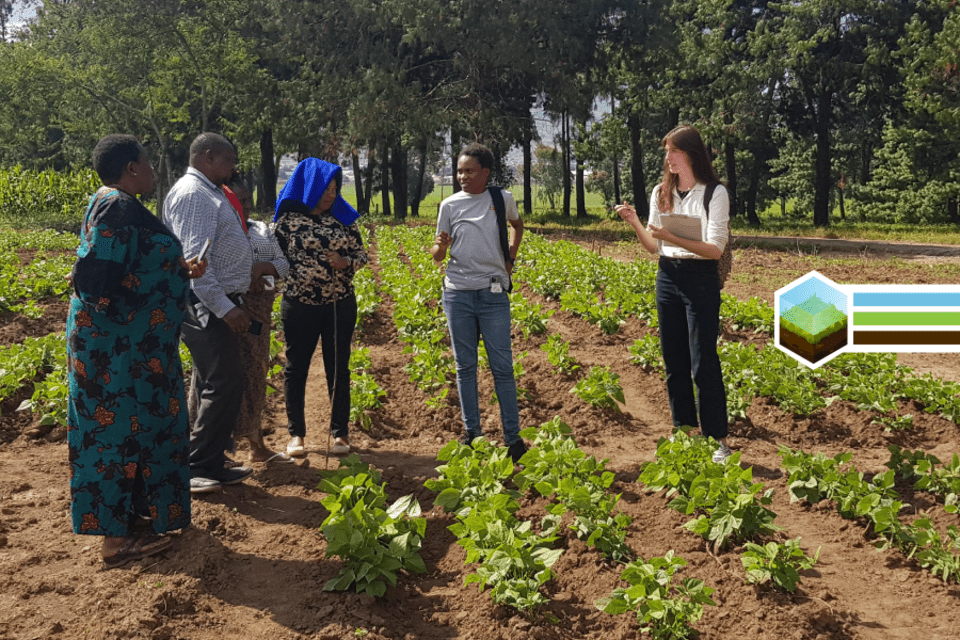
By mapping the breeder’s journey from trial setup to data analysis, and conducting interviews with users in Tanzania, the team identified critical pain points: tasks with high labor demands, frequent human error, and limited digital support. These insights shaped the design of:
- Low-cost, handheld image capture devices that improved throughput and reduced fatigue;
- Standard operating procedures (SOPs) tailored for on-farm and on-station use;
- Training materials adapted to various levels of digital literacy, including digital onboarding for decentralized enumerators.
Foundation models like DINOv2 and Segment Anything enabled trait models to be trained with far fewer images, reducing the barrier for customization across crops and traits.
The result is a phenotyping tool designed with, not just for, the people who will use it.
From measurement to meaning: Collecting farmer feedback with AI
The team also set out to capture what matters most to farmers in their own words, in their own languages, since improving accuracy in trait measurement is only part of the story.
Through the NDIZI project, researchers piloted a system that uses automatic speech recognition (ASR) and natural language processing (NLP) to collect audio feedback from farmers during field trials. Interviews in Swahili were transcribed using the Whisper model and analyzed for:
- Traits mentioned (e.g., yield, disease resistance, cooking time),
- Sentiment toward each trait (positive, negative, neutral),
- Trait importance, both individually and across farmer subgroups (e.g., women, drought-prone areas).
This approach replaces rigid surveys with flexible, voice-based tools, allowing farmers to engage in ways that feel natural. It also provides breeders with ranked, structured trait preferences that can be integrated into selection indices.
The multimodal data collection, which pairs what farmers say with what they see in the field, enables deeper insights into local perceptions of crop performance. Visual cues identified by farmers can even inform improvements in the CV models themselves.
So far, the integrated AI phenotyping and feedback system has demonstrated strong potential.
But challenges remain:
- High-performance AI models still require initial engineering investment and ongoing maintenance.
- Barriers like smartphone access, data costs, and digital literacy persist in many rural areas.
- Open-source models, while powerful, may embed biases that must be addressed to ensure equity.
Inclusive innovation demands an approach that is collaborative, adaptive, and reflective of the realities on the ground. From co-designing the standard operating procedures to collecting farmer audio data, the researchers are working to embed inclusivity not just in outcomes, but in the process of innovation itself.
What’s changing isn’t just methods, but the whole mindset behind how crop improvement is done. By combining AI-enabled tools, participatory design, and farmer-centered data, the Artemis team is demonstrating what inclusive, climate-resilient crop breeding can look like. The system is already producing results: faster, more accurate phenotyping; wider geographic reach; and deeper engagement with farmers. As technologies continue to evolve, so will the methods for co-developing seed systems that serve the people most affected by climate variability and food insecurity.
At its core, this work is about power: moving it closer to the people who grow the food. With the right tools, and the right partnerships, breeding can become more equitable.