Press and News Global Farm Platform awarded FAO 'Technical Recognition' for sustainable livestock transformation
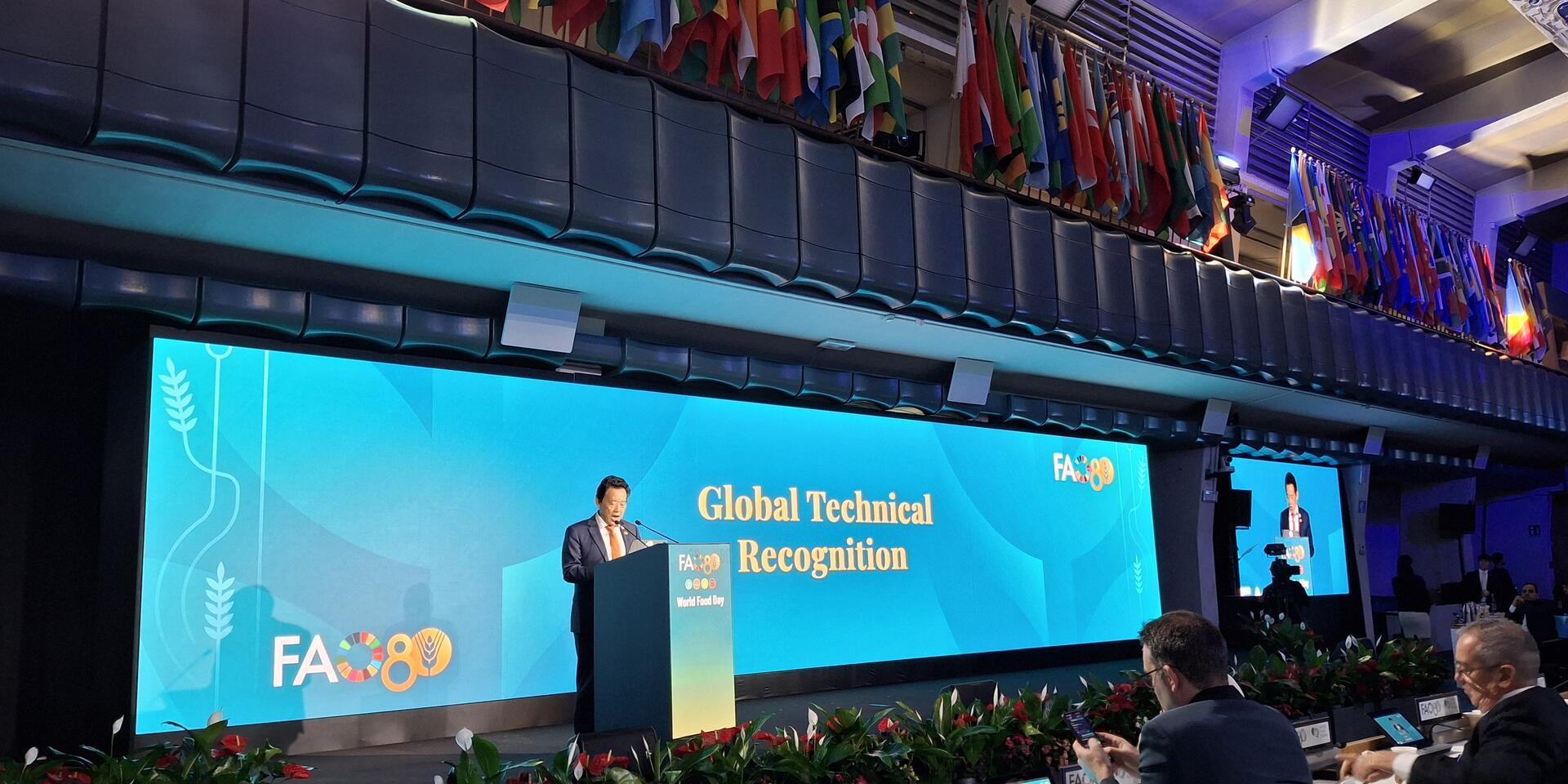

Rome, Italy: The Global Farm Platform (GFP) - a pioneering collaborative network of 19 research farms and 28 institutions across six continents, including the Alliance - has been awarded the prestigious Technical Recognition by the Food and Agriculture Organization of the United Nations (FAO) in Sustainable Livestock Transformation, One Health, Animal Health, and Reference Centers. The award was presented during the FAO Global Technical Recognition Ceremony on 15 October 2025, at FAO Headquarters in Rome, Italy, as part of the organization’s 80th anniversary celebration and the World Food Forum.
The ceremony recognised GFP’s innovative hub-and-spoke approach, which connects cutting-edge research with real-world farming practices to advance global food security, sustainable development, and agrifood systems transformation. This award follows GFP’s impactful presentation at the FAO 2025 Global Conference on Sustainable Livestock Transformation on 1 October, delivered by GFP Chair, Dr Jordana Rivero (Promar International and Rothamsted Research, UK), highlighting the platform’s transformative contributions to sustainable ruminant farming.
“This FAO recognition reinforces the Global Farm Platform’s role as a global leader in sustainable livestock transformation,” said Jordana Rivero. “Our hub-and-spoke model fosters collaboration across continents, empowering farmers, researchers, and policymakers with innovative, scalable solutions that tackle climate change, biodiversity loss, and food security whilst advancing One Health principles.”
The Alliance’s role in the Global Farm Platform
Through its participation in GFP, the Alliance collaborates with partners to support policymakers, scientists, and farmers in responding to some of the most pressing climate changes challenges of our time and help developing countries make livestock more competitive, profitable, and resilient through smarter, more sustainable practices.
“We’ve been part of the Global Farm Platform for several years now,” said An Notenbaert, Thematic Leader of the Alliance's Tropical Forages Team in Africa. “While we don’t operate a research farm in Africa, we contribute valuable insights from our close engagement with smallholder farmers across the region. From Colombia, we also share findings from our on-campus silvopastoral trials. Through our participation in GFP workshops, joint publications, and collaborative proposals, we’re proud to contribute to a shared vision of sustainable livestock transformation.
A hub-and-spoke model for global impact
Launched in 2014, with the Nature paper ‘Steps to Sustainable Livestock’, the GFP exemplifies technical leadership and collaboration through its unique hub-and-spoke model. Research farms (hubs) serve as regional centers for experimentation and demonstration, while commercial farms and smallholders (spokes) adopt and disseminate locally relevant, economically viable, and environmentally sustainable practices. This model ensures scalable solutions tailored to diverse farming communities worldwide, from Malawi’s Small-Scale Livestock and Livelihoods Programme, which boosts smallholder incomes by 30–50% through goat auctions and dual-purpose crops; to Uruguay’s Palo a Pique, enhancing soil fertility through no-tillage and pasture-crop rotations, demonstrate measurable economic, social, and environmental benefits.
The FAO recognition and conference presentation highlight GFP’s mission to bridge science and practice, delivering context-specific solutions that support the UN Sustainable Development Goals, particularly #4 (Quality Education), #13 (Climate Action), and #15 (Life on Land). With over £4 million in funding and a network spanning India’s Silent Valley smallholder dairy cattle system in tropical humid environments to New Zealand’s Dairy 1 pasture-based intensive dairy with once-a-day milking, GFP continues to drive transformative change in ruminant farming, benefiting farmers, ecosystems, and communities worldwide. Over the last almost 12 years, we’ve executed over 15 projects and conducted 35 international workshops. These activities have allowed us to support 15 internships for mainly early career researchers from a variety of countries such as Uruguay, China, Nigeria, Iran, India, Brazil, and Ghana. We are currently contributing to the Marshal Papworth program, working with international students from Africa and Asia. We’ve also published nearly 200 scientific articles, reporting our collaborative work around the globe. For more information about the Global Farm Platform and its initiatives, visit www.globalfarmplatform.org.
About the Global Farm Platform:
Established in 2014, the Global Farm Platform is a collaborative network of 19 research farms and 28 institutions across six continents, dedicated to optimising livestock production whilst minimising environmental impact. Each member has signed a Statement of Intent, of how they will contribute to the partnership, and have a financial agreement with an existing member organisation. Through its hub-and-spoke model, GFP integrates cutting-edge science with real-world farming, fostering sustainable livestock transformation, One Health, and global food security.
Media Contact:
Jordana Rivero
Global Farm Platform
Email: [email protected]