Blog Financing a low-emission food system in Colombia: A Q&A with our experts

In Colombia, deforestation, largely driven by the agriculture, forestry and other land use sector accounts for 56 percent of total emissions. As the nation strives to meet its ambitious goal of reducing greenhouse gas emissions by 51 percent by 2030, transforming food production systems will be essential.
However, achieving this transformation demands substantial investments, underscoring the need for effective strategies and resources to address climate change at scale. In this Q&A, Ma. Eliza J. Villarino, and Carlos Andrés Borda, researchers at the Alliance of Bioversity International and CIAT, present critical topics being addressed by the Low-Emissions Landscapes team of the Multifunctional Landscapes lever.
Why is funding a low-emission food system a priority?
Ma. Eliza J. Villarino (EJV): We know that emissions from food systems account for up to 30 percent of greenhouse gas emissions, for example from methane from livestock, deforestation and inefficient farming practices. Yet when you look at climate finance for the agricultural sector, it is very small. In order for us to reduce emissions in the food system, funding is required, especially to support key actors in reducing emissions – small scale producers.

Maria Eliza Villarino
Research FellowCarlos Borda (CB): Producers must be included in funding opportunities across the value chain, so that they can build capacity to reduce carbon emissions; and access funding. We know that when we work with governments, we can support initiatives that have multiple benefits including improving biodiversity, and these incentives must be aligned so that smallholders can access them while lowering emissions.

Carlos Borda
Senior Research Associate, Multifunctional LandscapeWhy should farmers implement low-emission strategies in Colombia?
EJV: Smallholder farmers are not the only drivers of harmful greenhouse gas emissions. When we talk about emissions in food systems, we look at the whole context. On this basis, guaranteeing food security must reduce emissions, combining social and environmental co-benefits at the same time. For example, introducing agroforestry is not only about deforestation but also about improving ecosystems as a whole. We see farmers as part of the solution to a low-emission future.
CB: Farmers must be able to produce food but also have the capacity to implement sustainable practices and to work in a peaceful environment. The way to do that is to give them access to financial and capacity support and benefits so they can participate in efforts to reduce emissions. Farmers may have limited resources, but we see working with them in a holistic way to move towards a food system that is beneficial to all, the planet and people.
What are the current financial challenges to developing a low-emission food system?
EJV: In Colombia, for example, getting formal credit may require producers to have collateral and a compliance certificate. This is a huge challenge for smallholder farmers, especially in the context of areas that have experienced conflict.
CB: Transforming food systems requires, on the one hand, addressing multiple challenges (including cultural barriers) and, on the other, creating or adopting financial mechanisms that enables the actions needed to achieve that transformation. Yet, practices to reduce emissions are not part of traditional financing mechanisms. Technical financial mechanisms need to be adopted to achieve low-emission practices in the food system, which may imply an increase in costs for the financial sector and for producers. Green taxonomy – a classification system for identifying activities or investments that will move a country toward meeting specific targets or environmental objectives – is a step forward to align sustainable practices with financial portfolios. Market instruments have also been developed to finance mitigation, but they are under development and do not go far enough.
What can be done to channel more funding towards low-emission food systems?
EJV: Policy instruments need to be aligned with financial options that are available and accessible to farmers and producers. Companies may not know about tax incentives that could be invested in projects with low-emission food system benefits, for example. These incentives must also be better communicated.
CB: We can also adopt traditional financial mechanisms to climate finance, such as the green taxonomy, taxes and loans to fund sustainable practices. These must be aligned with traditional bank sustainable practices. Also, we can send economic signals to consumers so that they are aware of products that have been produced sustainably, using seals and zero-deforestation labels. We also need to structure mitigation and adaptation strategies with co-benefits for rural communities in mind and reduce transaction costs.
What are the current financial instruments available to better support low-emission food systems?
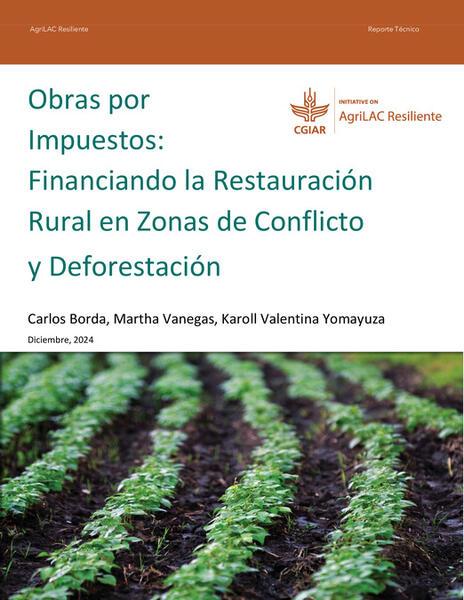
EJV: We have been working to blend finance mechanisms, for example, repurposing “obras for impuestos” (a mechanism through which individuals and legal entities subject to income tax and complementary taxes may pay their income tax by executing works or public investment projects of social significance.) so it can support payment for ecosystem schemes.
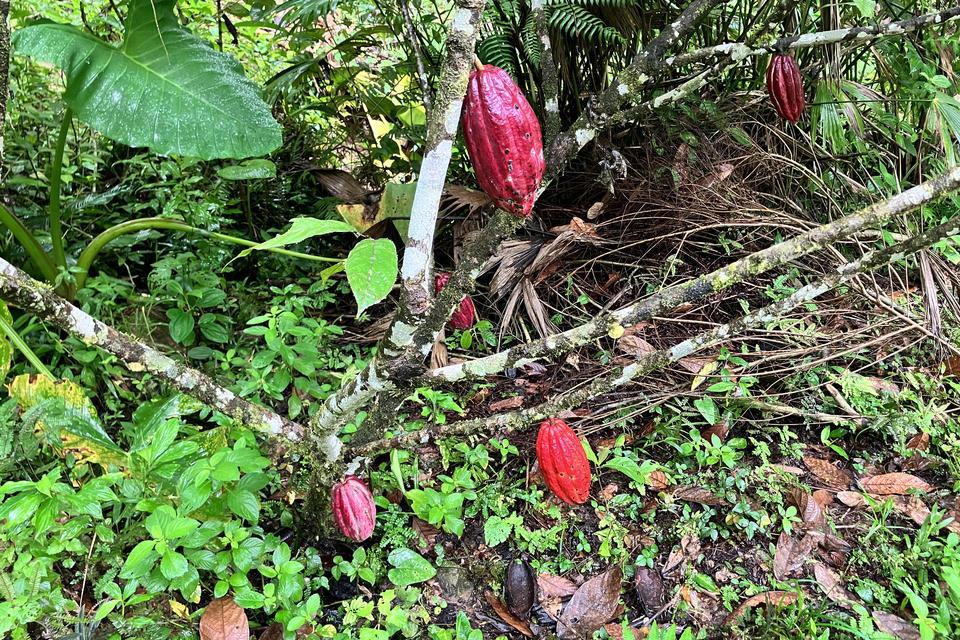
CB: For example, cocoa farmers can obtain a certificate that can be used to access finance when they produce without deforestation. The money to protect the forest is generated by a private company that supplies certification in accordance with agreed production standards. An agreement is then made, with support from the government, to allow farmers to obtain credit through traditional banks. Direct mitigation and adaptation measures also exist in Colombia, for example allowing farmers to obtain carbon credits by protecting the forest. Indirect credit, loans, subsidies and peace mechanisms can all be adapted to better serve communities.
How can these successful practices be scaled and improved on in the future?
EJV: The only way to get buy-in from stakeholders is by communicating successes and lessons learned. Whether it is among communities or the government, communicating what works is critical, alongside measuring the impact of change and allocating a value to the change and benefits that people can relate to.
CB: Working across different levels is critical. This includes working at the government level to influence public policy, improve production with producers, or implement zero-deforestation agreements that are mandatory rather than voluntary. Or, working with the private sector to improve market conditions; or making equitable financing available for sustainable projects. These practices can be built upon in the future.