Blog Cultivating women’s leadership for resilient agrifood systems

Women’s representation and leadership have long been recognized as drivers of more inclusive, equitable, and resilient food systems. Yet, too often, leadership is confused with a formal title or with women’s membership in groups.
What, then, does women’s leadership in agrifood systems really mean, and what makes it transformative?
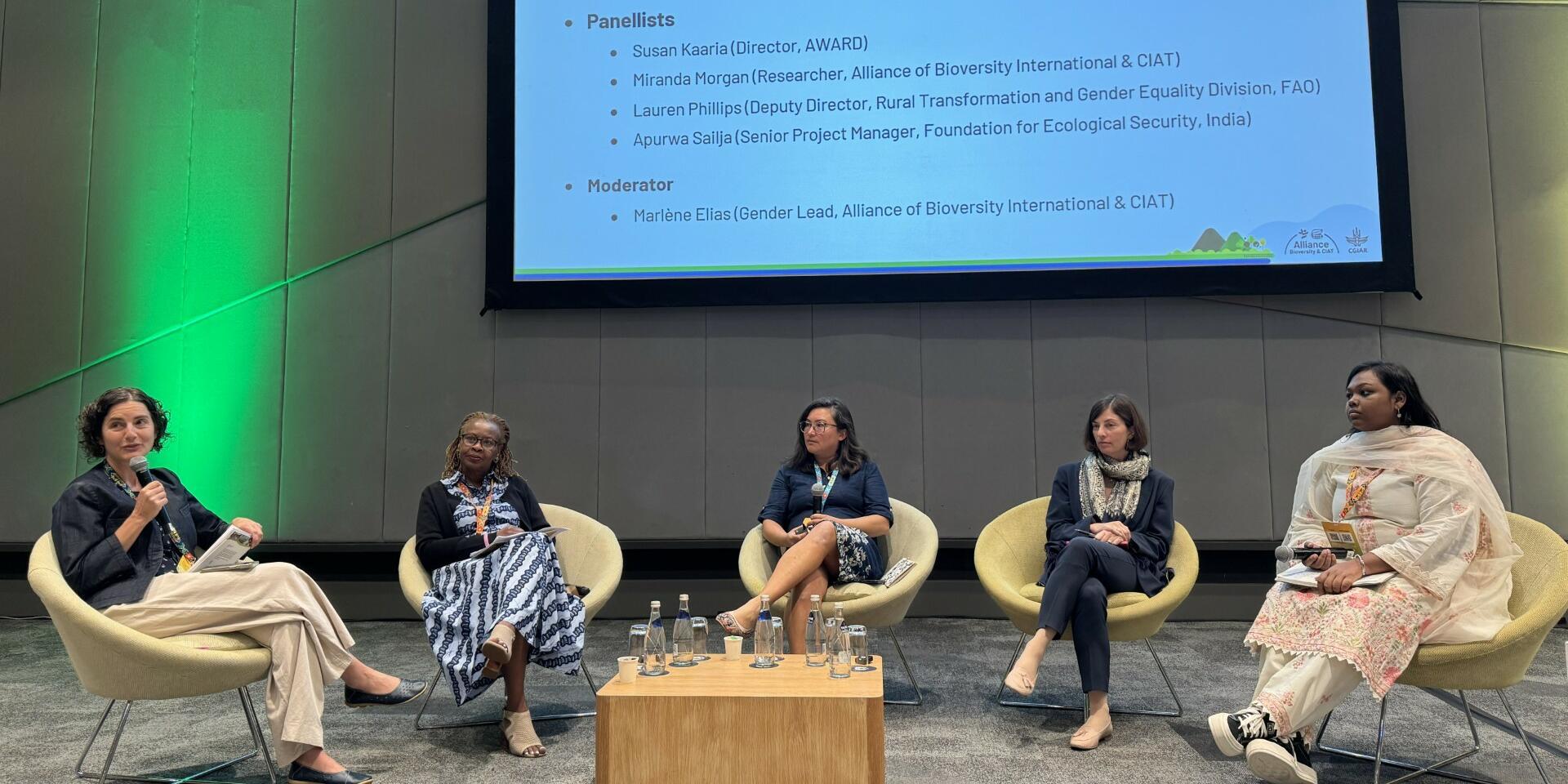
Building on ongoing research into the quality, depth, and influence of women’s leadership, the Alliance of Bioversity International and CIAT and the Food and Agriculture Organization of the United Nations (FAO) co-organized the session “Cultivating Women’s Leadership for Resilient Agrifood Systems” to bring these questions to the fore at the CGIAR GENDER Conference in Cape Town.
Moderated by Marlène Elias - Gender Lead at the Alliance - the panel brought together a diverse group of experts whose work spans years of applied research and practice with women leaders:
- Susan Kaaria, Director of African Women in Agricultural Research and Development (AWARD);
- Lauren Phillips, Deputy Director of FAO’s Rural Transformation and Gender Equality Division;
- Apurwa Sailja, Senior Project Manager at the Foundation for Ecological Security (FES), India; and
- Miranda Morgan, Researcher at the Alliance.
The speakers addressed complex questions, including:
How can leadership by women in all their diversity contribute to just and sustainable food systems?
What does it take to support that kind of leadership?
Understanding 'transformative' leadership
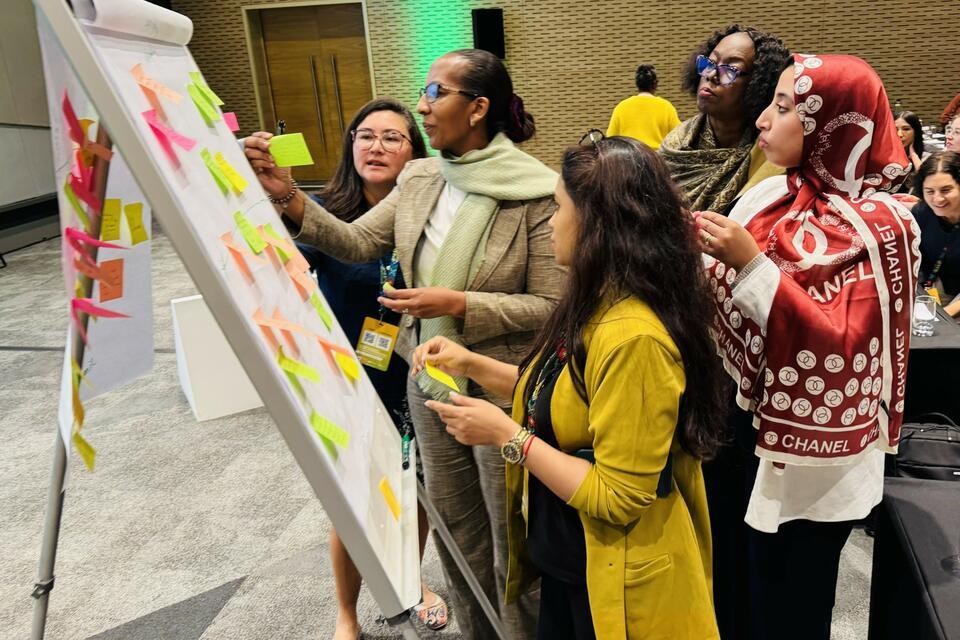
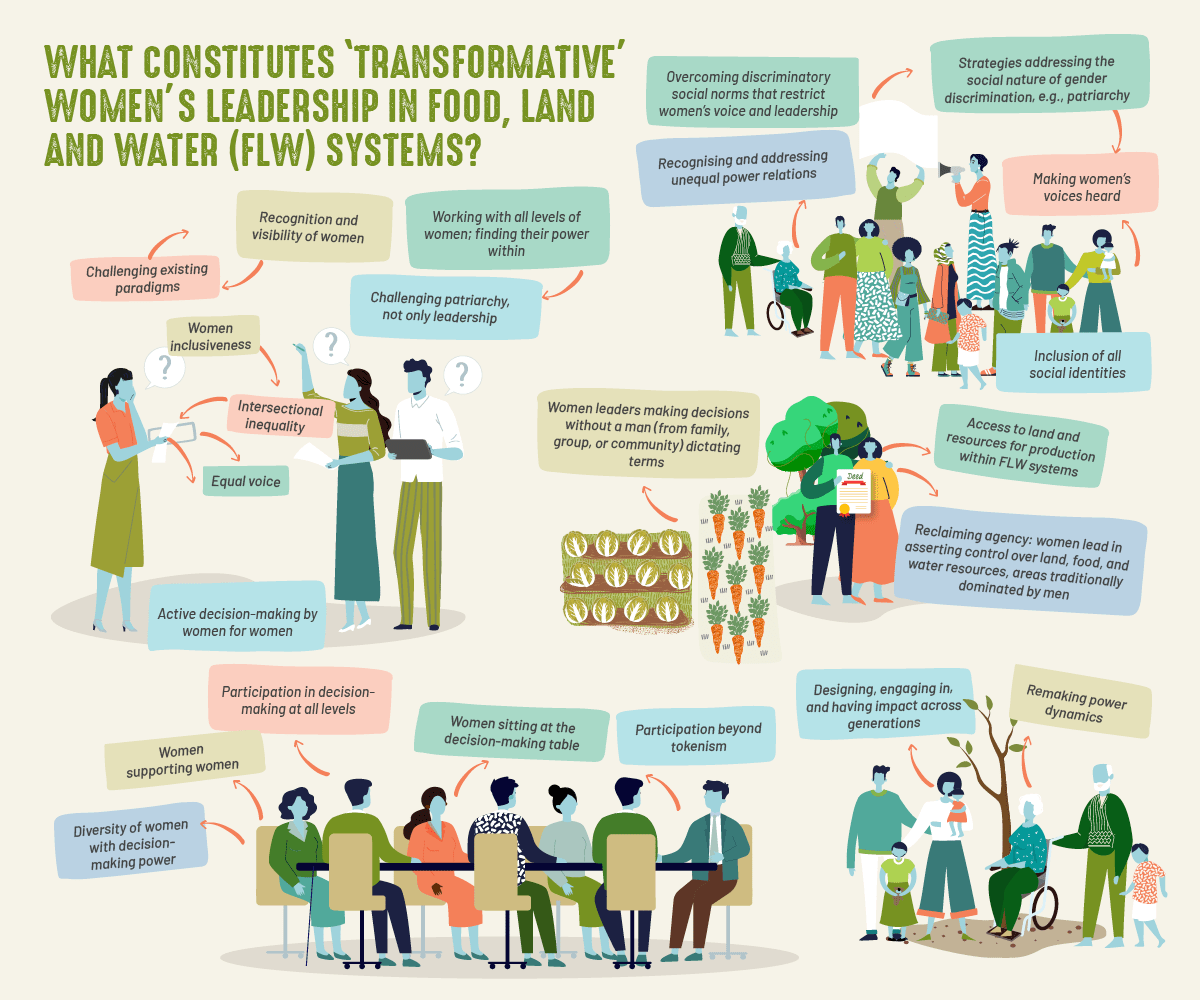
To open the discussion, the audience was invited to share their views through a live poll on what constitutes transformative women’s leadership in food, land, and water systems. Responses ranged from “equal voice” and “women sitting at decision-making tables” to “participation beyond tokenism” and “challenging patriarchy.”
Lauren Phillips encouraged thinking about transformation as a process that operates across three interconnected levels. At the household and community level, norms around who leads and who decides must evolve. At the institutional level, access to opportunities and resources must become genuinely equitable. And at the policy level, funding and accountability systems must reflect these priorities.
She observed:
Although leadership is often equated with holding a formal position or title and projecting the loudest voice, Miranda Morgan explained that leadership often manifests in less visible ways. Influence can emerge through informal spaces, collective action and the quiet work of building relationships and mobilizing. Conventional indicators of ‘leadership’, such as membership in groups or committees, tell us little about agency, exercising voice, or having those voices heard. True leadership, Morgan argued, depends on the quality of participation and influence (individual and collective), not simply on formal leadership titles. In response, recent research efforts conducted by the Alliance in partnership with NGOs in India and The Gambia have sought to provide a fuller and more nuanced understanding of what women’s leadership looks like in agrifood systems.
Persistent barriers
Across every level of food, land, and water systems, women continue to face structural barriers to leadership. Susan Kaaria described what she called the “leaky pipeline” in agricultural research and development: the progressive reduction of women at each stage of a career, particularly in fields like STEM, leading to an underrepresentation in leadership positions. This happens due to a combination of structural, cultural, and organizational barriers that push women out of the field at a higher rate than men.
She reflected:
"You find you are the only woman in your corridor, your department, or your meeting. The role models and the support are missing.”
Kaaria explained that AWARD’s leadership and management courses address these barriers by combining technical skills with mentoring and personal development.
“We talk about self-awareness and emotional intelligence — learning how to read the room, create alliances, and negotiate your space. Women lead differently, and that’s okay. You don’t have to be autocrative; consensus is okay. It’s okay to lead as a woman, and you will be as effective.”
At the grassroots level, Apurwa Sailja shared experiences from India, where household responsibilities and entrenched social norms too often limit women’s leadership potential.
“Many women ask: if I go out to lead, who will take care of my home? We want women to step forward, but we are not reducing the burden they carry…Representation alone is not enough. We need environments where women can lead without being overwhelmed.”
Among other initiatives targeting women’s leadership, FES works to build the capacity and confidence of elected women representatives in village councils and a more conducive environment for women leaders to flourish by helping them navigate institutions and create peer support networks.
Rethinking leadership
A key takeaway from the discussion was that there is no single model of leadership, whether for men or women. Leadership can be collaborative, relational, or exercised collectively. It can emerge through small yet powerful acts, like a woman speaking up for the first time in a community meeting, or influencing decisions informally within a group. Leadership initiatives must be careful not to reinforce existing hierarchies and pre-determined leadership behaviors.
Phillips highlighted that transformation is as much cultural as it is structural.
“It’s not about replacing men’s leadership. It’s about changing the culture of leadership itself. Otherwise, even when women rise into leadership positions, the incentive may be to replicate existing hierarchies rather than redefine them.”
Phillips further emphasized that:
“We can’t achieve cultural change by focusing on women alone. Men and boys must also be part of feminist leadership. We need to transform the leadership culture across society.”
Enabling women’s leadership
In conclusion, speakers reflected that fostering transformative women’s leadership requires acting on multiple fronts through:
- Mentorship and peer networks, with AWARD and FES showing how women supporting women can boost their confidence and accelerate change.
- Policy mechanisms (such as quotas) to open doors.
- Institutional reforms and shifts in social norms, to allow policy changes to take hold.
Sailja underscored the long-term commitment required to advance women’s leadership:
“We have to be deliberate about the change we want to see. Transformation doesn’t happen by chance. It’s built over time.”
The panel reaffirmed that enabling transformative leadership by and for women in all their diversity requires changing deep-seated structural barriers across the entire ‘leadership ecosystem’. As research and practice continue to evolve, the question is no longer whether women have a right to lead, but how we can collectively create the conditions that allow them to do so fully, effectively, and in ways that benefit their well-being and that of their communities.
The panel ‘Cultivating Women’s Leadership for Resilient Agrifood Systems’ took place on 7 October 2025 in Cape Town, at the Conference on “Accelerating Equality in Food, Land, and Water Systems”. The panel was organized under the CGIAR Gender Equality and Inclusion Accelerator, with support from the CGIAR Trust Fund Donors and from Co-Impact.
If interested in research related to topics discussed above, feel free to contact Miranda Morgan ([email protected]) for additional resources.