Research Articles Can agroecology feed the world? The debate is heating up… and we want you to join the conversation!
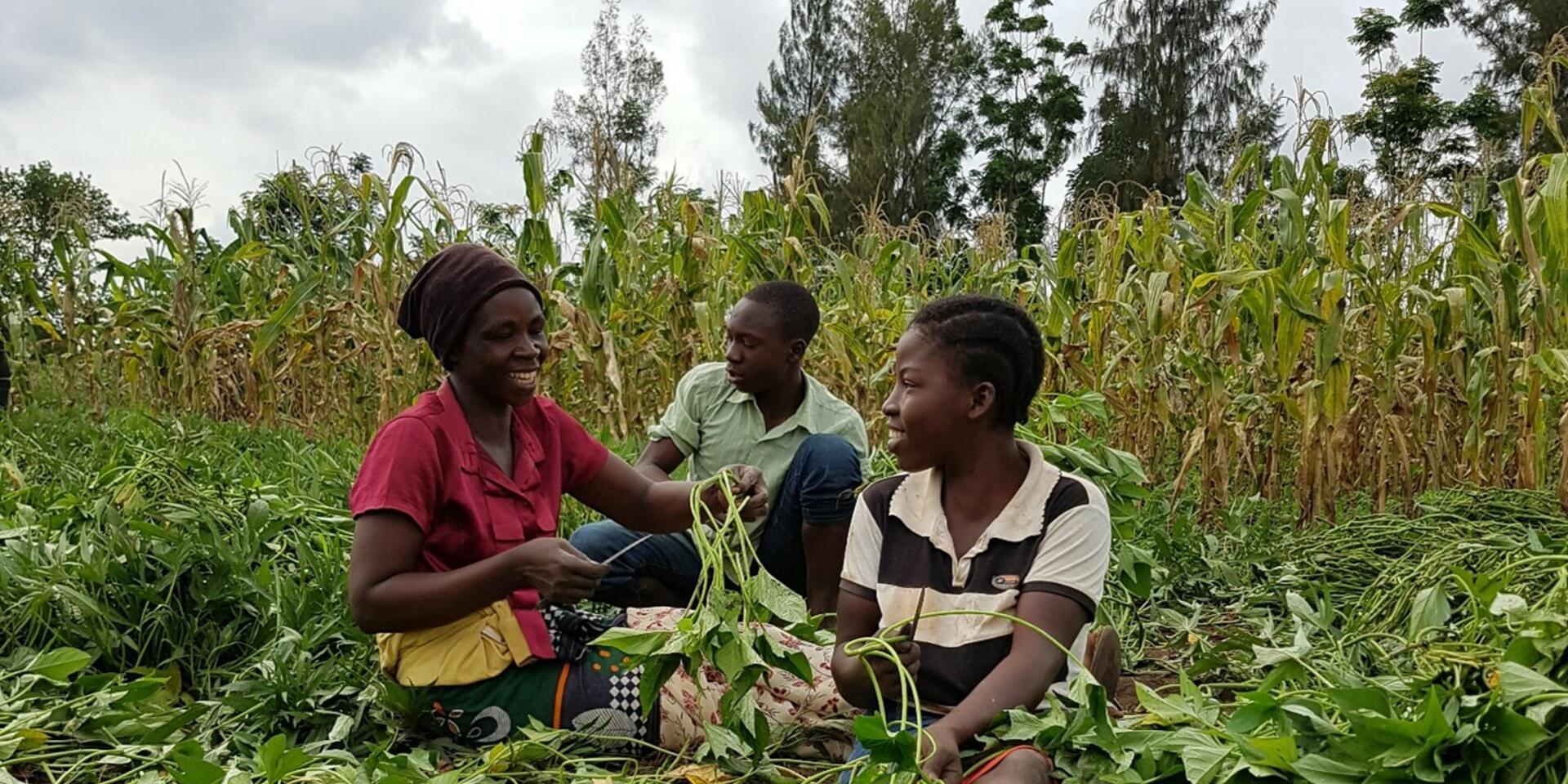

Industrial agriculture drives global warming, biodiversity loss and and inequality: the world produces enough food for everyone but the global food system left 670 million people hungry in 2024. Is agroecology a solution? The debate heats up.
Can agroecology feed the world? It’s a question that increasingly surfaces in conference halls, community assemblies, farmer’s fields and policy debates on the future of food. Even major agribusinesses appear to be discussing the question more.
But what is the substance of the debate? How much difference is there between agroecology’s proponents and those who see no future for it? And who is in the middle ground, proposing to unite the best of both systems?
To address those questions, a recent publication reviewed around 1,000 journal articles related to agroecology narratives. The research was published in July in Agroecology and Sustainable Food Systems and authored by researchers from the Alliance of Bioversity & CIAT, Hohenheim University from Germany, and the United Nations’ Food and Agriculture Organization (FAO).
What is agroecology?
According to the United Nations’ Food and Agriculture Organization (FAO), "Agroecology is a holistic and integrated approach that simultaneously applies ecological and social concepts and principles to the design and management of sustainable agriculture and food systems. It seeks to optimize the interactions between plants, animals, humans and the environment while also addressing the need for socially equitable food systems within which people can exercise choice over what they eat and how and where it is produced." While the application of agroecological principles is not new, there is increasing support for agroecology by national governments, development agencies, local communities and even major agribusinesses. There are also several open questions, research gaps and lively debates between stakeholders.
The debate of late
The new Alliance research follows a friendly exchange between scientists in a journal published by the prestigious Royal Society, an independent UK-based scientific academy. It started with the publication of research that called for sustainable high-yield agriculture as essential to “bending the curve” on biodiversity loss.
Scientists at the Alliance and colleagues responded, arguing that decades of “yield-centric agriculture, divorced from ecological and social concerns, have proven inadequate” to curbing agriculture’s toll on biodiversity – and on human health. They said a greater scaling up of agroecological and regenerative production, with its built-in benefits to biodiversity, should be a cornerstone of food system transformation.
The author responded, explaining the researcher’s team’s work supports the core, evidence-based arguments that they do “not advocate a continuation of business-as-usual high-yield farming.” While still advocating for increasing yields (in part, to reduce demands for natural landscapes to be converted into farmland, “we completely agree that biodiversity needs conserving in every biome.”
But what does a wider look at the agroecology literature say?
The three agroecology views: optimistic, pragmatic, pessimistic
In the new paper, researchers don’t choose sides. Their goal is to understand what the research literature tells about who is on which side of the agroecology debate, and how it matters to farmers, consumers, development agencies, and governments that increasingly support agroecology.
“Based on our insights, we need to know and understand these different views,” said Jonathan Mockshell, an Alliance researcher and lead author. “By integrating different views into policy processes and actions, it is possible to overcome the obstacles facing agroecology implementation.”

Jonathan Mockshell
Scientist and Project LeaderThe research does not delve into shifting attitudes toward agroecology but Mockshell, who has researched the topic and related themes for the last ten years, says he’s sees opinions toward agroecology are gradually moving in agroecology’s favor.
“We see some agroecology skeptics evolving toward a more pragmatic approach, which is essentially a middle ground,” said Francisco Hidalgo, an Alliance researcher and co-author.
“Overall, we think there are fewer all-out skeptics now. Many used to consider it a ‘backwards’ way to produce food. But there is more science supporting agroecology’s benefits, which I think is helping people become open to discussing – and implementing – agroecological principles,” said Marcela Quintero, the Alliance’s Associate Director General and co-author.

Marcela Quintero
Associate Director General, Research Strategy, and InnovationBut let’s walk through the research findings. What are the three dominant ways to ‘see’ agroecology? Who is in each camp? And what are the six often-contentious themes that dominate discussions?
Behind these questions lie more than concerns about yields, profits, and calories. Agriculture is about power, livelihoods, land, equity, identity, culture, and asks us all what kind of future we are sowing for the future of food.
Three Ways to See Agroecology
According to the researchers, there are three dominant narratives around agroecological transitions.
- The Supportive Narrative views agroecology as the path to regenerate the planet and uplift rural livelihoods. It’s a holistic and systems approach—one that blends knowledge, ecology, equity, and food sovereignty.
- The Skeptical Narrative warns that agroecology, with its lower input and often lower short-term yields, cannot meet global food demands. It sees intensification of "business as usual" as necessary to prevent further land-use expansion and degradation.
- The Pragmatic Narrative lands somewhere in the middle: it recognizes agroecology’s promise but insists that its success depends on access to land, credit, policy support, and knowledge systems tailored to local contexts.
Who are driving the three narratives?
Agroecology’s practicality is not just an academic debate. The narratives have well-identified advocates across society.
- Supporters tend to include farmers, grassroots organizations, Indigenous groups, and social science scholars.
- Skeptics are often agrifood corporations, governments, and some natural scientists focused on yield and efficiency.
- Pragmatists include NGOs, development agencies, and some academic sectors looking for scalable, workable agricultural models.
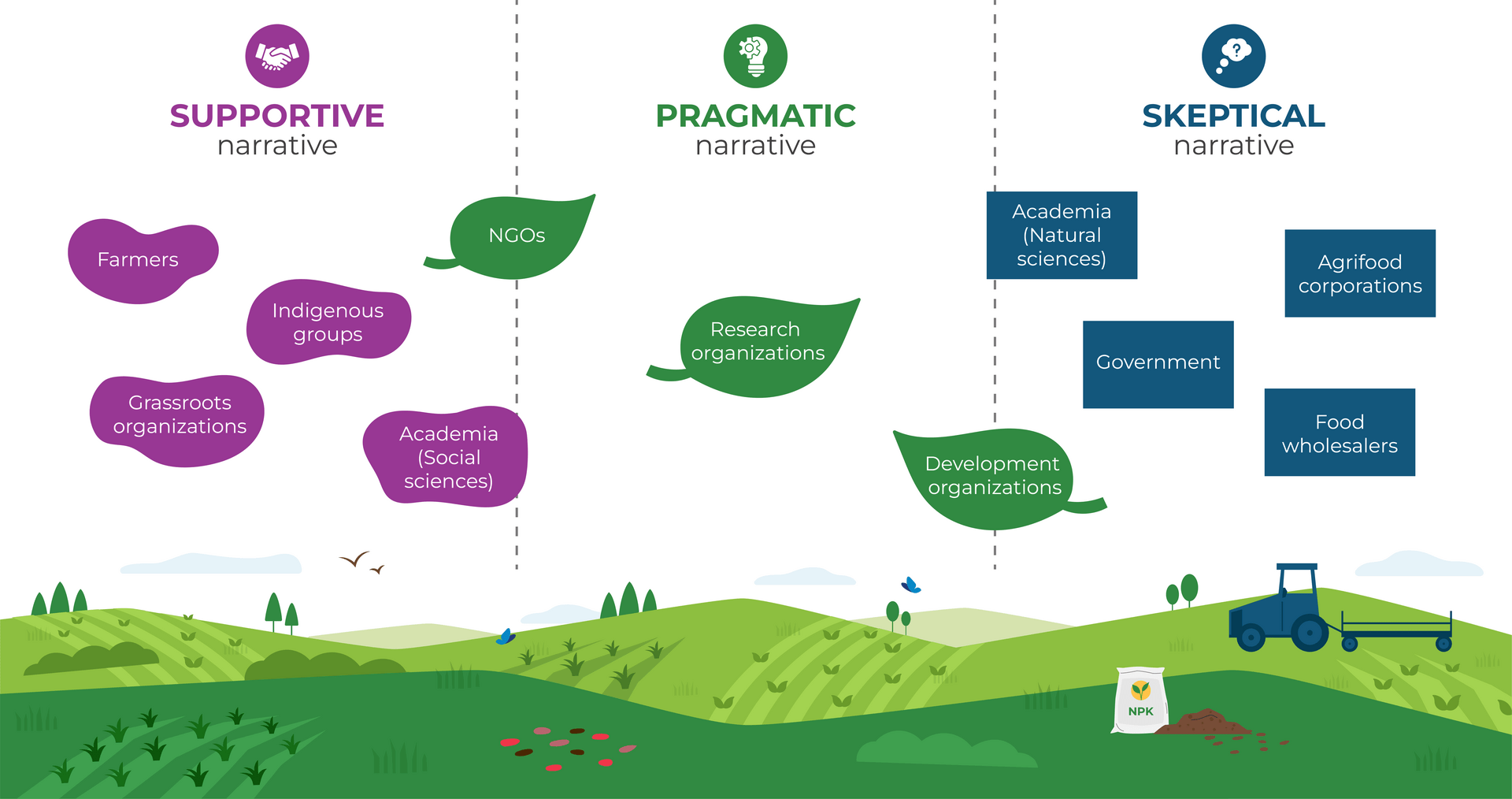
Image credit: CIAT/Isabella Muñoz
Digging Deeper: Six Areas That Matter
Beyond the overarching narratives, the review uncovers six contentious themes that shape the agroecological debate. Each is a lens to better understand what’s at stake—and the obstacles facing wider adoption of agroecology.
1. Initial Transition Costs
Everyone agrees that transitions are hard. But while supporters see diversification as a safety net and path to long-term gain, skeptics focus on the economic vulnerability of farmers. Pragmatists state that under certain enabling conditions (i.e., access to credits, incentives, policy and institutional support), production costs can offset initial hurdles.
2. Inputs and Supply
Supporters envision ecological justice—fewer synthetic inputs (fertilizers, pest controls) and more farmer autonomy. Skeptics argue that some soils (like those in Sub-Saharan Africa) are too depleted to thrive without external nutrients. Pragmatists call for rethinking supply chains, shared investment, responsible innovations, and a balance between targeted synthetic and organic inputs.
3. Yield Potential
Here lies the heart of the food security concern. Skeptics worry about drops in yield. Supporters point to case studies showing stable or even increased yields. Pragmatists say: It depends on where you start, and what success looks like. Therefore, one single solution does not fit all and varies according to the context.
4. Labor
Is more labor needed in agroecology? Supporters say yes—and that’s a good thing, creating rural jobs and supporting community food autonomy. Skeptics raise concerns about workforce shortages. Pragmatists push for technology and policies that make labor manageable without compromising livelihoods.
5. Scalability
Can agroecology scale? Supporters say: Yes, if rooted in local knowledge and social movements. Skeptics doubt its potential in the face of dominant economic models. Pragmatists advocate for hybrid strategies, building coalitions and governance structures that allow it to grow meaningfully.
6. Markets
Supporters favor solidarity economies, territorial markets and local empowerment. Skeptics warn that alternative markets may not absorb agroecological supply. Pragmatists emphasize the need for institutional backing, policy alignment, market incentives, and stronger links between producers and consumer markets.
The Power of Creating New Knowledge Collaboratively
A cross-cutting thread throughout the research is the need for knowledge co-creation. Agroecology isn’t just a set of practices and principles—it’s a holistic way of thinking and learning. It requires multi-stakeholder dialogue, local innovation, and participatory science.
But this only works if power dynamics are addressed. Without equity and inclusion, even the most participatory process can be more symbolic than meaningful. Real transformation begins when diverse actors shape goals together, not just exchange information.
Acknowledgements
We are grateful for funding from CGIAR Multifunctional Landscapes and Policy Innovations Science Programs.
The authors of the review leave us with a thought-provoking conclusion: Some say agroecology can’t feed the world. Others say it’s the only way we’ll manage to nourish the world. The truth may lie in the richness of the dialogue between both views.
Rather than choosing a camp, we need better tools for navigating complexity. We need to ask not just can it feed the world? But also, what kind of world do we want to feed and with what food? One where ecosystems thrive, farmers are empowered, markets are inclusive, and knowledge is built together.
Now we want to hear from you. Do you believe agroecology can feed the world?
Which narrative resonates with your experience? Are you supportive, skeptical, or pragmatic?
Drop your thoughts in our social media (Instagram, Linked In, X,) or share this article to keep the debate alive. Because the future of food is not just about what we grow. It’s about what we believe is possible.