

Earlier this year, the Center received funding from the Swiss Agency for Development and Cooperation (SDC) for a project titled ‘Improving food security, nutrition, incomes, natural resource base and gender equity for better livelihoods of smallholder households in Sub-Saharan Africa’. Some of the 5-year project’s funds were earmarked to strengthen bean activities in two flagship countries – Burundi and Zimbabwe. Partners launched the flagship initiative in Burundi on 17 and 18 November 2015. 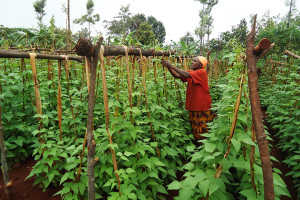
A Burundian farmer tends her climbing bean crop. CRuraduma/ISABU “I am with Burundi” came the words of a colleague as he left Bujumbura, referring to the engagement and commitment of national partners to transform Burundi’s bean sector. It was a sentiment echoed by each member of the Pan Africa Bean Research Alliance (PABRA) who travelled to Burundi for the launch. Burundi has a long history with PABRA. As one of its founding members, along with Rwanda and DR Congo, Burundi once had a strong bean research programme supporting improved food security and nutrition for its population of 10 million. Sadly, the programme suffered during 17 years of civil war. Since its end in 2005, the formidable Capitoline Ruraduma, Burundi’s bean research programme leader at the Institut des Sciences Agronomiques du Burundi (ISABU), has been working hard with her team and partners to restore it with the support of PABRA. They are determined that the current situation, which has left the international community fearing for the stability of this small landlocked country, will not halt progress. Capitoline Ruradumu, bean research programme leader, Institut des Sciences Agronomiques du Burundi (ISABU). SMalyon/CIAT “We need to produce food for the population. Everybody needs it. I don’t think one should sit and say that since there are problems we should not to this,” she said, as fellow researchers, NGOs, government officials, business owners and farmer organisations met to agree how the initiative will be implemented. “We have to involve ourselves.”
Small strides, big challenges
In 10 years, Capitoline and her small team of researchers have made much progress. The ‘bean team’ is the strongest of all ISABU crop research departments. Through regional germplasm exchange and capacity building from PABRA, ISABU has released 17 improved varieties that are high yielding, early maturing, highly marketable and more nutritious. To ensure these new varieties reach farmers, researchers are building partnerships with farmers, small seed entrepreneurs and NGOs to multiply quality seed. They have also trained farmers and extension service providers in better crop management practices, communities in nutrition and entrepreneurial women in bean processing, such as bean flour production. But there are many challenges that need to be addressed. The majority of farmers are struggling to access quality seed and knowledge of improved agronomic practices. Most can’t afford to invest in inputs to increase their yields or storage facilities to prevent post-harvest loss to pests. All of which put them at the mercy of opportunistic traders, who buy grain at low prices after harvest when farmers need cash, and sell it back at a higher price when they need food. Poor bean productivity in Burundi has led to trade opportunities for neighbouring farmers in Tanzania, Rwanda and Uganda, whose imported beans make up the shortfall between production and demand. Burundians eat an estimated 395,000 tons a year, yet national production only meets two thirds of the demand.“This situation is not positive,” says Capitoline. “Burundians eat beans at every meal but some families can only afford a small quantity which is not enough for the whole household. The situation has to change.”
Planning ahead
Government support
Entrepreneur Christelle Ndayishimiye discusses her bean-based composite flour with participants. SMalyon/CIAT The partnership has captured the support of Burundi’s new Minister of Agriculture, Dr Deo Guide Rurema, who opened the planning workshop. A scientist himself, and former food security and nutrition advisor to the government, Rurema has put the participation of farmers in research as central to his drive to intensify agricultural production and to improve post harvest management. Speaking at the event, he said:“This fits in with the objectives of national food security policy that prioritises the organisation and development of the seed sector in Burundi to increase agricultural production and thus improve the living conditions of the population and rural households in particular.”L-r: Dr Deo Guide Rurema, Minister of Agriculture & Livestock, Burundi, and Dr Robin Buruchara, Africa Regional Director, CIAT. SMalyon/CIAT