
Launch of the GIC-LAC Project in Colombia
🌍 A meeting to understand how Colombia measures its national emissions
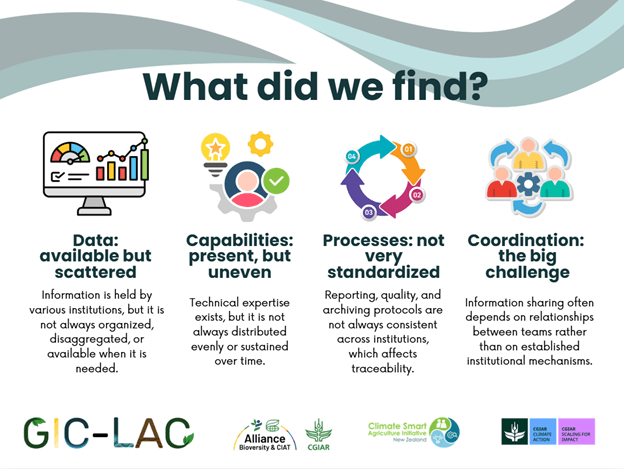
In Bogotá, key stakeholders involved with Colombia’s national emissions reporting for the Agriculture and Land Use (LULUCF) sectors gathered as part of the GIC-LAC project; the aim was to strengthen the country’s Monitoring, Reporting, and Verification (MRV) system. Through dialogue among institutions, experts, and national inventory managers, the meeting provided an opportunity to review progress, compare experiences, and identify gaps in data, capacity, and coordination, with the aim of improving the consistency and use of the information that underpins the country’s climate action.
What were the objectives?
• To improve the quality and level of detail of data.
• To strengthen technical capabilities within institutions.
• To move toward more accurate methodologies (Tier 2).
• To facilitate evidence-based decision-making.
How the workshop unfolded
Over two days, the workshop combined technical presentations with participatory exercises. The idea was to bring together technical evidence and the practical experience of those who work daily on emissions reporting.
The workshop served as a meeting point for institutions that do not always engage in direct dialogue. This allowed for the comparison of perspectives, the alignment of priorities, and the development of a more comprehensive understanding of the system.
GIC-LAC is funded through the New Zealand Government's Climate Smart Agriculture Initiative as part of its contribution to the Global Research Alliance on Greenhouse Gases in Agriculture (GRA), and CGIAR through Climate Action and Scaling for Impact Science Programs.