
Women’s participation in the forage seed market in Vietnam: Progress and barriers
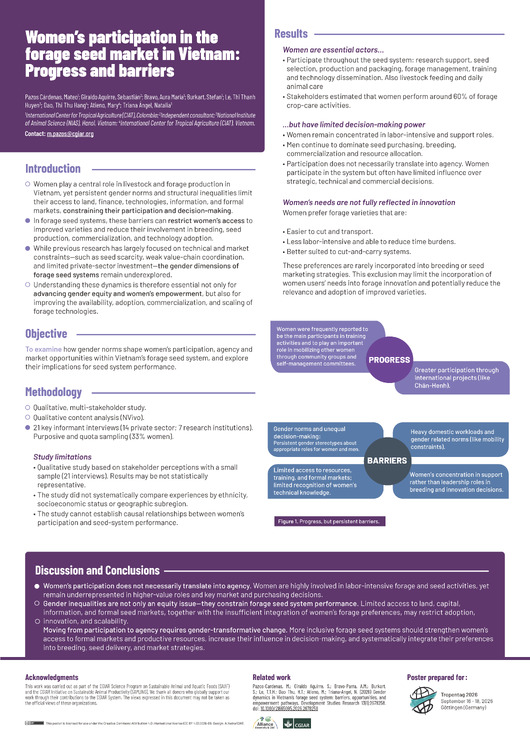
Women play a central role in livestock production and forage management in Vietnam, yet their contributions remain undervalued due to persistent gender norms and structural inequalities. In forage seed systems, these dynamics shape access to resources, participation in markets, and decision-making power, ultimately influencing both women’s empowerment and system performance. This study analyzes the gendered dynamics of Vietnam’s forage seed system, with a focus on identifying barriers, opportunities, and pathways to enhance women’s participation and agency. The research adopts a qualitative approach based on 21 key informant interviews with stakeholders across the forage seed system, including private companies and research institutions. Using a multistakeholder and seed system framework, the study examines how gender influences participation in seed production, research, distribution, and adoption, as well as key system outcomes such as availability, quality, and commercialization. Results show that women are actively involved in labor-intensive activities such as forage management, seed handling, and training participation, but remain largely excluded from higher-value roles, including breeding, seed purchasing, and market decision-making. Gendered divisions of labor, sociocultural norms, and limited access to land, capital, and information constrain their participation and agency. Women also tend to rely more on informal seed systems, which restricts access to improved forage varieties. At the same time, their preferences – particularly for labor-efficient and easy-to-manage forages – play a critical role in shaping adoption patterns but are insufficiently integrated into breeding and market strategies. The study concludes that gender inequalities not only affect equity outcomes but also create systemic inefficiencies that limit the performance and scalability of forage seed systems. Enhancing women’s inclusion requires moving beyond participation toward strengthening agency through gender-transformative approaches, improved access to formal markets, and the integration of women’s preferences into innovation processes. Addressing these structural constraints can contribute to more inclusive, efficient, and sustainable livestock systems.